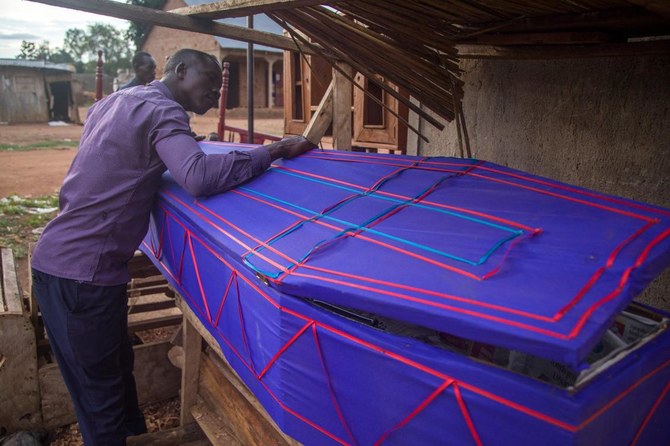
BUGOBI, Uganda: As a Covid-19 surge overwhelmed Uganda earlier this year, Livingstone Musaala, who was forced to quit his teaching job following school closures, turned to coffin-making to pay the bills and help his community.
But few welcomed his initiative at first. Family members criticized him for capitalizing on a pandemic-fueled boom in his densely-populated hometown of Bugobi, 140 kilometers (90 miles) east of Kampala.
“Of all the business ideas you start selling coffins as if you wish people death?” Musaala recounted a relative asking him.
But the former mathematics teacher realized that he could make and sell coffins for a lot less than the exorbitant prices charged by other carpenters after demand surged due to Covid-19 deaths.
“It was a tough decision but people now appreciate it,” the 28-year-old told AFP, with Bugobi residents no longer compelled to travel long distances to find affordable coffins.
“At the height of the pandemic, we did brisk business, we sold between four to 10 coffins daily,” he said, earning between 150,000 to 450,000 shillings ($42 to $125) per coffin.
His success prompted some 30 teachers to join him, many of whom were left frustrated and penniless by the ongoing school shutdown.
Although coffins have proven to be their biggest seller, the teachers have also taken on other joinery jobs.
Some had already been trained in carpentry, but most have simply learned on the job.
Today, many say they have no intention to return to school, even if classes resume — something that spells even worse news for the East African nation’s rickety education system.
Some 15 million students have been out of school since the government sent them home in March 2020, and activists fear a surge in teen pregnancies and child labor as a result.
With no income to speak of, some schools have shut down for good, rebranding themselves as hotels or restaurants. Others have defaulted on loans as interest piles up, putting their future in doubt and adding to the uncertainty faced by out-of-work teachers.
“If I was given an option between teaching and carpentry, I would take the latter because it is ready cash,” Godfrey Mutyaba told AFP as his colleagues shuffled around for pieces of timber to put the final touches on a coffin.
“I liked teaching but due to poor pay, I won’t go back,” the father-of-two said.
On average, teachers working at private schools in Bugobi earn between $100 to $250 per month.
Despite strong sales, the newly-minted coffin makers have struggled to raise capital to buy equipment like electric saws, and are now confronting a new challenge as the pandemic begins to ease after death rates soared in June and July.
Nevertheless, even as coffin sales fall, Musaala has no plans to return to his old job and is turning his attention to making furniture instead.
“Covid-19 has taught me there is life beyond teaching,” the father-of-two said.


Ugandan teachers turn coffin-makers after schools shut
https://arab.news/5m5xx
Ugandan teachers turn coffin-makers after schools shut

- Family members criticised him for capitalising on a pandemic-fuelled boom in his densely-populated hometown of Bugobi
- The former mathematics teacher realised that he could make and sell coffins for a lot less than the exorbitant prices charged by other carpenters


Cambodia takes back looted historic artifacts handled by British art dealer
- The objects were returned under a 2020 agreement between the Ministry of Culture and Fine Arts and the family of the late Douglas Latchford, a British art collector and dealer who allegedly had the items smuggled out of Cambodia
PHNOM PENH, Cambodia: Cambodian officials on Friday received more than six dozen historic artifacts described as part of the country’s cultural heritage that had been looted during decades of war and instability.
At a ceremony attended by Deputy Prime Minister Hun Many, the 74 items were unveiled at the National Museum in Phnom Penh after their repatriation from the United Kingdom.
The objects were returned under a 2020 agreement between the Ministry of Culture and Fine Arts and the family of the late Douglas Latchford, a British art collector and dealer who allegedly had the items smuggled out of Cambodia.
“This substantial restitution represents one of the most important returns of Khmer cultural heritage in recent years, following major repatriations in 2021 and 2023 from the same collection,” the Culture Ministry said in a statement. “It marks a significant step forward in Cambodia’s continued efforts to recover, preserve, and restore its ancestral legacy for future generations.”
The artifacts were described as dating from the pre-Angkorian period through the height of the Angkor Empire, including “monumental sandstone sculptures, refined bronze works, and significant ritual objects.” The Angkor Empire, which extended from the ninth to the 15th century, is best known for the Angkor Wat archaeological site, the nation’s biggest tourist attraction.
Latchford was a prominent antiquities dealer who allegedly orchestrated an operation to sell looted Cambodian sculptures on the international market.
From 1970 to the 1980s, during Cambodia’s civil wars and the communist Khmer Rouge ‘s brutal reign, organized looting networks sent artifacts to Latchford, who then sold them to Western collectors, dealers, and institutions. These pieces were often physically damaged, having been pried off temple walls or other structures by the looters.
Latchford was indicted in a New York federal court in 2019 on charges including wire fraud and conspiracy. He died in 2020, aged 88, before he could be extradited to face charges.
Cambodia, like neighboring Thailand, has benefited from a trend in recent decades involving the repatriation of art and archaeological treasures. These include ancient Asian artworks as well as pieces lost or stolen during turmoil in places such as Syria, Iraq and Nazi-occupied Europe. New York’s Metropolitan Museum of Art is one of the prominent institutions that has been returning illegally smuggled art, including to Cambodia.
“The ancient artifacts created and preserved by our ancestors are now being returned to Cambodia, bringing warmth and joy, following the country’s return to peace,” said Hun Many, who is the younger brother of Prime Minister Hun Manet.


