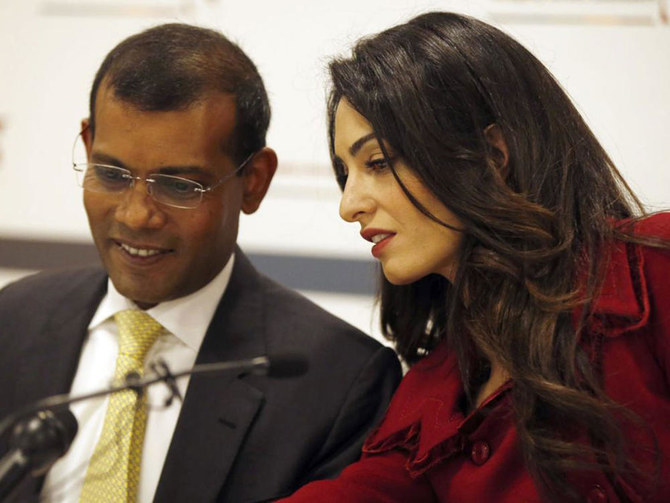
MALÉ, Maldives: Former Maldives president Mohamed Nasheed returned to his atoll nation unannounced Monday, five months after surviving a bomb attack and undergoing treatment in Germany.
The 54-year-old pro-democracy pioneer was welcomed by President Ibrahim Mohamed Solih at the Male international airport before being driven away under heavy armed escort.
“People were taken by surprise to see him arrive today,” a Maldivian official close to Nasheed told AFP. “The return was not announced in advance due to security considerations.”
Nasheed, currently the speaker of parliament, was critically wounded in a May 7 assassination attempt outside his home in the capital Male.
He underwent 16 hours of surgery before traveling to Germany in May for further treatment and rehabilitation.
There has been no claim of responsibility but Nasheed’s party has blamed religious extremists in the tiny Islamic republic, which practices a liberal form of the religion and is known for its upmarket tourism.
Maldivian authorities have arrested six people, all locals, in connection with the attack that rocked the largely peaceful nation of 340,000 Sunni Muslims.
The government has cracked down on extremism and foreign preachers are banned.
Violent attacks are rare, though a dozen foreign tourists were wounded by a bomb blast in Male in 2007.
Daesh claimed a boat arson attack last year, but there is little evidence the group has a presence in the archipelago of 1,192 tiny coral islands.
Nasheed caught international attention for holding a 2009 cabinet meeting underwater to highlight the threat of global warming, signing documents as officials wore scuba gear with coral reefs in the background.
He was toppled in a military-backed coup in 2012, convicted on a terrorism charge and jailed for 13 years.
He left the country on medical leave and sought refuge in Britain, returning to the Maldives after his nominee won the presidency in 2018.

Former Maldives leader returns after surviving bomb blast
https://arab.news/4jf66
Former Maldives leader returns after surviving bomb blast
- Mohamed Nasheed, currently the speaker of parliament, was critically wounded in a May 7 assassination attempt outside his home in the capital Male
- Nasheed underwent 16 hours of surgery before traveling to Germany in May for further treatment and rehabilitation
US allows oil majors to broadly operate in Venezuela, new energy investments
- Treasury Department issues general license allowing Chevron, BP, Eni, Shell and Repsol to operate oil and gas operations in Venezuela
- Move is the most significant relaxation of sanctions on Venezuela since US forces captured and removed President Nicolas Maduro
WASHINGTON: The US eased sanctions on Venezuela’s energy sector on Friday, issuing two general licenses that allow global energy companies to operate oil and gas projects in the OPEC member and for other companies to negotiate contracts to bring in fresh investments. The move was the most significant relaxation of sanctions on Venezuela since US forces captured and removed President Nicolas Maduro last month.
The Treasury Department’s Office of Foreign Assets Control issued a general license allowing Chevron, BP, Eni, Shell and Repsol to operate oil and gas operations in Venezuela. Those companies still have offices in the country and stakes in projects, and are among the main partners of state-run company PDVSA.
The authorization for the oil majors’ operations requires payments for royalties and Venezuelan taxes to go through the US-controlled Foreign Government Deposit Fund.
The other license allows companies around the world to enter contracts with PDVSA for new investments in Venezuelan oil and gas. The contracts are contingent on separate permits from OFAC.
The authorization does not allow transactions with companies in Russia, Iran, or China or entities owned or controlled by joint ventures with people in those countries.
The licenses “invite American and other aligned companies to play a constructive role in supporting economic recovery and responsible investment, ” the US State Department said in a release. Additional authorizations may be issued “as necessary,” it said.
A spokesperson for Chevron, the only US oil firm currently operating in Venezuela, said the company welcomed the new licenses.
“The new General Licenses, coupled with recent changes in Venezuela’s Hydrocarbons Law, are important steps toward enabling the further development of Venezuela’s resources for its people and for advancing regional energy security,” the spokesperson said in a statement.
Eni said it is assessing the opportunities in Venezuela that the authorization opens up.
Oil law reform
The US licenses follow a sweeping reform of Venezuela’s main oil law approved last month, which grants autonomy for foreign oil and gas producers to operate, export and cash sale proceeds under existing joint ventures with PDVSA or through a new production-sharing contract model.
The US has had sanctions on Venezuela since 2019 when President Donald Trump imposed them during his first administration. Trump is now seeking $100 billion in investments by energy companies in Venezuela’s oil and gas sector. US Energy Secretary Chris Wright said on Thursday, during his second day of a trip to Venezuela, that oil sales from the country since Maduro’s capture have hit $1 billion and would hit another $5 billion in months.
Wright said the US will control the proceeds from the sales until Venezuela stands up a “representative government.” Since last month, the Treasury issued several other general licenses to facilitate oil exports, storage, imports and sales from Venezuela. It also authorized the provision of US goods, technology, software or services for the exploration, development or production of oil and gas in Venezuela.
The Venezuelan government expropriated assets of Exxon Mobil and ConocoPhillips in 2007 under then-President Hugo Chavez. The Trump administration is trying to get those companies to invest in Venezuela as well. At a meeting at the White House with Trump last month, Exxon Mobil CEO Darren Woods said Venezuela was “uninvestable” at the moment.
Wright said on Thursday that Exxon, which no longer has an office in Venezuela, is in talks with the government there and gathering data about the oil sector. Exxon did not immediately comment.


