

African Union to broaden Somalia operations

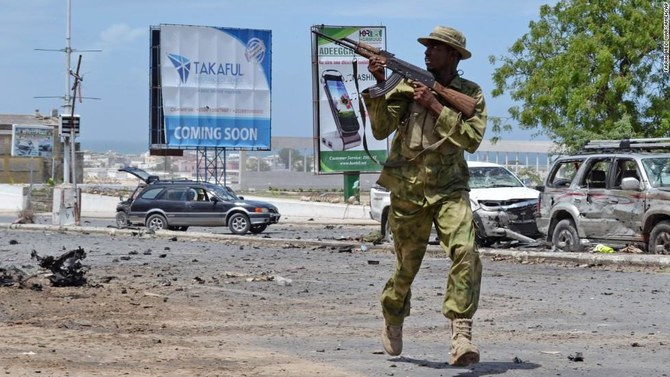
A Somali soldier takes aim at Al-Shabab militants during an attack on the parliament in Mogadishu, May 24, 2014. (AP Photo)
Short Url
Updated 11 October 2021
Follow

African Union to broaden Somalia operations

  • The Horn of Africa nation has faced renewed instability in recent months, with long-running election delays and an ongoing row between its president and prime minister
  • Despite the militants’ ouster from Mogadishu a decade ago, Somalia’s government controls only a small portion of the country, with the crucial help of some 20,000 soldiers from the AU

ADDIS ABABA: The African Union says it will extend and expand its military operations against Al-Qaeda-linked extremists in Somalia to include other member states, as its current mandate nears an end on December 31.

The Horn of Africa nation has faced renewed instability in recent months, with long-running election delays and an ongoing row between its president and prime minister sapping attention from an insurgency waged by Al-Shabab extremists.

Despite the militants’ ouster from Mogadishu a decade ago, Somalia’s government controls only a small portion of the country, with the crucial help of some 20,000 soldiers from the African Union Mission in Somalia (AMISOM).

AMISOM late Sunday said the AU’s Peace and Security Council had agreed to shift to a joint mission with the UN that would enable “other willing and interested AU Member States” to join operations against the extremists.

The plan will need to be endorsed by the UN Security Council and the government in Mogadishu.

The AU expressed “grave concern at the worsening security situation in Somalia,” where there had been a “worrying resurgence” of Al-Shabab activities.

The militants regularly stage deadly attacks against civilian and military targets in the capital and elsewhere.

The UN Security Council in March extended AMISOM’s mandate until December following fractious talks between Western countries and African members of the council over funding for the peacekeepers.

Sunday’s AU statement asked the UN Security Council “to consider a technical roll-over of the AMISOM mandate, while discussions continue on the details and modalities for transition toward the post-2021 arrangement.”

The statement also urged President Mohamed Abdullahi Mohamed, widely known as Farmajo, and Prime Minister Mohamed Hussein Roble to resolve their differences and “re-focus on concluding the overdue elections without further delay.”

“The ongoing political stand-off between the Office of the President and the Office of the Prime Minister is contributing to the worsening security situation, as the political authorities find their attention distracted from governance matters,” the statement said.


New Zealand mosque killer appeal causing ‘distress’ to victims: lawyer

Updated 2 sec ago
Follow

New Zealand mosque killer appeal causing ‘distress’ to victims: lawyer

WELLINGTON: Appeal hearings for a white supremacist who shot dead 51 people at two New Zealand mosques in 2019 caused “immense distress” to his victims, a lawyer representing the state said Friday as proceedings wrapped up.
Brenton Tarrant, a 35-year-old Australian former gym instructor, admitted carrying out New Zealand’s deadliest modern-day mass shooting before being sentenced to life in jail in August 2020.
The convicted killer argued this week in Wellington’s Court of Appeal that “torturous and inhumane” detention conditions had made him incapable of making rational decisions when he pleaded guilty, according to a court synopsis of the case.
As a week of hearings came to a close on Friday, Crown lawyer Madeleine Laracy urged the court to dismiss Tarrant’s case because he had no legal defense to offer at trial and conviction was certain, state broadcaster RNZ reported.
She urged the court to give closure to the victims and the wider Muslim community.
“There are literally hundreds of directly harmed victims in this case and keeping this case alive is a source of immense distress for those individuals,” Laracy said, according to RNZ.
The three judges did not give a decision on Friday in his case.
Tarrant is being held in a specialist unit for prisoners of extreme risk at Auckland Prison, seldom interacting with inmates or other people.

- Life sentence -

On Monday, he gave evidence via video link and said he did not have the “mind frame or mental health required” to give an informed guilty plea in 2020.
But Laracy told the three-judge panel on Friday that Tarrant was always going to end up in prison whether he had pleaded guilty or not.
“He was between a rock and a rock,” she said.
Tarrant’s lawyers, whose names are suppressed for security reasons, said his prison conditions were unlike anything else in the system.
If the court upholds Tarrant’s conviction, it will also need to consider an appeal against his sentence.
If his conviction is overturned, the case will be sent to the High Court for a retrial.
Armed with an arsenal of semi-automatic weapons, Tarrant attacked worshippers at two mosques in Christchurch on March 15, 2019.
He published an online manifesto before the attacks and then livestreamed the killings for 17 minutes.
His victims were all Muslim and included children, women and the elderly.
His penalty of life imprisonment without parole was the stiffest in New Zealand history.
There were heavy restrictions on who could be in court during the appeal hearing, with only counsel, media and court officials allowed.
Families and friends of those killed or wounded in the attacks were invited to watch proceedings in Christchurch remotely by video with a one-hour delay.