WASHINGTON: The United States called Monday on the president and prime minister of Somalia to resolve their "dispute," so as not to further delay the country's electoral process, with the African nation's presidential election scheduled for October 10.
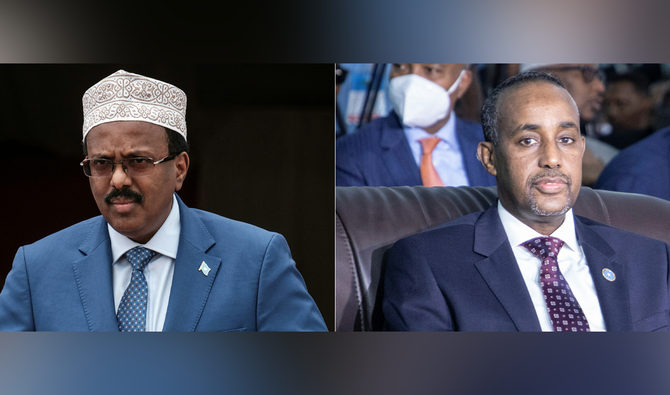
"Cooperation among Somalia's leaders — particularly President Farmaajo and Prime Minister Roble — is essential to ensure that the country quickly completes its ongoing electoral process," State Department spokesman Ned Price said in a statement.
"The dispute between President Farmaajo and Prime Minister Roble risks complicating this process and needs to be resolved immediately and peacefully."
The rivalry between President Mohamed Abdullahi Mohamed, popularly known as Farmajo, and Prime Minister Mohamed Hussein Roble has raised concerns for the country's stability.
The long-brewing dispute escalated this week when Farmajo suspended Roble's executive powers, a move the premier rejected as unlawful.
Somalia is due to vote for a president on October 10, but the leaders' spat threatens to imperil the repeatedly delayed poll and distract from efforts to confront a long-running Islamist insurgency.
The months-long delay has "concerned" Washington, Price said, stressing that any further postponement "increases the potential for violence and plays into the hands of al-Shabaab and other extremist groups seeking to destabilize the country."
The radical Islamist group Al-Shabaab, whose insurgency was unleashed on Somalia in 2007, control large rural areas and regularly carry out attacks in the capital.

US calls for Somalia leadership to resolve ‘dispute’
https://arab.news/6b457
US calls for Somalia leadership to resolve ‘dispute’
- The long-brewing dispute escalated this week when Farmajo suspended Roble's executive powers
Russia committed ‘crimes against humanity’ in deporting Ukrainian children: UN inquiry
- The inquiry said Russia had deported or transferred “thousands” of children from occupied areas of Ukraine, of which it had so far confirmed 1,205 cases
- “Four years on, 80 percent of the children deported or transferred in the cases investigated by the commission have not returned,” it said
GENEVA: Moscow’s deportation and forcible transfer of children from Ukraine to Russia amounts to a crime against humanity, a United Nations team of investigators said Tuesday.
The UN’s Independent International Commission of Inquiry on Ukraine said it had collected evidence leading it to conclude that “Russian authorities have committed the crimes against humanity of deportation and forcible transfer, as well as of enforced disappearance of children.”
The probe was established by the UN Human Rights Council shortly after Moscow launched its full-scale invasion of Ukraine in February 2022.
The inquiry said Russia had deported or transferred “thousands” of children from occupied areas of Ukraine, of which it had so far confirmed 1,205 cases.
“Four years on, 80 percent of the children deported or transferred in the cases investigated by the commission have not returned,” it said.
Moscow has failed to establish a system facilitating returns, and has instead focused on long-term placement of the children with families or institutions in Russia, while relatives were not informed of their fate.
The commission confirmed its previous finding that Russian authorities had unlawfully deported and transferred children — as a war crime — “and that they have unjustifiably delayed their repatriation, which is also a war crime.”
These measures “were not guided by the best interests of the child,” and have violated international law, the probe found.
- Putin cited -
It said the involvement of Russian President Vladimir Putin, “including through his direct authority over entities that have steered and executed this policy, has been visible from the outset.”
In 2023, the International Criminal Court issued a war crimes arrest warrant against Putin, accusing him of “unlawfully deporting” Ukrainian children.
The issue is highly sensitive in Ukraine and remains central to negotiations for a potential peace agreement between Kyiv and Moscow.
According to Kyiv, nearly 20,000 Ukrainian children have been forcibly removed since Russia’s full-scale invasion.
Russia insists it has moved some Ukrainian children from their homes or orphanages to protect them from hostilities.
As for Russian trials in the context of its invasion of Ukraine, the commission found that Russian authorities have “systematically fabricated evidence” and “systematically violated a range of fair trial guarantees,” while judges “have not acted with independence and impartiality.”
- ‘Extreme violence’ -
The commission also probed the situation of nationals from 17 countries who were recruited — either voluntarily or through deception — to fight with Russian troops in Ukraine.
They included men from Azerbaijan, Belarus, Brazil, Cuba, Egypt, Ghana, India, Iraq, Kazakhstan, Kenya, Nepal, Somalia, Sri Lanka, Tajikistan, Turkiye and Yemen.
“After training, usually lasting between one week and 30 days, they were forced to serve on frontlines in Ukraine, often assigned extremely dangerous duties,” the commission said in its report.
Commanders arbitrarily imposed “extreme violence” as punishment for refusing orders that meant almost certain death, with soldiers describing being treated like “cannon fodder,” sent on “meat assaults” without training or necessary equipment, and “forced to advance at all costs.”
“The evidence collected demonstrates abusive behavior, cruelty, humiliation, inhuman treatment, and a total disregard for human life and dignity, perpetrated with a sense of impunity,” the report said.
Regarding Ukraine, the report voiced concern about the overly broad definition and sometimes distorted interpretation of the crime of “collaboration.”
The commission also said reports regarding violent treatment of conscientious objectors during Ukrainian mobilization were “a source of concern.”
The report will be presented at the Human Rights Council in Geneva on Thursday.
Moscow does not recognize the commission and does not answer its requests for access, information and meetings.


