



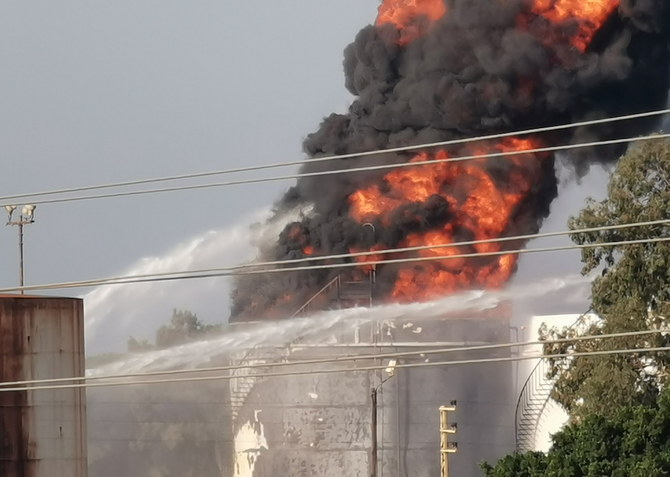
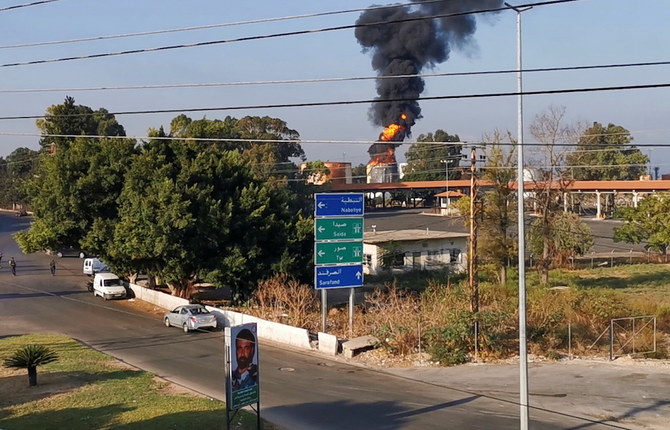

BEIRUT: Firefighters extinguished a blaze that broke out on Monday morning at Al-Zahrani oil facility, south of Beirut, with Lebanese Energy Minister Walid Fayyad estimating that 250,000 liters of petrol had been destroyed in the incident.
He suggested the fire had been caused by a “mistake during the process of transporting the fuel that was in the tank, whose ceiling was tilted.”
As many as 15 fully staffed fire trucks worked to control the fire by isolating the tank to prevent the flames from spreading.
#WATCH: Firefighters contained a blaze at a gasoline storage tank in southern #Lebanon on Monday, the latest blow to a nation grappling with a deep economic crisis and a crippling fuel and power shortages. https://t.co/muaQslsVEC pic.twitter.com/UsHCuDJFdO
— Arab News (@arabnews) October 11, 2021
The fire provoked memories of the massive blast at Beirut Port 14 months ago, which killed more than 200 people, injured thousands, and devastated the capital.
People went on social media to express their fears about the Al-Zahrani fire being deliberate, while others regretted their “bad luck and the never-ending daily catastrophes.”
An investigation has been launched into the fire.
“We must wait for the results of the investigation in order to know whether anyone is responsible or whether the fire was caused by natural factors,” Fayyad noted.
Civil Defense Director-General Brig. Gen. Raymond Khattar said it was “too early” to know the causes of the fire.
The Lebanese army gave 6,000 kiloliters of gas oil to Electricite du Liban from its reserves to reconnect the electrical grid in production plants to bring the country out of its total blackout due to fuel shortages.
Fayyad said: “Today, the Jiyeh reverse engine plant was connected to the grid with a power of 50 megawatts, Deir Ammar plant with a power of 210 megawatts, and the reverse engine plant in Zouk with a power of 120 megawatts, as well as Al-Zahrani.
“This quantity is enough for three days, after which the plants’ production capacity will be replaced by another from the Zouk and Jiyeh thermal plants after supplying them with the fuel oil that arrived on Sunday evening, samples of which were examined by the Bureau Veritas labs in Dubai. The total production capacity will thus remain within limits at 500 megawatts to maintain the grid’s stability.
“The Central Bank has agreed to secure $100 million to conduct a bid to import fuel, which will help raise the hours of electricity supply by the end of this month.”
Energy experts believed that Lebanese authorities were “patching up” the electricity crisis instead of finding concrete solutions.
Lebanon is facing a deficit in electricity generation because of the difficulty in securing fuel due to the Central Bank’s failure to open sufficient credits.
Huge losses
The electricity sector in Lebanon is considered one of the largest sectors causing huge losses, amounting to $43 billion, and most likely one of the main reasons for Lebanon’s current economic crises.
Lebanon relies on worn-out, low-efficiency thermal plants that use imported, expensive, and polluting heavy oil and diesel.
Corruption has wrecked this sector and the reform process has been marred by political differences.
The sector’s regulatory body, which was recognized years ago as a reliable authority that could take independent decisions, has yet to be formed because the energy minister argued it was limiting his powers.
After Hezbollah and Iran made their way into the sector by bringing Iranian fuel into Lebanon through illegal crossings with Syria, Iranian Foreign Minister Hossein Amirabdollahian tried to extend a hand to the electricity sector through an offer he made during his visit to Beirut on Oct. 7 “to build two power stations, one in Beirut and another in the south, within one and a half years.”
But it turned out that the proposal required Ghobeiry municipality, which is affiliated with Hezbollah, to take control of the Golf Club of Lebanon, which is located on a 410,000-square-meter property south of Beirut, on the pretext that the club had not paid fees owed to the municipality for four years, the total of which has been estimated at about LBP1 billion ($663,349).
The government did not take a stance on the Iranian offer despite pressure from Hezbollah, which began preparing to implement Iran’s plan on the golf club’s land.
Ghobeiry Mayor Maan Al-Khalil tweeted: “The property is rented from the state for LBP75 million, equivalent to $4,000. Khosh Amadid (Persian for welcome) to the Iranian grant, a 1,000-megawatt power plant to illuminate Beirut, its southern suburbs, and Mount Lebanon.”
The club’s lawyer, Imad Hamdan, denied claims the facility had dodged municipality fees and stressed the management’s confidence in “the state, its institutions and judiciary.”
The Iranian proposal provoked negative reactions, especially since the golf club is one of Beirut’s last green spaces.
Former MP Fares Souaid warned against “Hezbollah, backed by Iran, putting its hand on Lebanon’s real estate history and abolishing it.”


