BERLIN: Austrian Chancellor Sebastian Kurz said Saturday that he will step down in a bid to defuse a government crisis triggered by prosecutors’ announcement that he is a target of a corruption investigation.
Kurz, 35, said he has proposed to Austria’s president that Foreign Minister Alexander Schallenberg become chancellor. But Kurz himself will remain in a key political position: he said he will become the head of his conservative Austrian People’s Party’s parliamentary group.
Kurz’s party had closed ranks behind him after the prosecutors’ announcement on Wednesday, which followed searches at the chancellery and his party’s offices. But its junior coalition partner, the Greens, said Friday that Kurz couldn’t remain as chancellor and demanded that his party nominate an “irreproachable person” to replace him. The coalition government took office in January, 2020.
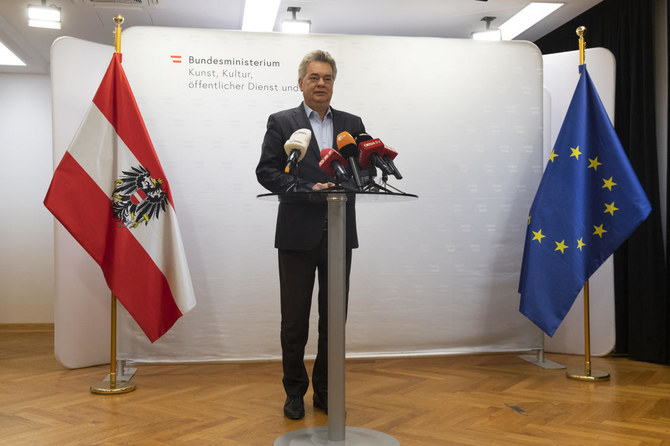
The Greens’ leader, Vice Chancellor Werner Kogler, welcomed Kurz’s decision as “a right and important step.”
“This means that we can continue our work in government,” he said.
Kurz and his close associates are accused of trying to secure his rise to the leadership of his party and the country with the help of manipulated polls and friendly reports in the media, financed with public money. Kurz, who became the People’s Party leader and then chancellor in 2017, denies wrongdoing.
The Greens said the probe created a “disastrous” impression. In a separate case, anti-corruption authorities put Kurz under investigation in May on suspicion of making false statements to a parliamentary commission, an allegation he also rejected.
Opposition leaders had called for Kurz to go and planned to bring a no-confidence motion against him Tuesday in parliament.
“We are still in a very sensitive phase in Austria — the pandemic is not yet over and the economic upswing has only just begun,” while a reform of the country’s tax system to help curb greenhouse gas emissions has been negotiated but is not yet implemented, Kurz said.
“What we need now are stable conditions,” he told reporters in Vienna. “So, in order to resolve the stalemate, I want to make way to prevent chaos and ensure stability.”
He insisted again that the accusations against him “are false and I will be able to clear this up — I am deeply convinced of that.”
Kurz said of the Greens’ demand for his replacement: “Many tell me that this is unfair and ... you can imagine that I personally would also be grateful if the presumption of innocence in our country really applied to everyone.”
He insisted that the accusations against him were being “mixed up” with old text messages that have surfaced in recent days. “Some of them are messages that I definitely wouldn’t formulate the same way again, but I am only a human being with emotions and also flaws,” he said.
Kurz will keep his party’s leadership as well as becoming its parliamentary group leader.
He responded to the demand for an untainted new leader with Schallenberg, 52. Although loyal to Kurz, Schallenberg has a background in diplomacy rather than party politics.
Schallenberg already served as foreign minister in a non-partisan interim government that ran the European Union nation of 8.9 million people for several months after Kurz’s first coalition with the far-right Freedom Party collapsed in 2019.
Kurz pulled the plug on that government after a video surfaced showing the vice chancellor and Freedom Party leader at the time, Heinz-Christian Strache, appearing to offer favors to a purported Russian investor.
Austria’s next regular parliamentary election is due in 2024.


![]()

Kurz to quit as Austrian chancellor amid corruption probe
Short Url
https://arab.news/mdtpv
Kurz to quit as Austrian chancellor amid corruption probe
- Kurz said he has proposed to Austria's president that Foreign Minister Alexander Schallenberg become chancellor
- Kurz's party had closed ranks behind him after the prosecutors' announcement on Wednesday


Latest updates


© 2026 SAUDI RESEARCH & PUBLISHING COMPANY, All Rights Reserved And subject to Terms of Use Agreement.