

Balochistan takes center stage as Pakistan officially inaugurates Expo Dubai pavilion

Pakistan's President Dr. Arif Alvi (3L) inaugurates the Pakistan Pavilion at Expo 2020 Dubai in Dubai on October 9, 2021. (Photo courtesy: @PresOfPakistan/Twitter)
Short Url
Updated 09 October 2021
Follow

Balochistan takes center stage as Pakistan officially inaugurates Expo Dubai pavilion

  • Exhibitors from 200 countries are participating in Expo with aim to boost trade and investment
  • Alvi’s visit coincides with the 50 years of the establishment of diplomatic relations between Pakistan and the UAE

DUBAI: President Dr. Arif Alvi on Saturday inaugurated the Pakistan Pavilion at Expo 2020 in Dubai with the spotlight on Balochistan province, which the South Asian nation will be promoting at the world fair throughout October.
The exhibition is the first to be held in the Middle East, and Dubai, the region’s tourism, trade and business hub, is hoping to boost its economy by attracting 25 million business and tourist visits to the exhibition, which has been built from scratch on 4.3 sq km of desert at a cost of around $6.8 billion.
Exhibitors from almost 200 countries are participating, with many countries and companies including from Pakistan looking to the Expo — the first major global event open to visitors since the coronavirus pandemic — to boost trade and investment.
The Expo started on October 1 and will run till March 31, 2022.
The president arrived in the United Arab Emirates on Saturday on a two-day visit, during which he is also meeting Emirati dignitaries, leading businessmen, investors, entrepreneurs and senior representatives of IT companies and media based in Dubai.
“It was very difficult to depict another country far off in another place but I am very proud of what we have achieved,” Dr. Alvi told reporters during the inauguration ceremony, during which renowned Pakistani singer Akthar Channal Zehri performed Balochi folk songs.
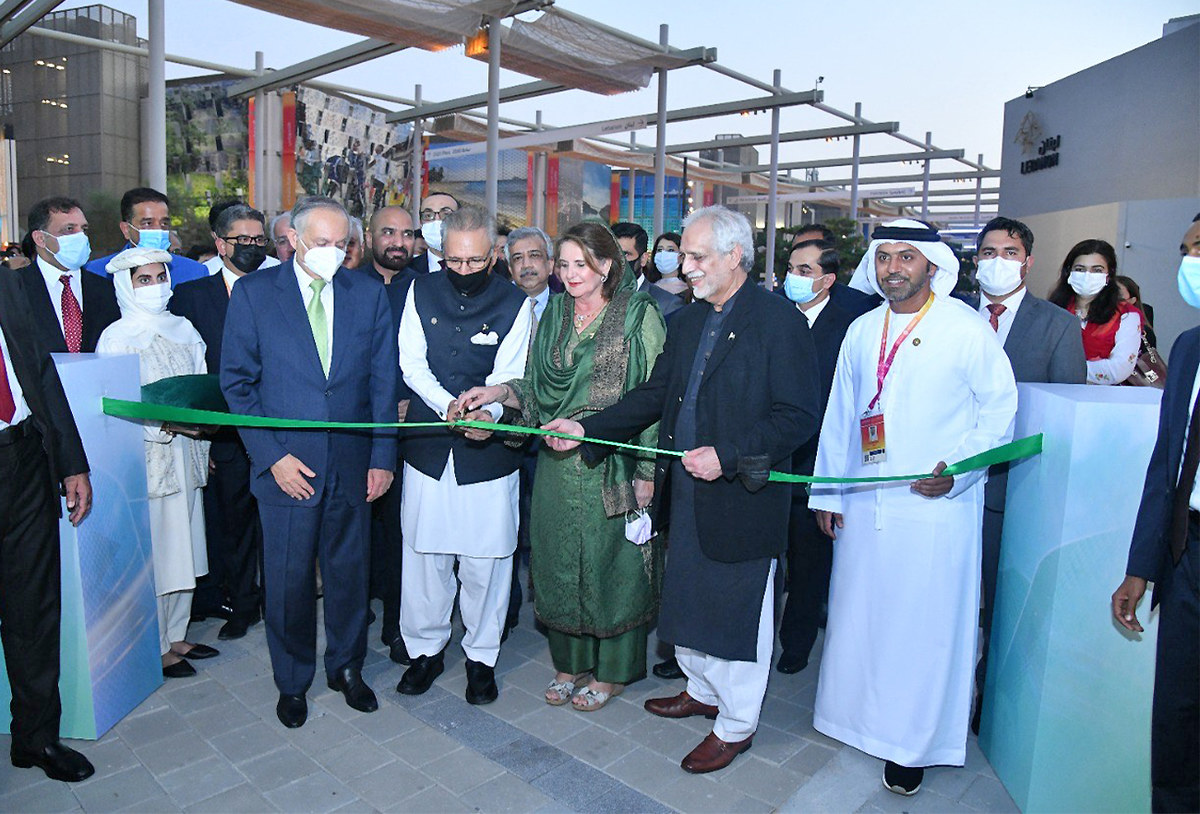


Pakistan President Dr. Arif Alvi (second left in the first row) inaugurates the the Pakistan Pavilion at Expo 2020 Dubai in Dubai on October 9, 2021. (Photo courtesy: PID)

Themed “Pakistan: The Hidden Treasure,” the Pakistan Pavilion is located in the Opportunity area of the exhibition.
Before visiting the Expo site, the president met Sheikh Mohammed bin Rashid Al-Maktoum, the Vice President and Prime Minister of the United Arab Emirates, its Minister of Defense, and ruler of the Emirate of Dubai.
“Both leaders discussed opportunities for further increasing the bilateral ties between Pakistan and the UAE,” the presidential office said after the meeting.

When he reached the Gulf state, the president was received by UAE Justice Minister Abdullah bin Sultan bin Awad Al-Nuaimi.
Commerce Minister Abdul Razak Dawood and Foreign Secretary Sohail Mahmood are part of Dr. Alvi’s entourage. First lady Begum Samina Alvi is also accompanying the president.
During his trip, the president will also interact with members of the Pakistani community living and working in the UAE.
Alvi’s visit coincides with the 50 years of the establishment of diplomatic relations between Pakistan and the UAE.


Pakistan finance minister touts debt discipline, export focus at Davos panel

Updated 5 sec ago
Follow

Pakistan finance minister touts debt discipline, export focus at Davos panel

  • Aurangzeb says debt must fund exports, not consumption, for sustainable growth
  • He says Pakistan used fiscal buffers to respond to floods without external appeals

KARACHI: Pakistan’s Finance Minister Muhammad Aurangzeb said on Wednesday disciplined borrowing, export-led growth and careful debt management were central to stabilizing the country’s economy, as Islamabad looks to unlock new sources of growth amid rising global debt levels.

Speaking at a panel discussion on the sidelines of the World Economic Forum (WEF) in Davos, he said debt was not inherently harmful if used productively, but warned that emerging economies such as Pakistan could not afford to deploy borrowed funds for consumption.

“For countries like Pakistan, debt must be channeled into investments that generate exportable surplus,” Aurangzeb said, according to a statement circulated by the Finance Division. “It is not about the availability of debt or funding, but how wisely and effectively it is steered to create long-term economic value.”

Pakistan has been pursuing fiscal reforms as part of an International Monetary Fund-backed stabilization program, including cutting subsidies, broadening the tax base and restructuring state-owned enterprises, as the government seeks to restore macroeconomic stability and revive growth.

Aurangzeb said Pakistan had reduced its debt-to-GDP ratio to 70 percent from 75 percent, achieved a primary fiscal surplus and brought inflation down from a peak of 38 percent to single digits, allowing the central bank to cut its policy rate to 10.5 percent.

He also flagged ongoing debt-management reforms, including liability management operations and buybacks, and said Pakistan plans to enter China’s capital markets with its first Panda bond, structured as a green bond.

Addressing climate risks, Aurangzeb said building fiscal buffers had allowed Pakistan to respond to recent floods using domestic resources rather than international emergency appeals, underscoring the need for resilience in climate-vulnerable economies.

He added that public-private partnerships and capital markets were playing a growing role in financing development, citing a $3.6 billion syndicated financing for a major copper mining project expected to generate $2.8 billion in annual exports from 2028.

The finance minister is part of Pakistan’s delegation visiting Davos for the annual gathering of global leaders and investors.

The delegation is led by Prime Minister Shehbaz Sharif, who highlighted the country’s shift toward an export-driven growth model, with a focus on minerals, information technology, artificial intelligence and digital services, while speaking at a breakfast event on the sidelines of the forum.