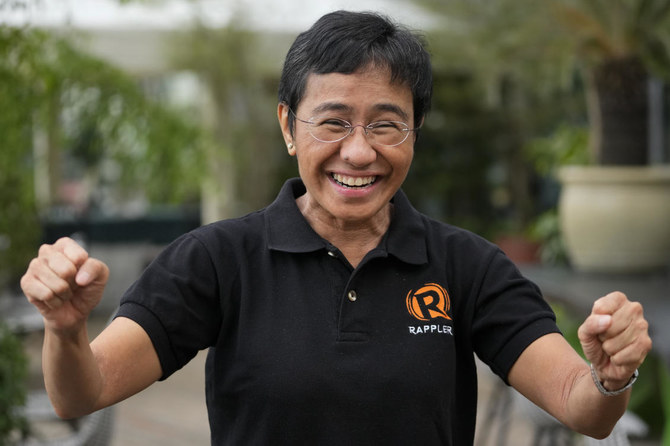
MANILA: Nobel Peace Prize winner Maria Ressa used her new prominence to criticize Facebook as a threat to democracy. She said the social media giant fails to protect against the spread of hate and disinformation and is “biased against facts.”
The veteran journalist and head of Philippine news site Rappler told Reuters in an interview after winning the award that Facebook’s algorithms “prioritize the spread of lies laced with anger and hate over facts.”
Her comments add to the pile of recent pressure on Facebook, used by more than 3 billion people, which a former employee turned whistleblower accused of putting profit over the need to curb hate speech and misinformation. Facebook denies any wrongdoing.
Sought for comment on Ressa’s remarks, a Facebook spokesperson said the social media giant continues to invest heavily to remove and reduce the visibility of harmful content.
“We believe in press freedom and support news organizations and journalists around the world as they continue their important work,” the spokesperson added.
Ressa shared the Nobel with Russian journalist Dmitry Muratov on Friday, for what the committee called braving the wrath of the leaders of the Philippines and Russia to expose corruption and misrule, in an endorsement of free speech under fire worldwide.
Facebook has become the world’s largest distributor of news and “yet it is biased against facts, it is biased against journalism,” Ressa said.
“If you have no facts, you can’t have truths, you can’t’ have trust. If you don’t have any of these, you don’t have a democracy,” she said. “Beyond that, if you don’t have facts, you don’t’ have a shared reality, so you can’t solve the existential problems of climate, coronavirus.”
Ressa has been the target of intense social-media hatred campaigns from President Rodrigo Duterte’s supporters, which she said were aimed at destroying her and Rappler’s credibility.
“These online attacks on social media have a purpose, they are targeted, they are used like a weapon,” said the former CNN journalist.
Rappler’s reporting has included close scrutiny of Duterte’s deadly war on drugs and a series of investigative reports into what it says is his government’s strategy to “weaponize” the Internet, using bloggers on its payroll to stir up anger among online supporters who threaten and discredit Duterte’s critics.
Duterte has not commented on Ressa’s award. The presidential palace, Duterte’s spokesperson, his chief legal counsel, and communications office did not respond to Reuters requests for comment.
Facebook in March 2019 removed an online network in the Philippines for “coordinated inauthentic behavior,” and linked it to a businessman who has previously said he helped manage the president’s social media election campaign in 2016.
Filipinos top the world in time spent on social media, according to 2021 studies by social media management firms.
Platforms like Facebook have become political battlegrounds and have helped strengthen Duterte’s support base, having been instrumental in his election victory in 2016 and a rout by his allies in mid-term polls last year.
The Philippines will hold an election in May to choose a successor to Duterte, who under the constitution is not allowed to seek another term.
That campaign “will be a battle for facts,” Ressa said. “We are going to keep making sure our public sees the facts, understands it. We are not going to be harassed or intimidated into silence.”

Philippine Nobel winner Ressa calls Facebook ‘biased against facts’
https://arab.news/yxfx8
Philippine Nobel winner Ressa calls Facebook ‘biased against facts’
- She said the social media giant fails to protect against the spread of hate and disinformation and is "biased against facts"
- Facebook's algorithms "prioritise the spread of lies laced with anger and hate over facts"
Gems of Arabia magazine launched to spotlight talents shaping Saudi Arabia’s evolving cultural landscape
- The publication features established and emerging talents elevating the region across design, fashion, art, tech, music, architecture and media
- Saudi fashion designer Hatem Alakeel seeks to highlight the richness of the Kingdom, and wider modern Arab culture to global audiences
DUBAI: When Saudi fashion designer Hatem Alakeel interviewed Princess Reema bint Bandar Al-Saud before her appointment as Saudi ambassador to the US, the longtime advocate of women’s empowerment made a powerful prediction: “I look forward to the day that the Saudi woman is no longer the story but rather a phenomenal achievement.”
That moment would become the foundation for Gems of Arabia, an arts and culture audio-visual podcast that spotlights the creative talents shaping the landscape of Saudi Arabia and the broader region.
Over six years, Gems of Arabia has documented the sweeping transformation of the Kingdom’s art and culture scene, and is now evolving into a full-fledged magazine.
“It started off as a column I used to write, and from there, it turned into a podcast. Now it is growing into a magazine,” Dubai-based Alakeel, the magazine’s founder and editor-in-chief, told Arab News ahead of the launch of the digital publication on Thursday.
Besides spotlighting celebrated regional artists, Alakeel said Gems of Arabia is in search of the “hidden gems” elevating the region across design, fashion, art, tech, music, architecture and media.
The magazine serves as a platform for talented, authentic creatives and tech entrepreneurs unable to articulate their work “because they don’t have the public relations or capacity to promote themselves even through social media.”
Alakeel added: “Our job is to identify all these authentic people; you don’t have to be famous, you just have to be authentic, and have a great story to tell.”
The digital publication offers a dynamic blend of short-form podcasts, coverage of regional cultural events, in-depth features and editorials, long-form interviews and artist profiles — spotlighting both celebrated and emerging talents. This is complemented by social media vox pops and bite-sized coverage of art events across the region.
Alakeel, who also runs Authenticite, a consulting and creative production agency connecting creators and brands who want to understand Saudi culture, said the magazine content is “carefully curated” to feature topics and personalities that resonate in the region.
What differentiates Gems of Arabia, he said, is its story of continuity and substance amassed over the years that has captured the evolution of the wider regional landscape.
“The website represents an archive of nearly 150 articles compiled through years of podcasts and long-form conversations that show continuity and depth changes,” he said.
“So, it’s an evolution and it’s another home for all our content and our community.”
Growing up in France, Alakeel said his mission started early on when he felt the need to represent his Saudi culture “in a way where it can hold its own internationally.”
Through his first brand, Toby, he sought to bring the traditional thobe into modern designs and introduce it to the luxury fashion world. This mission was accomplished when his thobe designs were placed alongside global labels such as Harvey Nichols, Dolce & Gabbana and Prada.
What began as a personal design mission would soon expand into a broader platform to champion Saudi talent.
“I was articulating my culture through fashion and it just felt natural to do that through the incredible people that the region has,” Alakeel said, adding that the magazine aims to highlight the richness of the Kingdom, and wider modern Arab culture to global audiences.
“Art is such a great way of learning about a culture and a country,” he said.
On the ground in Saudi Arabia, the publication hosts GEMS Forum, a series of live cultural gatherings that bring together prominent artistic figures for in-depth conversations later transformed into podcast episodes recorded with a live audience.
Alakeel said the print edition of Gems of Arabia will debut in March, designed as a collectible coffee-table quarterly distributed across the Gulf.
He envisions the platform growing into a long-term cultural record.
“It's a Saudi-centric magazine, but the idea is to make it inclusive to the region and everyone authentic has a seat at the table,” said Alakeel.