

Lebanese protest as Iranian fuel supplies falter 

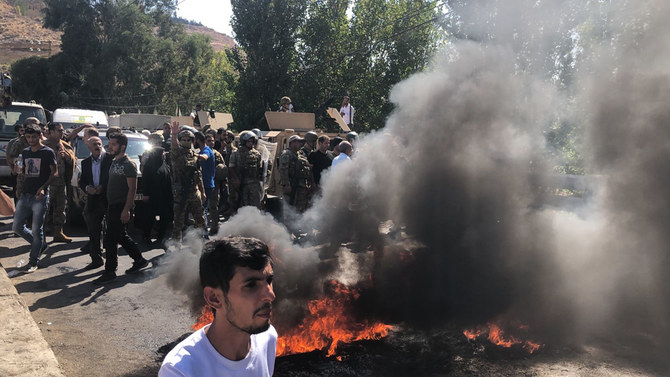
Hermel residents protest near the Assi River bridge. (AN Photo)
Short Url
Updated 08 October 2021
Follow

Lebanese protest as Iranian fuel supplies falter 

  • Discontent prevails in the Bekaa areas, especially in the Baalbek-Hermel region, where empty diesel tanks cannot operate the heaters needed to fight the extreme cold
  • Mayor of Baalbak Haidar Shamas told Arab News that the protests are due to the non-delivery of Iranian diesel to people who have paid for it

BEIRUT: Angry residents of Hermel in Lebanon’s north of Bekaa valley region took to the streets on Friday near the Assi River bridge where they burned tires and blocked the road to protest the unavailability of fuel and the total power outage. 

The Lebanese army intervened to reopen the roads following the first protests since Hezbollah delivered tons of Iranian fuel to Lebanon via illegal crossings with Syria, under the pretext of meeting people’s needs.

The region is one of Hezbollah’s strongholds. Discontent prevails in the Bekaa areas, especially in the Baalbek-Hermel region, where empty diesel tanks cannot operate the heaters needed to fight the extreme cold.

On Friday, the price of 20 liters of diesel jumped to LBP243,000 ($161), equivalent to half the minimum wage, after subsidies were fully lifted. The exchange rate exceeded LBP19,000 to the dollar on the black market.

Mayor of Baalbak Haidar Shamas told Arab News that the protests are due to the non-delivery of Iranian diesel to the people who paid for it, adding that the Al-Amana company has not delivered it.

People wishing to buy Iranian diesel must pay in cash to Hezbollah’s Al-Qard Al-Hasan Association, in accordance with the price determined by the US-sanctioned Al-Amana Co.

Al-Qard Al-Hasan is registered as a non-profit organization and was sanctioned by the US Treasury in 2016. However, its activity has not stopped.

Shamas said that in order to end people’s resentment, Hezbollah asked neighborhoods to register their names in exchange for 500 liters of diesel for free, with the rest to be sold to them in accordance with the Al-Amana Co.’s pricing.

“However, if it decides to start distributing diesel to houses, the free distribution to public hospitals, bakeries and electric generators will stop, as the Iranian diesel quantity is not enough. The monthly fees of generators will rise again and exceed 1 million Lebanese pounds at least. People supporting Hezbollah have started protesting against its policy to provide diesel for areas that do not support the party. It has increased the confusion for Hezbollah which has no previous experience in this field,” Shamas said.

There is a total power outage in the Baalbek-Hermel region, with lucky areas receiving just one hour of electricity per day.

Private generator owners have reduced their provision to only eight hours of electricity per day to drop fees to LBP600,000 after struggling families complained, with many opting to return to candles.

Elsewhere, protests sparked in Saida in Southern Lebanon as taxi drivers rejected the municipality’s attempt to implement a project of developing transit lines between the city and its surroundings, especially for school and university students, after the daily transportation fees became unaffordable.

Taxi drivers protested in front of the municipality, blocking the road with their cars.

Separately, after visiting Maronite Patriarch Bechara Boutros Al-Rahi on Friday, Prime Minister Najib Mikati said: “I am aware that there are great concerns, but we strive and seek to resolve them all.”

During his meeting with Mikati on Thursday, International Aid Coordinator for Lebanon Ambassador Pierre Dukan stressed “the need to accelerate the implementation of reforms, expedite the launch of negotiations with the International Monetary Fund and reach an agreement before the end of the year, when France seeks to organize an international conference to provide direct aid to the state budget.”

While meeting a number of Lebanese officials, US Ambassador to Lebanon Dorothy Shea said: “The financial situation is very difficult, and there is no solution without reasoning with the IMF as soon as possible.”

Washington has suggested that it will help Lebanon get electricity from Jordan and facilitate the flow of Egyptian gas through Jordan and Syria to northern Lebanon.


Lebanon approves financial gap draft law despite opposition from Hezbollah and Lebanese Forces

Lebanon's Prime Minister Nawaf Salam speaking during a press conference after a cabinet session in Beirut on December 26, 2025.
Updated 21 min 28 sec ago
Follow

Lebanon approves financial gap draft law despite opposition from Hezbollah and Lebanese Forces

  • Legislation aims to address the fate of billions of dollars in deposits that have been inaccessible to Lebanese citizens during the country’s financial meltdown

BEIRUT: Lebanon’s Cabinet on Friday approved a controversial draft law to regulate financial recovery and return frozen bank deposits to citizens. The move is seen as a key step in long-delayed economic reforms demanded by the International Monetary Fund.

The decision, which passed with 13 ministers voting in favor and nine against, came after marathon discussions over the so-called “financial gap” or deposit recovery bill, stalled for years since the banking crisis erupted in 2019. The ministers of culture and foreign affairs were absent from the session.

The legislation aims to address the fate of billions of dollars in deposits that have been inaccessible to Lebanese citizens during the country’s financial meltdown.

The vote was opposed by three ministers from the Lebanese Forces Party, three ministers from Hezbollah and the Amal Movement, as well as the minister of youth and sports, Nora Bayrakdarian, the minister of communications, Charles Al-Hajj, and the minister of justice, Adel Nassar.

Finance Minister Yassin Jaber broke ranks with his Hezbollah and Amal allies, voting in favor of the bill. He described his decision as being in line with “Lebanon’s supreme financial interest and its obligations to the IMF and the international community.”

The draft law triggered fierce backlash from depositors who reject any suggestion they shoulder responsibility for the financial collapse. It has also drawn strong criticism from the Association of Banks and parliamentary blocs, fueling fears the law will face intense political wrangling in Parliament ahead of elections scheduled in six months.

Prime Minister Nawaf Salam confirmed the Cabinet had approved the bill and referred it to Parliament for debate and amendments before final ratification. Addressing public concerns, he emphasized that the law includes provisions for forensic auditing and accountability.

“Depositors with accounts under $100,000 will be repaid in full with interest and without any deductions,” Salam said. “Large depositors will also receive their first $100,000 in full, and the remainder will be issued as negotiable bonds backed by the assets of the Central Bank, valued at around $50 billion.”

He said further that bondholders will receive an initial 2 percent payout after the first tranche of repayments is completed.

The law also includes a clause requiring criminal accountability. “Anyone who smuggled funds abroad or benefited from unjustified profits will be fined 30 percent,” Salam said.

He emphasized that Lebanon’s gold reserves will remain untouched. “A clear provision reaffirms the 1986 law barring the sale or mortgaging of gold without parliamentary approval,” he said, dismissing speculation about using the reserves to cover financial losses.

Salam admitted that the law was not perfect but called it “a fair step toward restoring rights.”

“The banking sector’s credibility has been severely damaged. This law aims to revive it by valuing assets, recapitalizing banks, and ending Lebanon’s dangerous reliance on a cash economy,” he said. “Each day of delay further erodes people’s rights.”

While the Association of Banks did not release an immediate response after the vote, it previously argued during discussions that the law would destroy remaining deposits. Bank representatives said lenders would struggle to secure more than $20 billion to cover the initial repayment tier and accused the state of absolving itself of responsibility while effectively granting amnesty for decades of financial mismanagement and corruption.

The law’s fate now rests with Parliament, where political competition ahead of the 2025 elections could complicate or delay its passage.

Lebanon’s banking sector has been at the heart of the country’s economic collapse, with informal capital controls locking depositors out of their savings and trust in state institutions plunging. International donors, including the IMF, have made reforms to the sector a key condition for any financial assistance.