

Egypt gasoline prices raised by 3.6 percent following oil surge
Egypt gasoline prices raised by 3.6 percent following oil surge/node/1943771/business-economy
Egypt gasoline prices raised by 3.6 percent following oil surge
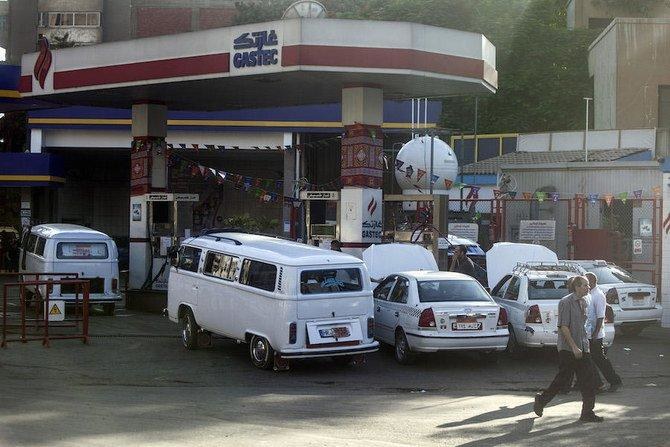
Egypt’s Automatic Pricing Committee for Petroleum Products meets every three months in line with the Egyptian government’s plan to gradually stop subsidizing fuel products. (AFP)
Egypt gasoline prices raised by 3.6 percent following oil surge
All fuel grades increased by 25 piasters
Updated 08 October 2021
Jana Salloum
RIYADH: Gasoline prices in Egypt have been raised by 3.6 percent effective today due to a global increase in the price of crude oil, the country’s official gazette reported.
The prices of 80-octane, 92-octane and 95-octane petrol were all raised by 25 piasters, to 7 Egyptian pounds ($0.45) per liter, 8.25 EGP/liter and 9.25 EGP/liter, respectively, effective from 0900 local time (0700 GMT).
Diesel prices remained unchanged, the paper said.
Egypt last raised gasoline prices in July when it also added 25 piasters to a liter of fuel, following a similar increase in April.
Egypt’s Automatic Pricing Committee for Petroleum Products meets every three months in line with the Egyptian government’s plan to gradually stop subsidizing fuel products within the framework of a reform program supported by the International Monetary Fund.
Prices have remained stable over the past year after dropping in April 2020 and October 2019.
EU investments in Saudi Arabia to prosper over next 5 years, says ambassador
Updated 8 sec ago
Wissam Al-Muqrin Ranim Al-Osaimi Al-Eqtisadiah
RIYADH: European investments in Saudi Arabia are set to see notable growth over the next five years, encompassing green energy, metals, critical raw materials, advanced industry, and the digital sector.
Christophe Farnaud, the EU Ambassador to Saudi Arabia, confirmed to Al-Eqtisadiah that an anticipated memorandum of understanding with the Kingdom in the energy field will provide an organized framework for cooperation in energy transition and sustainability, boosting investor confidence in the long-term partnership between the two sides.
The volume of trade in goods and services between Saudi Arabia and the EU amounts to €90 billion ($105.6 billion), according to the latest data from 2024, making the EU the Kingdom’s second-largest trading partner, according to Farnaud.
Currently, 2,500 European companies operate within the Saudi market, highlighting the depth of economic relations between the two sides.
A qualitative development in relations
Farnaud affirmed that Saudi-European relations are witnessing qualitative development, especially since the EU’s adoption in 2022 of its strategy towards Gulf Cooperation Council countries, which is based on enhancing political, security, and economic cooperation, in addition to cultural and humanitarian exchange.
He noted that Saudi Arabia’s Vision 2030 constitutes an attractive framework for strengthening this partnership.
The ambassador also pointed out that the launch of the European Chamber of Commerce in the Kingdom of Saudi Arabia during 2024 represented an important step to support cooperation between European and Saudi companies and enhance mutual investments, reflecting a positive outlook for the future of economic relations.
Economic relations are no longer limited to traditional trade exchange but have transformed into a multi-sector partnership, including investment, services, manufacturing, energy, and sustainability, according to Farnaud.
Christophe Farnaud, the EU Ambassador to Saudi Arabia meeting Crown Prince Mohammed bin Salman in 2025. X/@EUAmbGCC
Relaunching Free Trade Agreement negotiations
The ambassador revealed ongoing discussions to relaunch negotiations for a Free Trade Agreement between the EU and GCC countries, which have been stalled since 2008, aiming to reach a modern agreement covering investment, services, intellectual property protection, technical standards, and government procurement.
He also indicated readiness to launch negotiations for a bilateral strategic partnership agreement with Saudi Arabia, including industrial cooperation, critical raw materials, energy, and sustainability, alongside working to sign a memorandum of understanding in the energy field in the coming period.
The EU, according to Farnaud, is the largest foreign investor in Saudi Arabia, holding 29 percent of the total foreign direct investment stock, which amounted to 30.7 billion euros in 2023.
Investments are concentrated in the transport, energy, industry, tourism, education, and training sectors, with major European companies participating in strategic projects like the Riyadh Metro.
Sectors of common priority
The ambassador explained that the energy sector, especially renewable energy and green hydrogen, represents a common priority, amidst the global shift towards sustainability, in addition to significant opportunities in the high-tech manufacturing sector, industrial localization, and knowledge transfer.
He pointed to the growing interest of European investors in Saudi Arabia’s tourism sector, driven by Vision 2030’s targets to raise tourism’s contribution to the gross domestic product to 10 percent.
Wide opportunities stand out in areas of hospitality, tourist destination management, cultural tourism, transport, and sustainability, especially in major projects like NEOM, AlUla, the Red Sea Project, and Diriyah.
Farnaud cited existing partnerships with leading European companies such as Accor and Kempinski, in addition to French cooperation in developing AlUla as a global heritage and tourist site.