Israeli court ruling on major holy site angers Palestinians

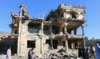
A group of religious Jews visit the Al-Aqsa mosque compound in Jerusalem’s Old City, on Thursday. (AFP)
Short Url
Updated 07 October 2021
Follow

Israeli court ruling on major holy site angers Palestinians

  • The court lifted the ban several days early, ruling that the man, “like many others, prays on a daily basis on the Temple Mount"
  • The Islamic endowment that maintains Al-Aqsa called the ruling a “flagrant violation” of the compound's sanctity and a “clear provocation” for Muslims worldwide

JERUSALEM: A ruling by a local Israeli court in favor of a Jewish man who prayed quietly at a flashpoint Jerusalem holy site has angered Muslim authorities. They denounced it on Thursday as a violation of the fragile status quo governing the compound.
The Al-Aqsa mosque compound is the third holiest site in Islam and the holiest site for Jews, who refer to it as the Temple Mount because it was the location of the ancient Jewish Temples. It is the emotional epicenter of the Israeli-Palestinian conflict, and tensions there helped ignite the 11-day Gaza war in May. Under informal understandings, Jews are not allowed to pray there.
The ruling by a magistrate court in Jerusalem concerned a Jewish man who had been barred from the site for 15 days after Israeli police caught him quietly praying there. The court lifted the ban several days early, ruling that the man, “like many others, prays on a daily basis on the Temple Mount.”
Noting that he did so quietly and privately, the ruling said “this activity by itself is not enough to violate the police instructions.”
Magistrate courts make up the lowest level of the Israeli judiciary and hear cases concerning relatively minor crimes.
Under a longstanding but informal arrangement known as the status quo, Jews are allowed to visit the site but not pray there. The agreement has broken down in recent years as large groups of Jews, including hard-line religious nationalists, have regularly visited and prayed at the site. The Israeli government says it is committed to maintaining the status quo.
The Palestinians and neighboring Jordan, which serves as the custodian of the holy site, fear that Israel plans to eventually take over the compound or partition it — as it did with a similarly contested holy site in Hebron, in the Israeli-occupied West Bank.
The Islamic endowment that maintains Al-Aqsa called the ruling a “flagrant violation” of the compound’s sanctity and a “clear provocation” for Muslims worldwide.
Friday prayers at the mosque are regularly attended by tens of thousands of Palestinians, and are sometimes followed by protests and clashes with Israeli police. A provocative visit by a right-wing Israeli politician in 2000 helped ignite the second Palestinian intifada, or uprising.
Israel captured east Jerusalem — including the Old City and its holy sites sacred to Jews, Christians and Muslims — in the 1967 war and annexed it in a move not recognized by most of the international community. The Palestinians want east Jerusalem to be the capital of their future state. The city’s status has been among the most divisive issues in decades of failed peace efforts.


Lebanon ex-central bank chief's corruption case being sent to top court, officials say

Updated 10 sec ago
Follow

Lebanon ex-central bank chief's corruption case being sent to top court, officials say

BEIRUT: The corruption case of Lebanon's former central bank governor, who is widely blamed for the country’s economic meltdown, has been transferred to the country's highest court, judicial officials told The Associated Press on Tuesday.
Riad Salameh was released on $14 million bail in September after a year in prison while awaiting trial in Lebanon on corruption charges, including embezzlement and illicit enrichment.
The trial of Salameh, 75, and his two legal associates, Marwan Khoury and Michel Toueini, will now be heard at the Court of Cassation, according to a copy of the notice obtained by the AP. Salameh and the others will be issued with arrest warrants if they don't show up for trial at the court.
No trial date has been set yet. Salameh denies the charges. The court’s final ruling can't be appealed, according to the four officials who spoke on condition of anonymity, because they weren't authorized to speak with the media.
In September 2024, he was charged with the embezzlement of $42 million, with the court later adding charges of illicit enrichment over an apartment rented in France, supposedly to be a substitute office for the central bank if needed. Officials have said that Salameh had rented from his former romantic partner for about $500,000 annually.
He was once celebrated for steering Lebanon’s economic recovery, after a 15-year civil war, upon starting his long tenure in 1993 and keeping the fragile economy afloat during long spells of political gridlock and turmoil.
But in 2023, he left his post after three decades with several European countries investigating allegations of financial crimes. Meanwhile, much of the Lebanese blame his policies for sparking a fiscal crisis in late 2019 where depositors lost their savings, and the value of the local currency collapsed.
On top of the inquiry in Lebanon, he is being investigated by a handful of European countries over various corruption charges. In August 2023, the United States, United Kingdom and Canada imposed sanctions on Salameh.
Salameh has repeatedly denied allegations of corruption, embezzlement and illicit enrichment. He insists that his wealth comes from inherited properties, investments and his previous job as an investment banker at Merrill Lynch.
Lebanon’s current central bank governor, Karim Souaid, announced last week that he's filing legal complaints against a former central bank governor and former banking official who diverted funds from the bank to what he said were four shell companies in the Cayman Islands. He didn't name either individual.
But Souaid said that Lebanon's central bank would become a plaintiff in the country's investigation into Forry Associates. The U.S. Treasury, upon sanctioning Salameh and his associates, described Forry Associates as “a shell company owned by Raja (Salameh’s brother) in the British Virgin Islands” used to divert about $330 million in transactions related to the central bank.
Several European countries, among them France, Germany, and Luxembourg, have been investigating the matter, freezing bank accounts and assets related to Salameh and his associates, with little to no cooperation from the central bank and Lebanese authorities.
Souaid said that he will travel later this month to Paris to exchange “highly sensitive” information as France continues its inquiries.