

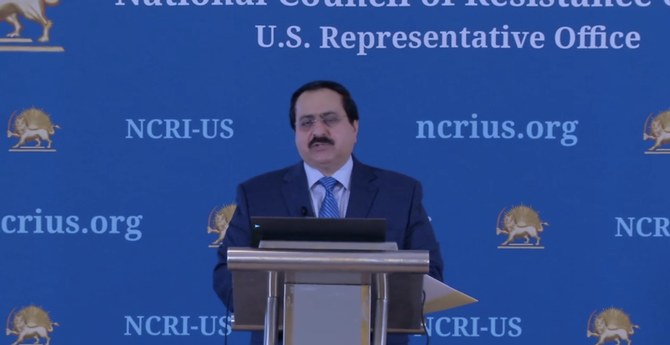


CHICAGO: Iran’s aggressive and expanding unmanned aerial vehicles program is a growing threat not only to countries in the Middle East, including Saudi Arabia, but also the West, according to officials from the National Council of Resistance of Iran.
Alireza Jafarzadeh, deputy director of the NCRI’s Washington office, said the program includes eight production and assembly sites across Iran that receive parts and materials from foreign countries.
During a briefing on Wednesday, attended by Arab News, he said UAVs, or drones, have been used to attack many Western targets in conflict zones such as Syria and Iraq, as well as targets in Lebanon and Saudi Arabia.
Tehran supplies the Houthi militia in Yemen with the drones that are the primary weapons used in its terror campaign against targets in Saudi Arabia, Jafarzadeh said. They are “assembled in Yemen” and many essential components come from sources outside of Iran, he added.
“The UAV program has only one purpose and that is destabilizing the region and creating chaos,” Jafarzadeh said. He added that eight industries in Iran are involved in “disguising” the production of the weaponized drones.
“The Iranian regime has really stepped up its efforts and money and resources to its UAV program, to destabilize the region. Billions of dollars have been spent on UAVs and missiles, and under (Iranian President Ebrahim) Raisi this program will gain more prominence. The question is, what is to be done?”
Jafarzadeh said that Iran’s multibillion-dollar UAV program, which he described as “the regime’s primary weapon for terrorism,” is directed by Quds Force of the Islamic Revolutionary Guards Corps.
He continued: “Iran is expanding its terror and destabilizing efforts in the region, and the oppression of people in Iran. We must hold Iran responsible and make them pay the price. … We need to see firmness, decisiveness and stepped-up pressure against the Iranian regime.”
Iran’s UAV program is a direct result of “counterproductive” negotiations with Western nations about the lifting sanctions, Jafarzadeh said, during which Tehran bolstered and expanded the program.
“Obviously, sanctions by themselves will not solve all of this problem,” he added. “But sanctions are a tool, making (Iran) pay the price.
“If the regime is allowed to carry out an extensive operation (like) that we showed today without any consequences, then they are encouraged and will do more. You want to hold the regime itself accountable.”
To support his arguments, Jafarzadeh presented detailed satellite images, graphs and charts he said reveal the complexity and “alarming new details” of Iran’s UAV terror program. The information was gathered inside Iran for the NCRI by opposition group the Mujahedin-e Khalq.
Over the past two decades, the NCRI has exposed dozens of what it says are key sites that form parts of Tehran’s nuclear weapons program, missile program and growing terrorism network in the region.


