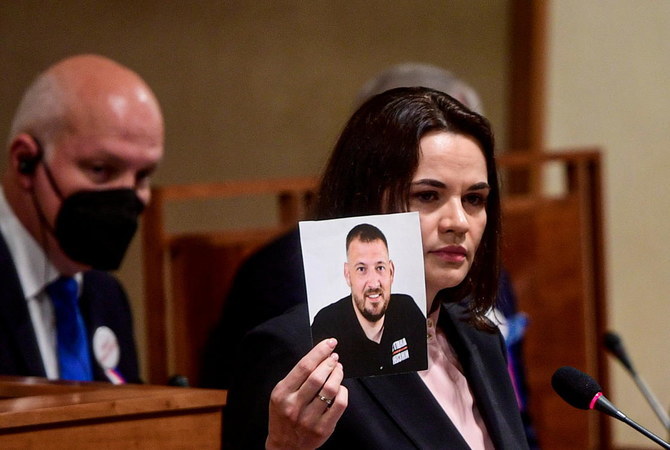
WARSAW, Poland: Belarus’ exiled opposition leader Sviatlana Tsikhanouskaya on Wednesday urged the global community to stop a “humanitarian catastrophe” which she said is being created by the Belarusian regime facilitating largescale migration into the European Union.
Thousands of migrants from Syria, Iraq, Afghanistan and Africa have been lured to Belarus on tourist visas and encouraged to cross into Poland, Lithuania, and to a lesser extent Latvia — all three EU nations that border Belarus.
Several recently died of exhaustion as they tried to get from Belarus to Poland across an area of forests and swamps.
Tsikhanouskaya warned that as winter approaches, she fears those deaths “will grow into dozens.”
“So I urge the United Nations and the world community to act to stop the humanitarian catastrophe that’s about to happen in the middle of Europe,” she told a press conference during the Warsaw Security Forum.
During her visit to Warsaw she also met with Polish President Andrzej Duda and other Polish leaders, who have been supportive of the efforts of the Belarusian opposition and given succor to people targeted by the regime in Minsk.
Tsikhanouskaya was the main opposition challenger to longtime authoritarian President Alexander Lukashenko in last year’s disputed election. She now lives in exile in Lithuania.
Poland has taken a tough approach to securing its border, saying it must defend its national security in the face of a “hybrid war” attack by Lukashenko.
“It’s revenge (against) Poland and Lithuania for their support of the Belarusian democratic movement,” Tsikhanouskaya said.
She did not directly criticize Poland’s approach, which has involved denying migrants the right to apply for asylum and pushing some families with children back across the border, in violation of international law. But she noted that “people who are crossing the border are not guilty. They are victims.”
She said that there are still some 10,000 to 15,000 migrants now in Belarus hoping to make the crossing into the EU, and that the number was growing. She did not specify the source of the numbers she quoted.


![]()

Belarus opposition leader warns of border migration crisis
Short Url
https://arab.news/bkc3v
Belarus opposition leader warns of border migration crisis
- Thousands of migrants from Syria, Iraq, Afghanistan and Africa have been lured to Belarus on tourist visas
- Sviatlana Tsikhanouskaya warned that as winter approaches, she fears those deaths "will grow into dozens”


Latest updates





© 2026 SAUDI RESEARCH & PUBLISHING COMPANY, All Rights Reserved And subject to Terms of Use Agreement.