

UAE starts selling first federal government dollar bonds

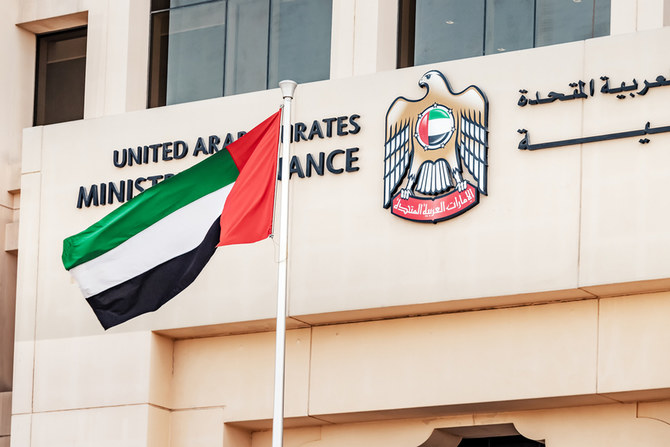
Dubai, UAE: coat of arms and flag at the Ministry of Finance of the United Arab Emirates in Dubai
Short Url
Updated 06 October 2021
Follow

UAE starts selling first federal government dollar bonds

  • The bonds have tranches of 10, 20, and 40 years
  • The UAE finance ministry is expected to raise between $3 billion and $3.5 billion

The United Arab Emirates marketed a triple-tranche U.S. dollar-denominated bond on Wednesday, the first issued by the federal government rather than individual emirates, in a sale to be concluded the same day, a document showed.


The bonds have tranches of 10, 20, and 40 years.

The 10-year notes were offered with an initial price guidance of about 105 basis points (bps) over U.S. Treasuries, the 20-year at about 135 bps over the same benchmark, and the 40-year at about 3.6 percent.


The 40-year portion will be Formosa bonds, which are debt securities sold in Taiwan by foreign borrowers and denominated in currencies other than the Taiwanese dollar.


The UAE finance ministry is expected to raise between $3 billion and $3.5 billion, two sources familiar with the matter have told Reuters.


The federal government has never issued bonds before but several of the seven emirates that it comprises have, most notably the capital Abu Dhabi and commerce hub Dubai.

"They'll likely land roughly 10 bps wider than Abu Dhabi. Given it's a debut, I expect there'll be a new issuance premium," a fixed income strategist said.


Moody's has assigned the UAE bonds an Aa2 rating in line with Abu Dhabi's, "supported by the assumed full backing of the government of Abu Dhabi and its strong balance sheet".


Fitch Ratings rated the UAE AA-(minus), which reflects "the likelihood of support from Abu Dhabi (AA/Stable) in the event of need."


The proceeds will be used to finance cabinet-approved infrastructure projects and back investments by the Emirates Investment Authority, the UAE's only federal sovereign wealth fund.


Saudi POS spending jumps 28% in final week of Jan: SAMA

Updated 06 February 2026
Follow

Saudi POS spending jumps 28% in final week of Jan: SAMA

RIYADH: Saudi Arabia’s point-of-sale spending climbed sharply in the final week of January, rising nearly 28 percent from the previous week as consumer outlays increased across almost all sectors. 

POS transactions reached SR16 billion ($4.27 billion) in the week ending Jan. 31, up 27.8 percent week on week, according to the Saudi Central Bank. Transaction volumes rose 16.5 percent to 248.8 million, reflecting stronger retail and service activity. 

Spending on jewelry saw the biggest uptick at 55.5 percent to SR613.69 million, followed by laundry services which saw a 44.4 percent increase to SR62.83 million. 

Expenditure on personal care rose 29.1 percent, while outlays on books and stationery increased 5.1 percent. Hotel spending climbed 7.4 percent to SR377.1 million. 

Further gains were recorded across other categories. Spending in pharmacies and medical supplies rose 33.4 percent to SR259.19 million, while medical services increased 13.7 percent to SR515.44 million. 

Food and beverage spending surged 38.6 percent to SR2.6 billion, accounting for the largest share of total POS value. Restaurants and cafes followed with a 20.4 percent increase to SR1.81 billion. Apparel and clothing spending rose 35.4 percent to SR1.33 billion, representing the third-largest share during the week. 

The Kingdom’s key urban centers mirrored the national surge. Riyadh, which accounted for the largest share of total POS spending, saw a 22 percent rise to SR5.44 billion from SR4.46 billion the previous week. The number of transactions in the capital reached 78.6 million, up 13.8 percent week on week. 

In Jeddah, transaction values increased 23.7 percent to SR2.16 billion, while Dammam reported a 22.2 percent rise to SR783.06 million. 

POS data, tracked weekly by SAMA, provides an indicator of consumer spending trends and the ongoing growth of digital payments in Saudi Arabia.  

The data also highlights the expanding reach of POS infrastructure, extending beyond major retail hubs to smaller cities and service sectors, supporting broader digital inclusion initiatives.  

The growth of digital payment technologies aligns with Saudi Arabia’s Vision 2030 objectives, promoting electronic transactions and contributing to the Kingdom’s broader digital economy.