

Violent clashes with police in Islamabad as young doctors hold protests over licensing exam

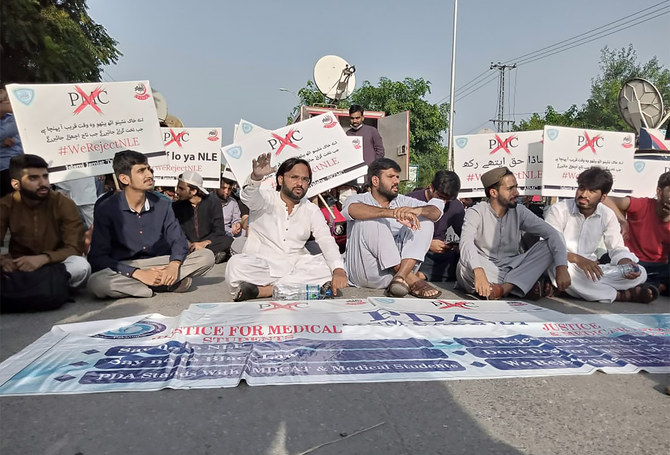
Young doctors protest outside Pakistan Medical Commission's office in Islamabad, Pakistan, on October 5, 2021. (Photo courtesy: @isbjamiat/Twitter)
Short Url
Updated 06 October 2021
Follow

Violent clashes with police in Islamabad as young doctors hold protests over licensing exam

  • The Pakistan Medical Commission made a comprehensive exam mandatory for graduates of medical institutions before practicing their profession
  • Young doctors, who have been resisting the policy, took their protest outside the PMC building on Tuesday where violence broke out

ISLAMABAD: A clash broke out on Tuesday between a group of young doctors protesting against the national licensing examination in front of the Pakistan Medical Commission (PMC) and the police deployed outside the building, reported the local media.
The PMC recently made it mandatory for graduates of medical institutions to take a comprehensive exam before getting themselves registered to practice medicine in the country.
However, the decision did not go down well with young doctors who raised their voice against it on Tuesday in front of the PMC building.
“The protest turned violent when the police resorted to baton-charge and fired tear gas at the demonstrators, prompting some of them to barge into the PMC building,” Dawn said in a news report. “Later, the police detained around 20 doctors and dispersed the remaining through the use of force, according to a statement from the Young Doctors Association (YDA).”
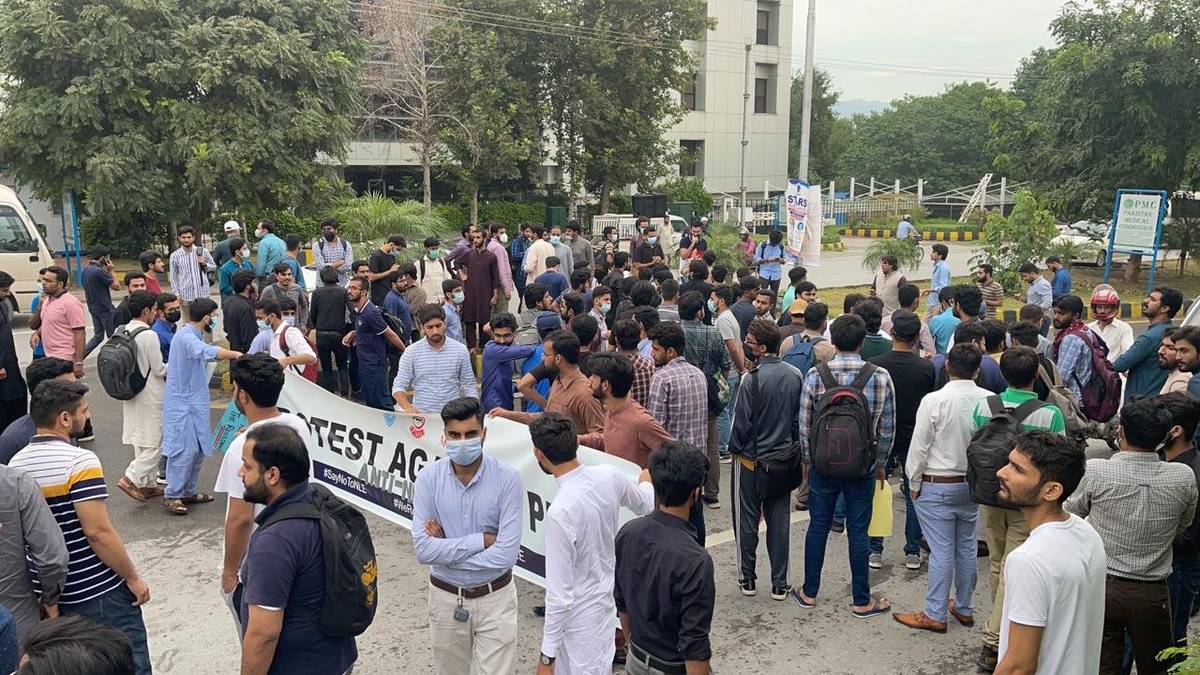


Young doctors protest gather Pakistan Medical Commission's office in Islamabad, Pakistan, on October 5, 2021. (Photo courtesy: @AamerGorsi/Twitter)

However, the police accused the protesters of trying to forcefully enter the building and said the doctors also threw stones at officials of the law enforcement agency.
The young doctors later called an emergency meeting at the Pakistan Institute of Medical Sciences (PIMS) wherein they threatened to go on a nationwide strike if their colleagues were not released by the police.
PMC officials have emphasized the significance of the exam in recent weeks, saying it would help deliver standardized health care in the country.


Pakistan organizes second phase of Hajj training for 2026 pilgrims in Islamabad

Updated 4 sec ago
Follow

Pakistan organizes second phase of Hajj training for 2026 pilgrims in Islamabad

  • Training sessions held to inform pilgrims of various stages of Hajj, precautionary measures, obligatory acts, says state media 
  • Pilgrims told to improve their physical fitness, keep essential travel documents and vaccination cards ready ahead of Hajj 2026

ISLAMABAD: Pakistan’s Ministry of Religious Affairs organized the second phase of Hajj training for 2026 pilgrims in Islamabad today, Sunday, state media reported. 

Pakistan’s religion ministry kicked off the first phase of the mandatory Hajj trainings last Sunday in Islamabad and other cities. The ministry said the trainings were made mandatory to ensure that intending pilgrims are fully aware of Hajj rituals and administrative procedures. 

“Ministry of Religious Affairs and Interfaith Harmony organized second phase of Hajj training session for pilgrims in Islamabad today,” state broadcaster Radio Pakistan reported. 

It said the primary objective of the program was to provide awareness about the various stages of the pilgrimage, necessary precautionary measures and the obligatory acts of both Hajj and Umrah.

“Pilgrims were advised to improve their physical fitness by walking 2 to 3 kilometers daily and keep essential travel documents including original passport, CNIC, flight ticket, visa copies and vaccination cards ready,” the state media said. 

Intending pilgrims were strictly warned against carrying prohibited items such as narcotics, naswar (smokeless tobacco), cigarettes and unverified medicines.

Saudi Arabia has allocated Pakistan a quota of 179,210 pilgrims for Hajj 2026, of which around 118,000 seats have been reserved under the government scheme while the remainder will be allocated to private tour operators.

Under Pakistan’s Hajj scheme, the estimated cost of the government package ranges from Rs1,150,000 to Rs1,250,000 ($4,049.93 to $4,236), subject to final agreements with service providers.