

New alarm in US over Iran drive toward nuclear bomb

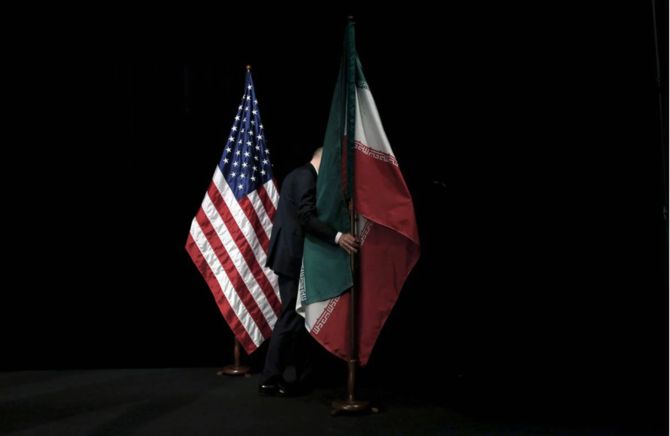
A staff member removes the Iranian flag from the stage after a group picture with ministers and representatives of different countries during the Iran nuclear talks in Vienna, July 14, 2015. (Reuters)
Short Url
Updated 06 October 2021
Follow

New alarm in US over Iran drive toward nuclear bomb

  • Under JCPOA deal, Iran curbed uranium enrichment program, a possible pathway to nuclear arms, in return for lifting of economic sanctions

JEDDAH: The US is alarmed by Iran’s progress toward obtaining an atomic weapon and hopes to resume talks soon to curb Tehran’s nuclear program, a top official in Washington said on Tuesday.

Iran’s nuclear activity was also at the center of talks in Washington between US and Israeli national security teams.

Israeli national security adviser Eyal Hulata and his White House counterpart Jake Sullivan joined a meeting of the US-Israel Strategic Consultative Group of diplomatic, military and intelligence agencies.

US President Joe Biden wants to reverse his predecessor Donald Trump’s decision to pull the US out of the 2015 deal to curb Iran’s nuclear program in return for the lifting of economic sanctions that have crippled the Iranian economy.

Talks in Vienna aimed at reviving the deal are stalled over whether Iran or the US should take the first step. “The path in Vienna for negotiations does remain open,” a senior Biden administration official said on Tuesday. “The Iranians are sending indications to a number of parties that they are preparing to come back to Vienna and of course we will have to see whether they re-engage in that process.”

Despite skepticism among Gulf states and Israel, the Biden administration believes “very strongly that the diplomatic path remains the best,” the official said.

However, the official said the White House and Israel’s new government agreed that Iran had made rapid advances since Trump quit the 2015 deal and restored sanctions. “We have a common assessment of the extent to which Iran’s nuclear program has dramatically broken out of the box,” the official said.

“The breakout time, meaning stockpiles of enriched uranium and other ways to look at this, it’s gone from about 12 months down to a period of a few months. So obviously that’s quite alarming.”

The official said the US believed diplomacy would be “the best way to put a ceiling on the program and roll back the gains that Iran has made in recent years.” However, there was no movement toward the US lifting sanctions and if diplomacy failed “there are other avenues.”

“We think the onus right now is on the Iranian side,” the official said.

Meanwhile Iran has admitted that an Israeli sabotage attack in June on a uranium centrifuge workshop caused “severe damage,” after previously claiming that it had been thwarted.

Tehran demanded that the International Atomic Energy Agency, the UN nuclear watchdog, “clarify its position” on the attack on the plant in Karaj, about 50km from Tehran.


Bangladesh’s religio-political party open to unity govt

Updated 01 January 2026
Follow

Bangladesh’s religio-political party open to unity govt

  • Opinion polls suggest that Jamaat-e-Islami will finish a close second to the Bangladesh Nationalist Party in the first election it has contested in nearly 17 years

DHAKA: A once-banned Bangladeshi religio-political party, poised for its strongest electoral showing in February’s parliamentary vote, is open to joining a unity government and has held talks with several parties, its chief said.

Opinion polls suggest that Jamaat-e-Islami will finish a close second to the Bangladesh Nationalist Party in the first election it has contested in nearly 17 years as it marks a return to mainstream politics in the predominantly Muslim nation of 175 million.

Jamaat last held power between 2001 and 2006 as a junior coalition partner with the BNP and is open to working with it again.

“We want to see a stable nation for at least five years. If the parties come together, we’ll run the government together,” Jamaat chief Shafiqur Rahman said in an interview at his office in a residential area in Dhaka, ‌days after the ‌party created a buzz by securing a tie-up with a Gen-Z party.

Rahman said anti-corruption must be a shared agenda for any unity government.

The prime minister will come from the party winning the most seats in the Feb. 12 election, he added. If Jamaat wins the most seats, the party will decide whether he himself would be a candidate, Rahman said.

The party’s resurgence follows the ousting of long-time Prime Minister Sheikh Hasina in a youth-led uprising in August 2024. 

Rahman said Hasina’s continued stay in India after fleeing Dhaka was a concern, as ties between the two countries have hit their lowest point in decades since her downfall.

Asked about Jamaat’s historical closeness to Pakistan, Rahman said: “We maintain relations in a balanced way with all.”

He said any government that includes Jamaat would “not feel comfortable” with President Mohammed Shahabuddin, who was elected unopposed with the Awami League’s backing in 2023.