

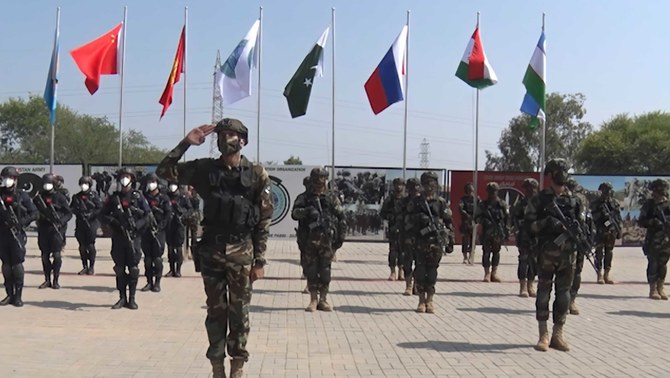
First-ever military exercise conducted in Pakistan under Shanghai Cooperation Organization concludes

Chinese and Pakistani troops participate in Joint Anti-Terrorist Exercise (JATE) 2021 in Pakistan on October 04, 2021. (Photo courtesy: ISPR)
Short Url
Updated 04 October 2021
Follow

First-ever military exercise conducted in Pakistan under Shanghai Cooperation Organization concludes

  • Chinese and Pakistani troops participate, share experiences of capacity building and new technologies to counter threats
  • Exercise “focused on enhancing cooperation and cohesiveness” in combating international terrorism and was conducted in two stages

The Joint Anti-Terrorist Exercise (JATE) 2021 concluded in Pakistan on Monday, with a closing ceremony held at the National Counter-Terrorism Center in the northwestern Khyber-Pakhtunkhwa province, a statement by the army’s military wing said. 
Chinese and Pakistani troops participated in the exercise and shared their experiences of capacity building, innovative approaches and new technologies to counter threats. 
“This is the first ever military exercise conducted in Pakistan under the ambit of Shanghai Cooperation Organization (SCO) Regional Anti-Terrorism Structure,” the Pakistan army said in a statement. 
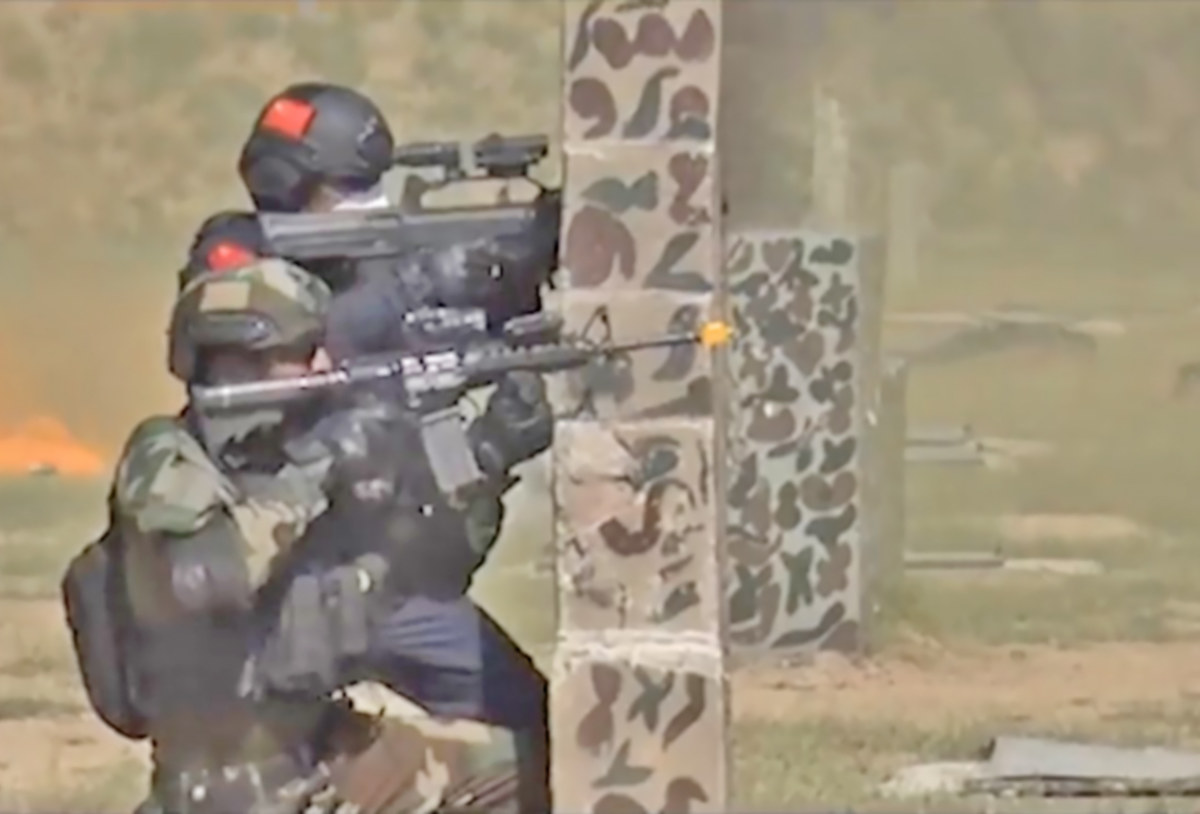


Chinese troops aim at the target during the Joint Anti-Terrorist Exercise (JATE) 2021 in Pakistan on October 04, 2021. (Screengrab from ISPR video)


It said the exercise “focused on enhancing cooperation and cohesiveness” in combating international terrorism and was conducted in two stages. 
“Stage 1 of the training was conducted in respective SCO member countries from 26-31 July while stage 2 conducted in Pakistan from 21 September to 4 October 2021,” the army said. 
“During the two weeks long training, participating troops from China and Pakistan extensively practiced various drills as part of the Joint Counter Terrorism Operations from planning to conduct; including Cordon & Search, Compound Clearance, Close Quarter Battle, Rappelling from Helicopter, Explosive Handling and Medical Evacuation.”


Pakistani, Saudi foreign ministers discuss regional situation amid Yemen tensions

Updated 5 sec ago
Follow

Pakistani, Saudi foreign ministers discuss regional situation amid Yemen tensions

  • The development comes after ships transported weapons from UAE’s Fujairah to Yemen’s Mukalla without permission from Arab Coalition
  • The UAE has announced withdrawal of its remaining counter-terrorism units in Yemen, citing recent developments and ongoing operations

ISLAMABAD: Pakistani and Saudi foreign ministers on Tuesday spoke over the phone and discussed the regional situation, the Pakistani foreign ministry said, amid escalating tensions over Yemen.

The development came hours after Saudi Arabia-led Coalition to Support Legitimacy in Yemen said it conducted a “limited” airstrike targeting two shipments of smuggled weapons and other military hardware coming from the Emirati port of Fujairah into Mukalla in southern Yemen.

Coalition Forces spokesman Major General Turki Al-Maliki said the weapons and combat vehicles were meant to support the Southern Transitional Council forces, backed by the United Arab Emirates (UAE), in Yemen’s Hadramaut and Al-Mahra “with the aim of fueling the conflict.”

Rashad Al-Alimi, leader of Yemen’s presidential council, on Tuesday announced a 90-day state of emergency, including a 72-hour air, sea and land blockade, and canceled a defense pact with the UAE, the state news agency said, calling for pullout of Emirati troops.

“Deputy Prime Minister and Foreign Minister, Senator Mohammad Ishaq Dar, called Saudi Foreign Minister H.H. Prince Faisal bin Farhan,” the Pakistani foreign ministry said.

“Both leaders exchanged views on the current regional situation and recent developments.”

Disregarding previous agreements with the Arab Coalition, the Southern Transitional Council (STC) separatist group, launched a sweeping military campaign early in December, seizing the governorates of Hadramaut along the Saudi border and the eastern governorate of Al-Mahra in Yemen’s border with Oman.

STC forces captured the city of Seiyun, including its international airport and the presidential palace. They also took control of the strategic PetroMasila oilfields, which account for a massive portion of Yemen’s remaining oil wealth.

The advance has raised the spectre of the return of South Yemen, a separate state from 1967 to 1990, while dealing a hammer-blow to slow-moving peace negotiations with Iran-backed Houthi rebels.

Saudi Arabia on Tuesday expressed regret over what it described as pressure by the UAE on STC forces to carry out military operations in Yemen’s Hadramout and Al-Mahra governorates, warning that such actions pose a direct threat to the Kingdom’s national security and regional stability.

In a statement, the Saudi Ministry of Foreign Affairs said the reported moves were inconsistent with the principles of the Arab Coalition that supports the internationally recognized government of Yemen and undermined ongoing efforts to achieve security and stability in the country.

The UAE announced the withdrawal of its remaining counter-terrorism units in Yemen on Tuesday, citing recent developments and concerns over the safety and effectiveness of ongoing operations.

In a statement issued on Tuesday and carried on Emirates News Agency, the UAE Ministry of Defense said the decision was taken voluntarily and in coordination with relevant international partners, ensuring the safety of UAE personnel.

The UAE earlier reaffirmed its unwavering commitment to Saudi Arabia’s security and sovereignty, rejecting any actions that could threaten the Kingdom or undermine regional stability.

Separately, Pakistan Prime Minister Shehbaz Sharif, along with Dar and other officials, met with UAE President Sheikh Mohamed bin Zayed Al-Nahyan, who is on a private visit to the Pakistani city of Rahim Yar Khan following his first official visit to Islamabad earlier this month.

“He (Sharif) stressed upon the need for both sides to actively pursue enhancement in bilateral trade through a quantum jump which will bring it to the desired level,” Sharif’s office said in a statement.

“The two leaders also discussed ways to enhance cooperation in a wide range of areas including IT, energy, mining & minerals, as well as defense cooperation.”

Pakistan has close relations with both Saudi Arabia and the UAE, while Islamabad this year also signed a landmark defense pact with Riyadh, pledging that aggression against one country would be treated as an attack on both.