

Albania rejects deal with ‘anti-immigration’ Britain to process channel migrants

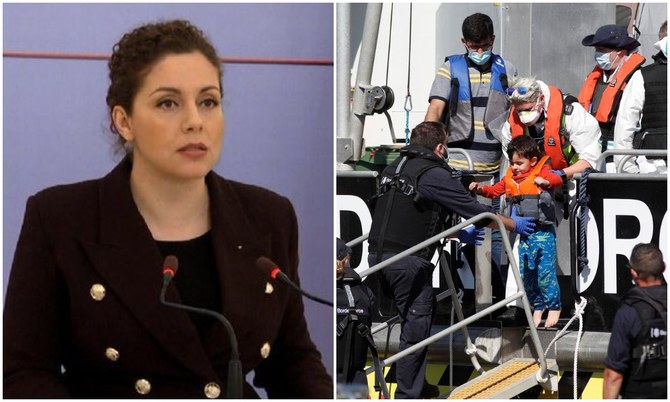
Albania's Olta Xhacka said that any suggestion her country would participate in such a scheme with the UK was “embarrassing.” (Reuters/File Photos)
Short Url
Updated 04 October 2021
Follow

Albania rejects deal with ‘anti-immigration’ Britain to process channel migrants

  • Albania will ‘never be a hub of anti-immigration policies,’ foreign minister said
  • UK grapples with sharp rise in number of people arriving on its shores from France via English Channel

LONDON: Albania’s foreign minister has denied reports that migrants arriving in the UK will be sent to her country to have their asylum claims processed, calling the alleged plans “fake news.”

Olta Xhacka said that any suggestion her country would participate in such a scheme was “embarrassing,” following a report in the British press that the UK Home Office was discussing the construction of a processing center in the Balkan country.

The Sun newspaper claimed that a British government source said talks over the construction of a processing center were at the “technical stage.”

But, speaking Sunday, Xhacka said: “So embarrassing the fake news spreading in the British media about an ‘offshore hub in the Balkans’ namely in Albania to ‘detain migrants crossing Channel from France.’

“Albania will proudly host 4,000 Afghan refugees based on its goodwill, but will never be a hub of anti-immigration policies of bigger and richer countries.”

Xhacka added that she had instructed that the Albanian Embassy in the UK demand a retraction of the story.

Endri Fuga, the director of communications for the Albanian government, labeled the story “completely untrue.” In a tweet, he added: “Albania opened its doors to 4,000 Afghans and we are proud of that.”

Australia already processes asylum applications from overseas centers, and the British government is said to be in talks with the Danish government over the establishment of a shared processing center in Rwanda.

The UK has struggled to contain an increasing number of people arriving in the country via small boats across the English Channel.

According to data from the UK Home Office, compiled by the Press Association, over 17,000 people had arrived in the UK via the Channel by the end of September this year — more than double the figure for the whole of 2020.

The growing number of arrivals has put pressure on the government domestically, as images surface daily of young men in life jackets arriving on British beaches. It has also led to tensions and disagreements with its French neighbors, which the UK argues should be doing more to prevent people from attempting the perilous crossing.

Despite the growing number of people arriving in Britain via the Channel, the number of asylum applications that the UK processed actually fell in 2020 — down to 29,456 from 35,737 in 2019.

That is roughly a third of the all-time high in applications of 84,132 in 2002.

A UK government spokesperson said: “We are determined to tackle the unacceptable rise in dangerous Channel crossings … This is a shared, international challenge and we continue to work with other countries to meet it.”


Czech Prime Minister Babiš faces confidence vote as government shifts Ukraine policy

Updated 4 sec ago
Follow

Czech Prime Minister Babiš faces confidence vote as government shifts Ukraine policy

  • “I’d like to make it clear that the Czech Republic and Czech citizens will be first for our government,” Babiš said
  • Babiš has rejected any financial aid for Ukraine and guarantees for EU loans

PRAGUE: The Czech Republic’s new government led by populist Prime Minister Andrej Babiš was set to face a mandatory confidence vote in Parliament over its agenda aimed at steering the country away from supporting Ukraine and rejecting some key European Union policies.
The debate in the 200-seat lower house of Parliament, where the coalition has a majority of 108 seats, began Tuesday. Every new administration must win the vote to govern.
Babiš, previously prime minister in two governments from 2017-2021, and his ANO, or YES, movement, won big in the country’s October election and formed a majority coalition with two small political groups, the Freedom and Direct Democracy anti-migrant party and the right-wing Motorists for Themselves.
The parties, which share admiration for US President Donald Trump, created a 16-member Cabinet.
“I’d like to make it clear that the Czech Republic and Czech citizens will be first for our government,” Babiš said in his speech in the lower house.
The political comeback by Babiš and his new alliance with two small government newcomers are expected to significantly redefine the nation’s foreign and domestic policies.
Unlike the previous pro-Western government, Babiš has rejected any financial aid for Ukraine and guarantees for EU loans to the country fighting the Russian invasion, joining the ranks of Viktor Orbán of Hungary and Robert Fico of Slovakia.
But his government would not abandon a Czech initiative that managed to acquire some 1.8 million much-needed artillery shells for Ukraine only last year on markets outside the EU on condition the Czechs would only administer it but would not contribute money.
The Freedom party sees no future for the Czechs in the EU and NATO, and wants to expel most of 380,000 Ukrainian refugees in the country.
The Motorists, who are in charge of the environment and foreign ministries, rejected the EU Green Deal and proposed revivals of the coal industry.