

Albania rejects deal with ‘anti-immigration’ Britain to process channel migrants

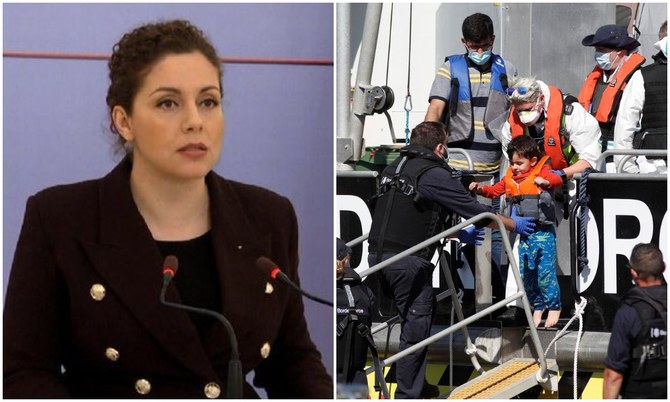
Albania's Olta Xhacka said that any suggestion her country would participate in such a scheme with the UK was “embarrassing.” (Reuters/File Photos)
Short Url
Updated 04 October 2021
Follow

Albania rejects deal with ‘anti-immigration’ Britain to process channel migrants

  • Albania will ‘never be a hub of anti-immigration policies,’ foreign minister said
  • UK grapples with sharp rise in number of people arriving on its shores from France via English Channel

LONDON: Albania’s foreign minister has denied reports that migrants arriving in the UK will be sent to her country to have their asylum claims processed, calling the alleged plans “fake news.”

Olta Xhacka said that any suggestion her country would participate in such a scheme was “embarrassing,” following a report in the British press that the UK Home Office was discussing the construction of a processing center in the Balkan country.

The Sun newspaper claimed that a British government source said talks over the construction of a processing center were at the “technical stage.”

But, speaking Sunday, Xhacka said: “So embarrassing the fake news spreading in the British media about an ‘offshore hub in the Balkans’ namely in Albania to ‘detain migrants crossing Channel from France.’

“Albania will proudly host 4,000 Afghan refugees based on its goodwill, but will never be a hub of anti-immigration policies of bigger and richer countries.”

Xhacka added that she had instructed that the Albanian Embassy in the UK demand a retraction of the story.

Endri Fuga, the director of communications for the Albanian government, labeled the story “completely untrue.” In a tweet, he added: “Albania opened its doors to 4,000 Afghans and we are proud of that.”

Australia already processes asylum applications from overseas centers, and the British government is said to be in talks with the Danish government over the establishment of a shared processing center in Rwanda.

The UK has struggled to contain an increasing number of people arriving in the country via small boats across the English Channel.

According to data from the UK Home Office, compiled by the Press Association, over 17,000 people had arrived in the UK via the Channel by the end of September this year — more than double the figure for the whole of 2020.

The growing number of arrivals has put pressure on the government domestically, as images surface daily of young men in life jackets arriving on British beaches. It has also led to tensions and disagreements with its French neighbors, which the UK argues should be doing more to prevent people from attempting the perilous crossing.

Despite the growing number of people arriving in Britain via the Channel, the number of asylum applications that the UK processed actually fell in 2020 — down to 29,456 from 35,737 in 2019.

That is roughly a third of the all-time high in applications of 84,132 in 2002.

A UK government spokesperson said: “We are determined to tackle the unacceptable rise in dangerous Channel crossings … This is a shared, international challenge and we continue to work with other countries to meet it.”


What is Trump’s ‘Board of Peace’?

Updated 6 sec ago
Follow

What is Trump’s ‘Board of Peace’?

  • The Board of Peace’s charter does not appear to limit its role to the occupied Palestinian territory of Gaza
  • Trump will be chairman but also “separately serve as inaugural representative of the United States of America”

BRUSSELS: US President Donald Trump’s government has asked countries to pay $1 billion for a permanent spot on his “Board of Peace” aimed at resolving conflicts, according to its charter seen by AFP.
The board was originally conceived to oversee the rebuilding of war-torn Gaza, but the charter does not appear to limit its role to the occupied Palestinian territory.
What exactly will it do? And who has been invited?

- To what end? -

The Board of Peace will be chaired by Trump, according to its founding charter.
It is “an international organization that seeks to promote stability, restore dependable and lawful governance, and secure enduring peace in areas affected or threatened by conflict,” reads the preamble of the charter sent to countries invited to participate.
It will “undertake such peace-building functions in accordance with international law,” it adds.

- Who’s boss? -

Trump will be chairman but also “separately serve as inaugural representative of the United States of America.”
“The Chairman shall have exclusive authority to create, modify, or dissolve subsidiary entities as necessary or appropriate to fulfill the Board of Peace’s mission,” the document states.
He will pick members of an Executive Board to be “leaders of global stature” to “serve two-year terms, subject to removal by the Chairman.”
He may also, “acting on behalf of the Board of Peace,” “adopt resolutions or other directives.”
The chairman can be replaced only in case of “voluntary resignation or as a result of incapacity.”

- Who can be a member? -

Member states have to be invited by the US president, and will be represented by their head of state or government.
Each member “shall serve a term of no more than three years,” the charter says.
But “the three-year membership term shall not apply to Member States that contribute more than USD $1,000,000,000 in cash funds to the Board of Peace within the first year of the Charter’s entry into force,” it adds.
The board will “convene voting meetings at least annually,” and “each member State shall have one vote.”
But while all decisions require “a majority of Member States present and voting,” they will also be “subject to the approval of the Chairman, who may also cast a vote in his capacity as Chairman in the event of a tie.”

- Who’s already in? -

The White House has said its members will include:
US President Donald Trump, chair
US Secretary of State Marco Rubio
Steve Witkoff, Trump’s special negotiator
Jared Kushner, Trump’s son-in-law
Tony Blair, former UK prime minister
Marc Rowan, billionaire US financier
Ajay Banga, World Bank president
Robert Gabriel, loyal Trump aide on the National Security Council

- Who’s been invited? -

The list of countries and leaders who say they have been invited include, but are not limited to:
Russia’s President Vladimir Putin
Canada’s Prime Minister Mark Carney
Egypt’s President Abdel Fattah El-Sisi
Argentina’s President Javier Milei
Jordan
Brazil
Paraguay
India
Pakistan
Germany
France
Italy
Hungary
Romania
Uzbekistan
Belarus
Greece
Morocco
Slovenia
Poland

- When does it start? -

The charter says it enters into force “upon expression of consent to be bound by three States.”