

Egypt prevents students from entering universities without coronavirus vaccination certificate 

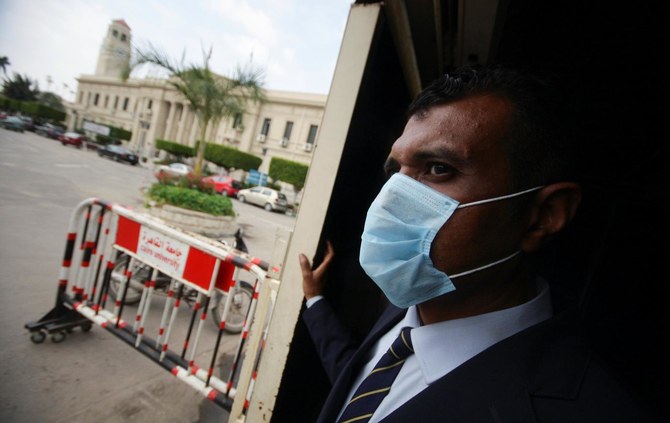
Security officer stands at Cairo University. (Reuters)
Short Url
Updated 04 October 2021
Follow

Egypt prevents students from entering universities without coronavirus vaccination certificate 

  • Ministry spokesman, Adel Abdel Ghaffar, said that the ministry had equipped more than 300 centers to vaccinate students

CAIRO: The Egyptian ministry of higher education has announced that students cannot enter universities or university dormitories without a certificate proving that they have had the coronavirus vaccine.

Ministry spokesman, Adel Abdel Ghaffar, said that the ministry had equipped more than 300 centers to vaccinate students.

“Technical teams and awareness teams are scattered in various Egyptian universities,” he said. Students could get the vaccine on the same day if they went to youth centers providing the vaccination service.

“The vaccination is available at the level of the various governorates of the republic for free,” Abdel Ghaffar said. Students could receive the vaccine in university hospitals, he said.

The spokesman said that was no excuse for students not having the vaccine. “Universities are strict in this matter to ensure safety within all universities, and universities take measures that determine whether the student receives the vaccine or not,” he said.

Mohamed Awad Taj El-Din, adviser to the Egyptian president for health and prevention affairs, said that the possibility of postponing study in light of the increase in infections in the country would be considered depending on the circumstances. The Egyptian supreme committee for the management of the coronavirus was closely following developments related to the virus, he said.

Taj El-Din said that Egyptian President Abdel Fattah El-Sisi was closely following the issue of vaccinating teaching staff, workers and employees in universities and schools, as well as university students, and said that a large number of these people had received the vaccine.

Tariq Shawky, the Egyptian minister of education and technical education, confirmed that education was taking place in person in schools, with the application of precautionary measures to contain the coronavirus.


Syria Kurds impose curfew in Qamishli ahead of govt forces entry

Updated 58 min 34 sec ago
Follow

Syria Kurds impose curfew in Qamishli ahead of govt forces entry

  • The curfew came after Syrian security personnel entered the mixed Kurdish-Arab city of Hasakah and the countryside around the Kurdish town of Kobani on Monday

QAMISHLI: Kurdish forces imposed a curfew on Kurdish-majority Qamishli in northeastern Syria on Tuesday, ahead of the deployment of government troops to the city, an AFP team reported.
The curfew came after Syrian security personnel entered the mixed Kurdish-Arab city of Hasakah and the countryside around the Kurdish town of Kobani on Monday, as part of a comprehensive agreement to gradually integrate the Kurds’ military and civilian institutions into the state.
The Kurds had ceded territory to advancing government forces in recent weeks.
An AFP correspondent saw Kurdish security forces deployed in Qamishli and found the streets empty of civilians and shops closed after the curfew came into effect early on Tuesday.
It will remain in force until 6:00 am (0300 GMT) on Wednesday.
The government convoy is expected to enter the city later on Tuesday and will include a limited number of forces and vehicles, according to Marwan Al-Ali, the Damascus-appointed head of internal security in Hasakah province.
The integration of Kurdish security forces into the interior ministry’s ranks will follow, he added.
Friday’s deal “seeks to unify Syrian territory,” including Kurdish areas, while also maintaining an ongoing ceasefire and introducing the “gradual integration” of Kurdish forces and administrative institutions, according to the text of the agreement.
It was a blow to the Kurds, who had sought to preserve the de facto autonomy they exercised after seizing vast areas of north and northeast Syria in battles against Daesh during the civil war, backed by a US-led coalition.
Mazloum Abdi, head of the Kurdish-led Syrian Democratic Forces (SDF), had previously said the deal would be implemented on the ground from Monday, with both sides to pull forces back from frontline positions in parts of the northeast, and from Kobani in the north.
He added that a “limited internal security force” would enter parts of Hasakah and Qamishli, but that “no military forces will enter any Kurdish city or town.”