ISLAMABAD: Pakistan’s participation in Expo 2020 Dubai will renew its ties with the United Arab Emirates, Islamabad’s envoy to the UAE said on Sunday.
The first world fair to be held in the Middle East, Expo 2020 Dubai opened on Friday. Delayed by one year, the event aims to attract 25 million visitors over the next six months.
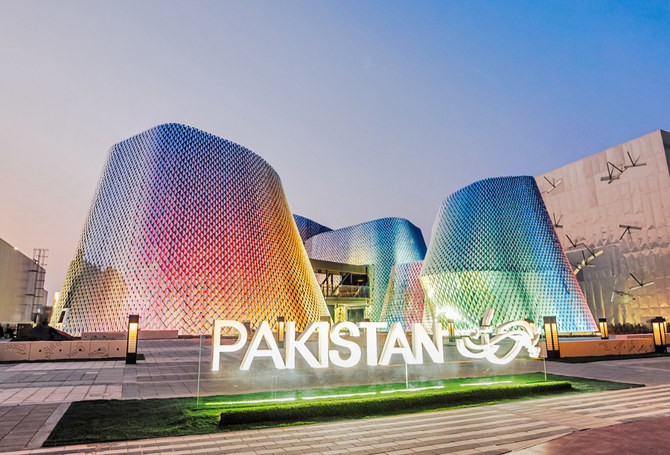
Pakistan is one of over 190 countries showcasing their cultures and innovations inside pavilions on the 438-hectare exhibition site.
“Our participation would renew closer connection and effective interaction between our two countries,” Ambassador Afzaal Mahmood said in an interview with Emirates News Agency (WAM).
“Through Pakistan Pavilion, we wish to invite the international community to learn about our nation, visit Pakistan for tourism and do business with our country,” he said.
On the first day of the exhibition, WAM said, the Pakistani pavilion was visited by some 8,000 people.
Themed “Connecting Minds, Creating the Future,” Expo 2020 Dubai is divided into three sub-theme districts: Opportunity, Mobility and Sustainability. The Pakistani pavilion is in the Opportunity area.
Themed “Pakistan: The Hidden Treasure,” it was built with $14 million funding support from the UAE and inaugurated by the Pakistani prime minister’s adviser on commerce and investment, Abdul Razak Dawood in March.
“It will serve as the hub of business opportunities and promoting our 7,000 years old culture,” Dawood said at the time, adding that Pakistan expects Expo 2020 to give the Pakistani business community “access to networking with the international market and investors.”

Pakistan’s participation in Expo 2020 to ‘renew’ ties with UAE — envoy
https://arab.news/9ggvx
Pakistan’s participation in Expo 2020 to ‘renew’ ties with UAE — envoy
- Expo 2020 Dubai, hosting exhibitors from 200 countries, starts on Friday after delay of a year due to the pandemic
- Pakistan’s pavilion, themed “Pakistan: The Hidden Treasure,” is located in the Opportunity area of the exhibition site
Pakistan says illegal immigration to Europe down 47 percent amid major crackdown
- Over 1,700 human smugglers arrested nationwide this year, interior ministry says
- EU praises Pakistan’s efforts as Brussels, Islamabad agree to deepen cooperation
ISLAMABAD: Pakistan has achieved a 47 percent drop in illegal immigration to Europe this year, with more than 1,700 human smugglers arrested as part of an expanded nationwide crackdown, the interior ministry said on Thursday.
The announcement followed Interior Minister Mohsin Naqvi’s meeting in Brussels with European Union Commissioner for Home Affairs and Migration Magnus Brunner, where both sides discussed efforts to curb human smuggling and strengthen migration cooperation.
Pakistan intensified action against illegal migration in 2023 after hundreds of migrants, including 262 Pakistanis, drowned when an overcrowded vessel sank off the Greek town of Pylos, one of the deadliest boat disasters in the Mediterranean. Authorities say they continue to target networks sending citizens abroad through dangerous routes, following heightened scrutiny at airports and a series of arrests involving forged documents.
“Commissioner Magnus Brunner paid strong tribute to the Government of Pakistan for achieving a 47 percent reduction in attempts to reach Europe through illegal ‘dunki’ routes during the past year and described Pakistan’s measures as exemplary,” the interior ministry said in a statement.
“Dunki routes” refer to irregular migration paths used by smugglers to move people across multiple borders toward Europe, the United Kingdom and the United States.
Pakistani authorities say the routes are controlled by transnational criminal networks that also engage in document fraud and other illicit activities.
“Mohsin Naqvi stated that 1,770 human smugglers and their agents have been arrested in Pakistan this year, which clearly reflects the government’s zero-tolerance policy against illegal immigration,” the interior ministry said.
It added that Pakistan and the EU agreed to coordinate future strategies against illegal immigration, human smuggling and drug trafficking, including deeper information-sharing between law enforcement bodies. Brunner would soon visit Pakistan to acknowledge the country’s efforts and discuss next steps in reducing irregular migration flows, the statement said.
It also quoted Naqvi as saying that the nexus between smuggling networks, drug mafias and militant groups posed a major challenge to Pakistan and required “international cooperation to confront it.”
Earlier in December, Pakistan announced it would roll out an AI-based immigration screening system in Islamabad from January next year to detect forged travel documents and prevent illegal departures.
In September, Pakistan’s Federal Investigation Agency released a list of more than 100 of the country’s “most wanted” human smugglers as part of its ongoing nationwide operation, identifying major hubs of trafficking activity across Punjab and the capital.