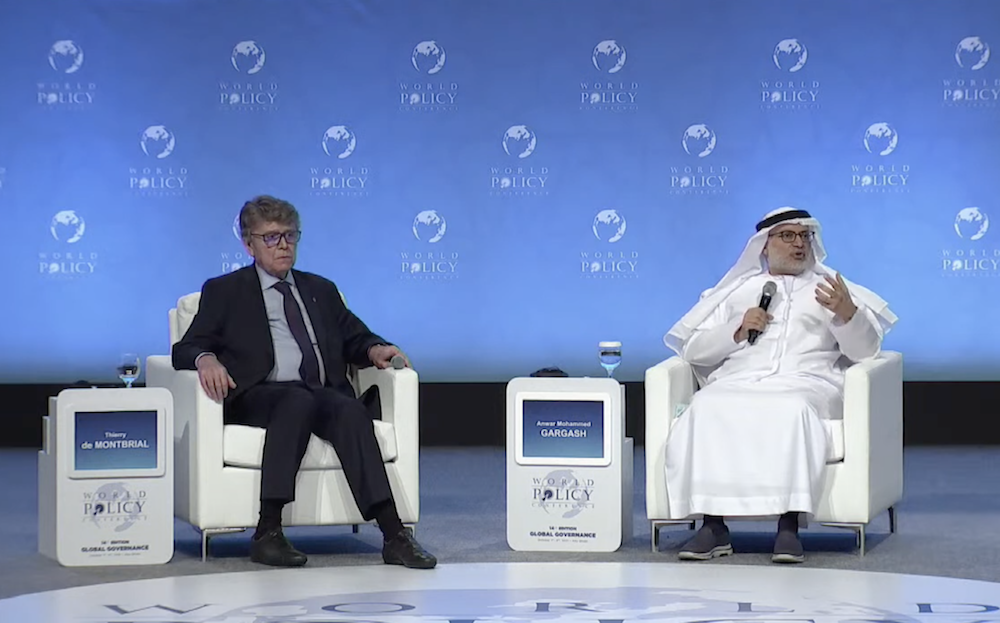
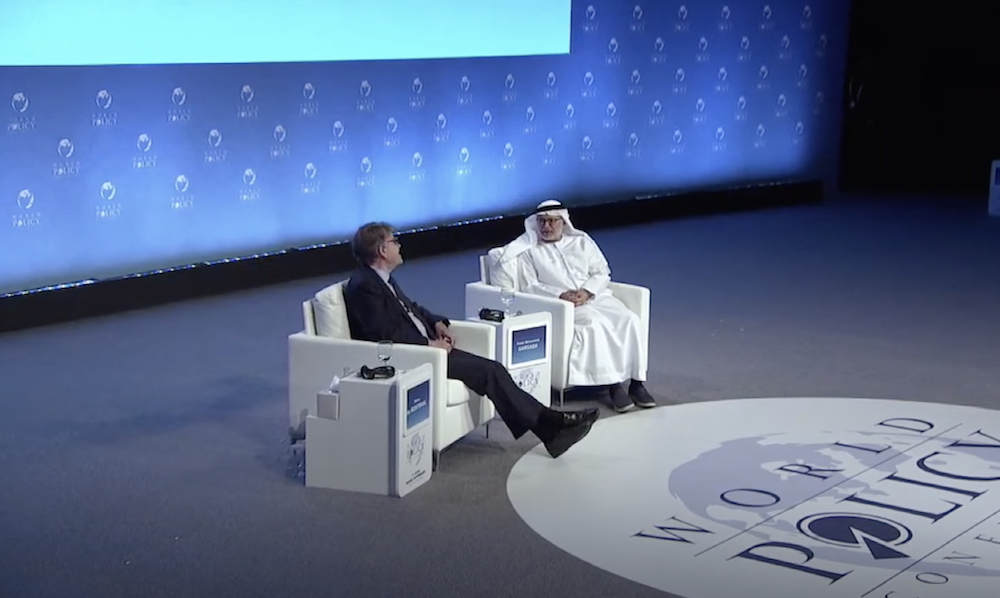
ABU DHABI: Economic and strategic competition between the US and China is putting immense pressure on the Arab Gulf states, a top Emirati official told delegates on the second day of the 14th World Policy Conference in Abu Dhabi.
Anwar Gargash, the UAE’s presidential diplomatic adviser and former minister of state for foreign affairs, said the geopolitical rivalry is forcing countries in the region to make impossible choices concerning their strategic and business partnerships.
Gargash urged the international community to speak up against such pressure and not to become pawns in a new Cold War. “I think if this message comes across to the Chinese, to the Americans and to others, this will create what I would call a moral collective,” he said on Saturday.
“We’re all worried, very much, by a looming Cold War. That is bad news for all of us because the idea of choosing is problematic in the international system, and I think this is not going to be an easy ride.”
The UAE and other Arab Gulf countries have long been close US allies. However, China has since emerged as a powerful economic player in the region and its thirst for crude oil has made it the Gulf’s biggest buyer, presenting nations such as the UAE with a dilemma.
“This is going to be a big challenge for all of us,” Gargash said. “For us here in the UAE, the United States is our predominant strategic partner but China is our number one or two — with India — economic partner.”
Although the Chinese offer lucrative opportunities for trade and business partnerships, Gargash hinted the UAE considers the Americans a more transparent strategic ally.
“China will continue to be extremely important,” Gargash said. “While America’s direction is something you can glean from various readings and conferences and discussions, understanding China’s direction, I think, is more opaque.”
What began as a trade war over China’s economic policies has since evolved into a clash between differing ideologies, leading to mounting tensions in the South China Sea and schisms between the US and its traditional European allies.
US-China bilateral relations nosedived in 2018 when President Donald Trump imposed punitive tariffs on China. This was followed by restrictions on China’s access to US tech products and foreign investments involving security concerns and by allegations of unfair Chinese commercial practices.
President Joe Biden has since amplified his predecessor’s policies by strengthening anti-China alliances and implementing additional sanctions. Borrowing from the Cold War playbook, Biden has characterized the US-China conflict as “a battle between the utility of democracies in the 21st century and autocracies.”
Analysts believe US-China tensions are driven less by economic realities and more by great power rivalries — exacerbated by mutual mistrust over each other’s strategic aims.
Gargash pointed to the impact of the COVID-19 pandemic on international affairs, arguing it demonstrated the need for greater cooperation rather than confrontation.
“We are really seeing several dimensions to the changes in the international system,” he said. “I think, on the one hand, the pandemic makes it very, very clear that our geostrategic priorities need not only be political … but it can be about other issues.
“It will need from all of us an understanding … that confrontation is not the way forward, and communication is the way forward.
“It doesn’t mean that we will be able to change Iran’s perception of its role in the region, or Turkey’s perception of its role in the region, or how we see the Arab world and how it should come back to a more lively regional system. But at the same time I think we need to also understand that it is extremely important that we avoid confrontations.”