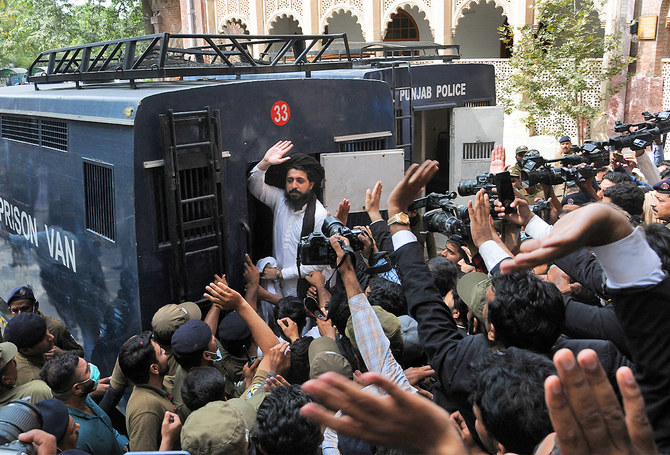
ISLAMABAD: Saad Rizvi, chief of the banned Tehreek-e-Labbaik Pakistan (TLP) religious party, is expected to be released early next week after a high court approval of a petition against his prolonged detention, the TLP leader’s lawyer said on Saturday.
Rizvi was arrested in Lahore in April for threatening the government with rallies if it did not expel the French envoy to Islamabad over cartoons of the Prophet Muhammad (pbuh) published in France last year.
Violent demonstrations by TLP supporters erupted in major cities after his arrest. Six policemen were killed and over 800 injured, according to official figures, in protests that lasted a week.
The Lahore High Court (LHC) on Friday approved a petition filed by Rizvi’s uncle against his continued detention under Pakistan’s antiterrorism laws.
“We are hopeful for Saad Rizvi’s release on Monday as the court’s written order will reach the relevant departments on first working day of the week,” Advocate Burhan Moazzam Malik, who represents Rizvi, told Arab News.
He said the court had declared the TLP leader’s detention illegal in its detailed judgment but a written order for the verdict’s implementation is awaited.
“The government failed to provide any plausible reason in the court to detain him under the Anti-Terrorism Act, 1997,” Malik said. “The right to protest is enshrined in the constitution.”
Rizvi has been detained at Kot Lakhpat Jail in Lahore, which is managed by the provincial government of Punjab. Punjab Prisons Minister Fayyaz-ul-Hassan Chohan declined comment on the case.
TLP spokesperson Mohammad Ali said party members were expecting Rizvi to be free on Monday.
“We are a peaceful party, and we are sure our leader will be released on Monday as per the court verdict,” he told Arab News.
The party has built a wide base of support in recent years, rallying around cases of blasphemy, which are punishable by death in Pakistan.
It was banned following April’s protests.
Rizvi became the leader of TLP in November last year after the sudden death of his father, Khadim Hussein Rizvi.


![]()

Release of banned Tehreek-e-Labbaik Pakistan chief expected next week — lawyer
Short Url
https://arab.news/w5pt9
Release of banned Tehreek-e-Labbaik Pakistan chief expected next week — lawyer
- Lahore High Court (LHC) on Friday approved a petition filed by Rizvi’s uncle against his continued detention
- Saad Rizvi was arrested in Lahore in April for threatening the government with rallies if it did not expel the French envoy to Islamabad
Latest updates




© 2026 SAUDI RESEARCH & PUBLISHING COMPANY, All Rights Reserved And subject to Terms of Use Agreement.