

UAE Pavilion at Expo 2020 Dubai takes visitors on journey to explore its history and culture

1 / 2
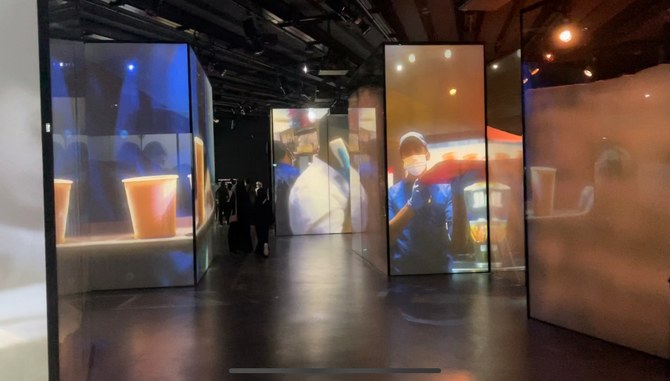
The pavilion features a series of exhibitions representing Emirati culture and explain the history of the country, as well as the story of its leaders and their vision. (AN Photo/Farah Heiba)
2 / 2
The pavilion features a series of exhibitions representing Emirati culture and explain the history of the country, as well as the story of its leaders and their vision. (AN Photo/Farah Heiba)
Short Url
Updated 01 October 2021
Follow

UAE Pavilion at Expo 2020 Dubai takes visitors on journey to explore its history and culture

  • The pavilion features a series of exhibitions representing the Emirati culture

DUBAI: A celebration of Emirati culture, as well as the country’s prosperity and growth are the main features of the UAE Pavilion at the Expo 2020 Dubai.

The pavilion showcases a series of exhibitions representing the Emirati culture, and explains the history of the country, as well as the story of its leaders and their vision.

Arab News went on a tour to explore the pavilion, the largest structure that sits at the heart of the Expo site.

The celebration of the nation starts before you even enter the pavilion - visitors pass Al-Ghaf trees planted around the building.

The drought-tolerant Al-Ghaf is the UAE’s national tree and has a historic and cultural symbol of stability and peace, which also can withstand the blistering summertime temperatures.

Inside the pavilion, visitors start their tour in a room featuring a floor with sand covered corners to reflect the country’s desert landscape.

Laser projectors displaying images and videos of the Emirate’s founding father, the late Sheikh Zayed bin Sultan Al-Nahyan, were reflected on the sand with his voice playing in the background.

In a corner of the room, named the Cross Roads Area, stands a structure decorated with lights and objects.

This structure symbolizes trade between the UAE and other countries including Africa.

Visitors then enter the next room on their journey featuring large screens showing images of the UAE culture.

Finally, people enter a theatre to watch a short animation about the Gulf country.

The audience is engaged with the usual sound and vision, but also experience a sensation of motion as their chairs move in tandem with the sites and sounds laid out before them on the screen.

The pavilion covers an area of 15,000 square meters and includes an auditorium, food and beverage outlets and VIP lounges.

Its roof structure is made up of 28 wings, which can be opened within three minutes, covering a range of 110 and 125 degrees.


Israel says Hamas ‘will be disarmed’ after group proposes weapons freeze

Updated 3 sec ago
Follow

Israel says Hamas ‘will be disarmed’ after group proposes weapons freeze

  • A top Hamas leader said on Wednesday that the militant group is open to a weapons “freeze,” but rejects the demand for disarmament

DOHA: Israel said on Thursday that Hamas “will be disarmed” as part of the US-sponsored peace plan for Gaza, after a top leader from the Islamist movement suggested a weapons freeze.
“There will be no future for Hamas under the 20-point plan. The terror group will be disarmed and Gaza will be demilitarised,” the Israeli official told AFP.
Hamas’s Khaled Meshaal told Qatari news channel Al Jazeera on Wednesday that the militant group is open to a weapons “freeze,” but rejects the demand for disarmament put forward in US President Donald Trump’s plan for Gaza.

A top Hamas leader told Qatari news channel Al Jazeera on Wednesday that the militant group is open to a weapons “freeze,” but rejects the demand for disarmament put forward in the US-sponsored peace plan for Gaza.
“The idea of total disarmament is unacceptable to the resistance (Hamas). What is being proposed is a freeze, or storage (of weapons)... to provide guarantees against any military escalation from Gaza with the Israeli occupation,” said Khaled Meshaal in an interview aired Wednesday.
“This is the idea we’re discussing with the mediators, and I believe that with pragmatic American thinking... such a vision could be agreed upon with the US administration,” he said.
The US-sponsored ceasefire deal, in effect since October 10, halted the war that began after Hamas’s deadly attack on Israel on October 7, 2023. But it remains fragile as Israel and Hamas accuse each other almost daily of breaches.
The agreement is composed of three phases. Israeli Prime Minister Benjamin Netanyahu recently indicated that it was about to enter the second phase.
Under that phase Israeli troops would further withdraw from their positions in Gaza and be replaced by an international stabilization force (ISF), while Hamas would lay down its weapons.
Netanyahu is expected to meet with US President Donald Trump in the US later this month to discuss the steps forward in the truce.
But the Palestinian militant group has indicated it would not agree to giving up its arsenal.
“Disarmament for a Palestinian means stripping away his very soul. Let’s achieve that goal another way,” Meshaal added.
In the first phase of the deal Palestinian militants committed to releasing the remaining 48 living and dead captives held in the territory. All of the hostages have so far been released except for one body.
In exchange, Israel has released nearly 2,000 Palestinian prisoners in its custody and returned the bodies of hundreds of dead Palestinians.
As for the international peacekeeping force, Meshaal said the group was open to its deployment along Gaza’s border with Israel, but would not agree to it operating inside the Palestinian territory, calling such a plan an “occupation.”
“We have no objection to international forces or international stabilization forces being deployed along the border, like UNIFIL,” he said, referring to the UN peacekeeping force deployed in southern Lebanon near the Israeli border.
“They would separate Gaza from the occupation,” he added, referring to Israel.
“As for the presence of international forces inside Gaza, in Palestinian culture and consciousness that means an occupying force.”
Mediators as well as Arab and Islamic nations, he said, could act as “guarantors” that there would be no escalation originating from inside Gaza.
“The danger comes from the Zionist entity, not from Gaza,” he added, referring to Israel.