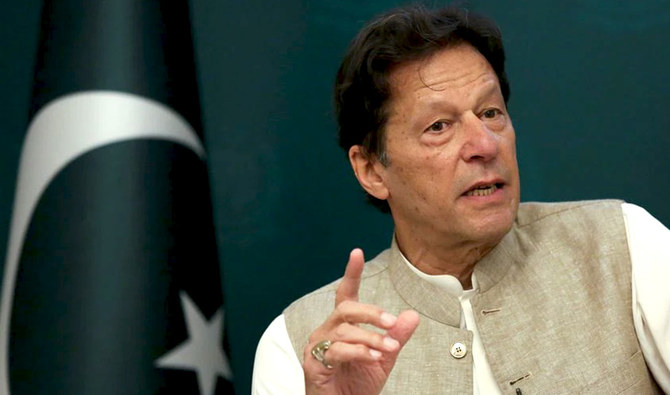
ISLAMABAD: Prime Minister Imran Khan told an international media organization on Friday his administration was negotiating with some factions of the proscribed Tehreek-e-Taliban Pakistan (TTP) militant network, adding he was not in favor of military solution as a politician.
President Arif Alvi and Foreign Minister Shah Mahmood Qureshi announced last month the government was willing to offer amnesty to TTP members if they laid down their arms, abandoned extremist ideology and adhered to the country’s constitution.
However, the militant network issued a statement in response, saying it was proud of its “struggle” while adding that its members were not seeking forgiveness from anyone.
“The Pakistan Taliban groups actually want to talk to our government for some peace and reconciliation,” the prime minister told an international news channel. “And we are in talks with some of the groups.”
Asked if the Afghan Taliban were facilitating the dialogue process, he simply responded that the talks were taking place in Afghanistan.
Khan said his government was willing to forgive members of the proscribed network once they laid down their arms.
“They will become normal citizens,” he continued.
The prime minister was hopeful a deal was likely to come out of the negotiation process, though it was not clear from a brief interview excerpt shared on the social media who was leading the talks from the Pakistani side, what were the TTP demands, and how soon was a breakthrough expected.
“I do not believe in military solutions,” Khan added. “I always believe as a politician that political dialogue is the way ahead which I always thought was the case with Afghanistan.”
TTP, a conglomerate of several armed factions, was banned soon after its emergence in Pakistan’s tribal areas in 2007 since it started killing Pakistani civilians and security forces.
Inspired by Al Qaeda ideology, it targeted the army headquarters in Rawalpindi and massacred more than 100 children at a school in Peshawar.
The network also took responsibility for shooting Malala Yousafzai, who later became the world’s youngest Nobel laureate, in her hometown, Swat, for advocating girls’ education.
Asked why the TTP was attacking the Pakistani security forces while negotiating with the government to secure a settlement, Khan said: “I think it was just a spate of attacks, but we are talking. [However,] we might not reach some sort of a conclusion.”


![]()

PM says government negotiating with Pakistani Taliban as militants continue attacks
Short Url
https://arab.news/njkbz
PM says government negotiating with Pakistani Taliban as militants continue attacks
- The prime minister tells an international news channel TTP militants will become ‘normal citizens’ after laying down arms
- Tehreek-e-Taliban Pakistan said in a statement last month it was proud of its ‘struggle’ and was not seeking forgiveness from anyone
Latest updates


Recommended


© 2026 SAUDI RESEARCH & PUBLISHING COMPANY, All Rights Reserved And subject to Terms of Use Agreement.