

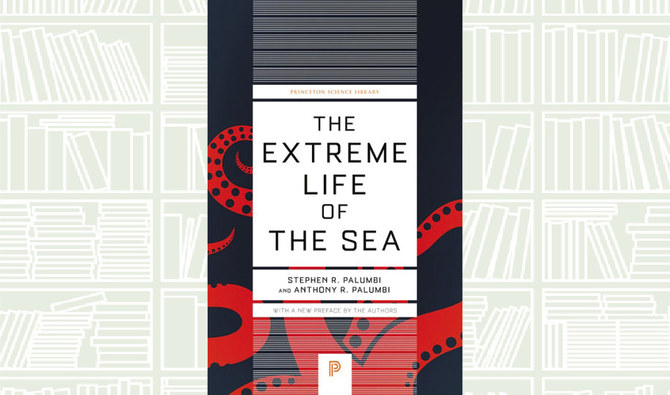
What We Are Reading Today: The Extreme Life of the Sea

Short Url
Updated 01 October 2021
Follow

What We Are Reading Today: The Extreme Life of the Sea

Authors: Anthony R. Palumbi & Stephen R. Palumbi

The ocean teems with life that thrives under difficult situations in unusual environments. The Extreme Life of the Sea takes readers to the absolute limits of the ocean world—the fastest and deepest, the hottest and oldest creatures of the oceans.
It dives into the icy Arctic and boiling hydrothermal vents—and exposes the eternal darkness of the deepest undersea trenches—to show how marine life thrives against the odds. This thrilling book brings to life the sea’s most extreme species, and tells their stories as characters in the drama of the oceans. Coauthored by Stephen Palumbi, one of today’s leading marine scientists, The Extreme Life of the Sea tells the unforgettable tales of some of the most marvelous life forms on Earth, and the challenges they overcome to survive. Modern science and a fluid narrative style give every reader a deep look at the lives of these species.
The Extreme Life of the Sea shows you the world’s oldest living species. It describes how
flying fish strain to escape their predators, how predatory deep-sea fish use red searchlights only they can see to find and attack food.


What We Are Reading Today: The Political Economy of Security by Stephen G. Brooks

Updated 04 March 2026
Follow

What We Are Reading Today: The Political Economy of Security by Stephen G. Brooks

In this book, Stephen Brooks provides a systematic empirical and theoretical examination of how economic factors influence security affairs. Empirically, he analyzes how economic variables of all kinds affect interstate war, terrorism, and civil war; in total, 16 pathways are examined.

Brooks shows that the relationship between economic factors and conflict is complex and multifaceted; discrete economic factors—such as international trade, economic development, and globalized manufacturing, to name a few—are sometimes helpful for promoting peace and stability, but at other times are detrimental.

Brooks also develops a stronger theoretical foundation for guiding future research on the economics-security interaction. 

Drawing on Adam Smith, he provides a more complete range of answers to the three key conceptual questions analysts must consider: how economic goals relate to security goals; what economic factors to focus on; and how economic actors influence security policies.

Combining an innovative theoretical understanding with empirical rigor, Brooks’s account will reshape our understanding of the political economy of security.