

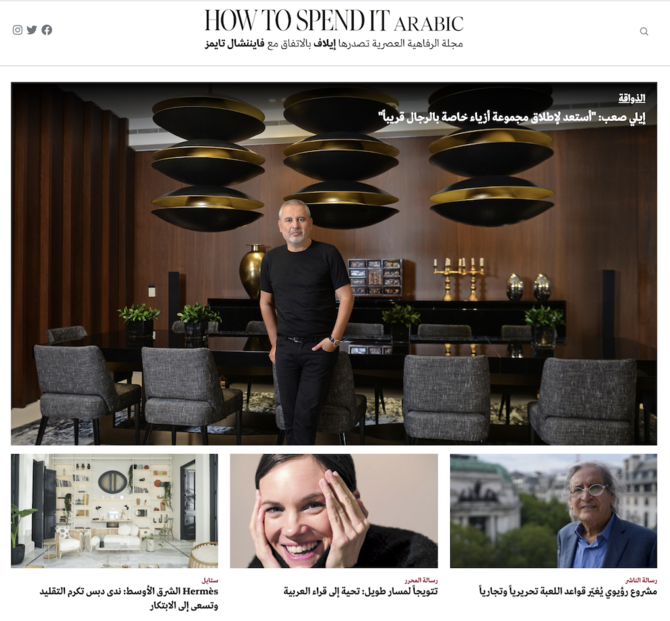
Elaph, Financial Times launch first issue of How To Spend It Arabic 

HTSI Arabic’s first issue will be available in Saudi Arabia, the UAE, and Qatar on Oct. 1, and later in Morocco, Kuwait, Egypt, Bahrain, and Jordan. (Screenshot)
Short Url
Updated 30 September 2021
Follow

Elaph, Financial Times launch first issue of How To Spend It Arabic 

  • The new edition, that will also be available online, was unveiled at a special event held in London on Tuesday

LONDON: Independent online newspaper Elaph and the Financial Times have launched the debut issue of How To Spend It Arabic magazine.

The new edition, that will also be available online, was unveiled at a special event held in London on Tuesday.

Othman Al-Omeir, founder and editor-in-chief of Elaph and publisher of HTSI Arabic, said: “I believe that this special journalistic enterprise will succeed because it is different from any other publication as it combines two languages.

“I am very much proud of the efforts made by the teams of the Financial Times, How To Spend It, and Elaph, to make this special project come into being.”

The English-language HTSI is an award-winning luxury magazine from FT Weekend that presents themed issues on fashion, interiors, art, travel, and lifestyle.

The Arabic-language version will bring top content related to these themes, geared toward Arab audiences. The result will be a mix of translated material from HTSI as well as exclusive original content.

HTSI editor, Jo Ellison, said that the fast-paced economic developments taking place in the Gulf region, “makes us reconsider our concepts about luxury markets and consumer markets, especially as the Gulf states have become key tourist destinations.”

She added: “This launch aligns with the FT’s wider strategy of growing its brand reach through enhanced reader engagement.

“The Arabic-speaking world represents an important readership for HTSI and the combination of the FT’s HTSI editorial with original content from Elaph represents a bespoke offering for those readers who seek out unique lifestyle features and themes.”

Samar Abdul Malik, editor of HTSI Arabic, said the magazine would offer unique content to readers and “shed light on the world of luxury, on everything related to luxurious lifestyle, in both the Middle East and North Africa and the rest of the world.”

HTSI Arabic’s first issue will be available in Saudi Arabia, the UAE, and Qatar on Oct. 1, and later in Morocco, Kuwait, Egypt, Bahrain, and Jordan.


Meta to charge Arab advertisers extra fee for reaching European audiences

Updated 11 March 2026
Follow

Meta to charge Arab advertisers extra fee for reaching European audiences

  • US tech giant told advertisers it will add fees ranging from 2 to 5 percent on image and video ads delivered on its platforms to offset digital service taxes
  • Charges are determined by where the audience is located, not where the advertiser is based

LONDON: Meta will from July 1 impose location-based surcharges on advertisers targeting audiences in six European countries, a move that will directly affect Arab businesses that run campaigns across the continent.

The US tech giant announced it will add fees ranging from 2 to 5 percent on image and video ads delivered on its platforms, including Facebook, Instagram and WhatsApp, to offset digital service taxes imposed by individual governments.

Crucially, the charges are determined by where the audience is located, not where the advertiser is based.

That means Saudi, Emirati, Egyptian or other Arab companies paying to reach consumers in the UK, France or Italy will face the additional costs regardless of their own country’s tax arrangements with Meta.

Fees will apply at 2 percent for ads reaching UK audiences, 3 percent for France, Italy and Spain, and 5 percent for Austria and Turkiye.

“If you deliver $100 in ads to Italy, where there is a 3% location fee, you will be charged $100 (ad delivery), plus $3 (location fee), for $103 total,” the company wrote in an email to an advertiser initially reported by Bloomberg. “Note that any applicable VAT will be calculated on top of the total amount.”

The taxes have been introduced at different points, starting with France in 2019, though not the EU as a bloc.

Many tech companies report substantial sales in Europe and millions of users but pay minimal tax on profits. The goal is to claw back locally derived economic value, Bloomberg reported.

The move follows similar decisions by Google and Amazon, which have also begun passing European digital tax costs on to advertisers.

For Arab brands with growing European footprints, particularly in fashion, travel, hospitality and media, the new fees add another layer of cost to campaigns already subject to currency and targeting complexities.

Digital services taxes, levied as a percentage of revenues earned by major tech platforms in individual countries, have drawn criticism from Washington, which argues they unfairly target US companies.

Meta has been reached for comments.