- Senator Shibli Faraz says the country will introduce its first national hemp policy in the next four to six months
- Last year, UN voted to remove cannabis for medicinal purposes from list of dangerous drugs
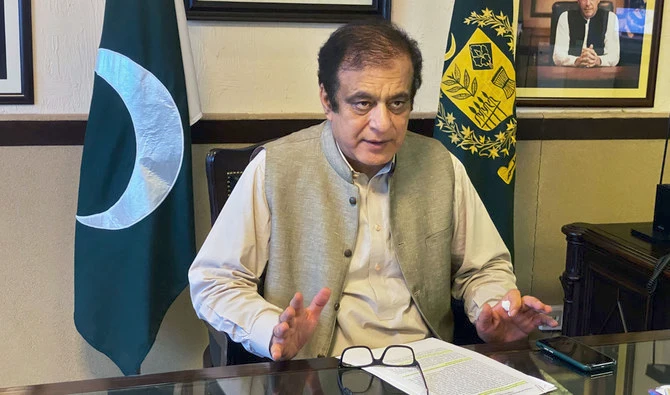
ISLAMABAD: Pakistan’s Minister for Science and Technology Senator Shibli Faraz said on Thursday his government would boost industrial hemp production to diversify its exports and benefit from a lucrative global market for the product.
The government approved industrial hemp production and legalized its farming in September 2020.
Hemp is a type of cannabis plant, used commonly for medicinal purposes due to its cannabidiol (CBD) concentration.
Pakistani officials hope hemp production will help local farmers tap into the global $400 billion cannabis market and increase the country’s export revenue.
“Hemp plantation and production will help diversify our exports to the international market,” Faraz said while inaugurating an initiative at the Arid Agriculture University in Rawalpindi to boost the production of the plant. “Pakistan wants to become part of the billions of dollars of hemp industry by introducing its own quality product.”
The minister added the government was going to present a national hemp policy in the next four to six months to increase its cultivation and production for industrial and medicinal usage.
Faraz said that foreign investors could also participate in hemp production in Pakistan once its cultivation and harvesting took off.
“We need to work on its quality seeds and topnotch extraction process to sell it in the international market,” he continued.
The government’s decision to boost hemp production came after a UN commission voted to remove cannabis made for medicinal purposes from the category of the world’s most dangerous drugs last year.
Experts maintain the UN decision will further strengthen medical research on hemp and legalize it across the world.
Professor Dr. Qamaruz Zaman, vice-chancellor at the Arid Agriculture University in Rawalpindi, said his institution had already launched at least Rs3 billion of programs with local industries to benefit from the opportunity.
He recalled that Prime Minister Imran Khan had given a go-ahead for hemp plantation last year after a detailed briefing on its advantages and export potential.
“We will be planting it on hundreds of acres in the next couple of years as all initial work on the project is complete,” he said.
Dr. Syed Hussain Abidi, chairman of the Pakistan Council of Scientific and Industrial Research (PCSIR), said many countries had already legalized hemp production for its numerous industrial and medicinal benefits and Pakistan was also struggling to become part of the global industry.
“We will be supporting all the research work required for hemp plantation, harvesting and processing for export,” he informed.