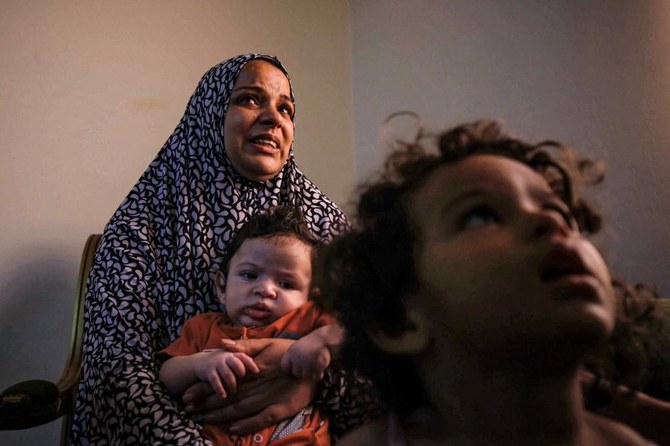
BEIRUT: More than 1 million Syrian refugees in crisis-hit Lebanon are experiencing deteriorating conditions that have left nine out of ten of them in extreme poverty, UN agencies warned Wednesday.
The worsening conditions come despite increased assistance for Syrians living in Lebanon, where one in four people is a refugee. Among the Syrians, child marriage and labor is on the rise, while thousands are at risk of eviction.
The yearly report on conditions of Syrians living in Lebanon is produced by the United Nations’ refugee agency, its World Food Program, as well as its children’s agency.
The report said that the cost of an essential food basket has increased more than seven-fold since late 2019 when the financial crisis in Lebanon began to unfold. The subsistence food basket includes only 13 items, such as potatoes, bread, eggs and powdered milk. The UN describes it as the minimum to survive, “not live in dignity.”
Lebanon is experiencing a historic economic crisis that has caused the national currency to crash, losing 90 percent of its value, driving more than 55 percent of the population below the poverty line, and sending prices and unemployment soaring.
The crisis made things much worse for Syrian refugees, many of them already living in temporary housing and with low paying jobs.
Ayaki Ito, UNHCR Representative in Lebanon, warned of long-term consequences, urging stronger support for Lebanon and the refugees. “We cannot fail them now,” he said.
The UN agencies said Syrian children are bearing the brunt. School attendance for children between 6 and 14 years old dropped by 25 percent in 2021 while nearly 30 percent of children in school age have never attended. Thousands of Syrian children are engaged in child labor, and one out of five girls between the age of 15 and 19 were married, a trend that has been present for the last three years.
Syrians have escaped to Lebanon during the early years of the war in Syria which started in 2011. The Lebanese government closed the door for refugees in 2015, saying their numbers have become a burden on its government and infrastructure, but Syrians continued to arrive.
Making matters worse, almost 60 percent of Syrian refugee families are living in dangerous, substandard or overcrowded shelters, up from 50 percent last year.
The report said the increase of average rent is putting many at risk of eviction.

UN says Lebanon’s economic crisis blights Syrian refugees
Short Url
https://arab.news/mvhr3
UN says Lebanon’s economic crisis blights Syrian refugees
- The worsening conditions come despite increased assistance for Syrians living in Lebanon
- Lebanon is experiencing a historic economic crisis that has caused the national currency to crash
Iran urges US to drop ‘excessive demands’ to reach deal
- Longtime adversaries Iran and the United States held their third round of Omani-mediated nuclear talks on Thursday in Geneva
- Both Iran and Oman cited progress after the talks, with technical discussions scheduled for Monday in Vienna
TEHRAN: Iran’s Foreign Minister Abbas Araghchi said on Friday that in order to reach a deal, the United States will have to drop its “excessive demands,” after the two sides held talks in Geneva.
In a phone call with Egypt’s top diplomat Badr Abdelatty, Araghchi said “success in this path requires seriousness and realism from the other side and avoidance of any miscalculation and excessive demands.”
Araghchi did not clarify what demands he was referring to, but Washington has pointed to Iran’s ballistic missile program and has repeatedly described Tehran’s uranium enrichment capability as a red line.
US President Donald Trump said on Wednesday that Tehran had “already developed missiles that can threaten Europe and our bases overseas, and they’re working to build missiles that will soon reach the United States of America.”
Also on Wednesday, US Secretary of State Marco Rubio said Iran is “not enriching right now, but they’re trying to get to the point where they ultimately can,” adding that Tehran “refuses” to discuss its ballistic missile program and “that’s a big problem.”
Iran has repeatedly said its missile program is part of its defensive capabilities and has ruled out abandoning uranium enrichment, insisting its nuclear program is solely for peaceful purposes.
Longtime adversaries Iran and the United States held their third round of Omani-mediated nuclear talks on Thursday in Geneva, seeking to avert military escalation as Washington expands its military build-up in the region.
Both Iran and Oman cited progress after the talks, with technical discussions scheduled for Monday in Vienna ahead of a fourth round expected next week.
In a phone call with Egypt’s top diplomat Badr Abdelatty, Araghchi said “success in this path requires seriousness and realism from the other side and avoidance of any miscalculation and excessive demands.”
Araghchi did not clarify what demands he was referring to, but Washington has pointed to Iran’s ballistic missile program and has repeatedly described Tehran’s uranium enrichment capability as a red line.
US President Donald Trump said on Wednesday that Tehran had “already developed missiles that can threaten Europe and our bases overseas, and they’re working to build missiles that will soon reach the United States of America.”
Also on Wednesday, US Secretary of State Marco Rubio said Iran is “not enriching right now, but they’re trying to get to the point where they ultimately can,” adding that Tehran “refuses” to discuss its ballistic missile program and “that’s a big problem.”
Iran has repeatedly said its missile program is part of its defensive capabilities and has ruled out abandoning uranium enrichment, insisting its nuclear program is solely for peaceful purposes.
Longtime adversaries Iran and the United States held their third round of Omani-mediated nuclear talks on Thursday in Geneva, seeking to avert military escalation as Washington expands its military build-up in the region.
Both Iran and Oman cited progress after the talks, with technical discussions scheduled for Monday in Vienna ahead of a fourth round expected next week.
© 2026 SAUDI RESEARCH & PUBLISHING COMPANY, All Rights Reserved And subject to Terms of Use Agreement.


