Pakistani database authority admits minor violations as Senate report says IDs issued to militants

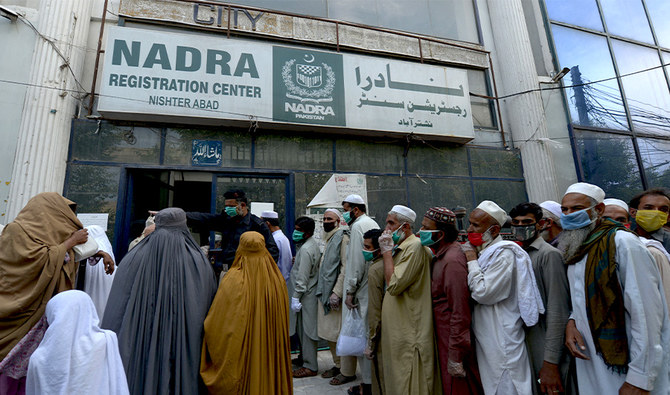
Residents wearing facemasks line up in a queue outside the National Database and Registration Authority office in Peshawar on May 4, 2020. (AFP)
Short Url
Updated 29 September 2021
Follow

Pakistani database authority admits minor violations as Senate report says IDs issued to militants

  • National Database and Registration Authority spokesman says “travesty of facts” that millions of unauthorized cards issued
  • FIA director accuses NADRA employees of helping Daesh, Pakistani Taliban militants get ID cards in exchange for bribes

KARACHI: Pakistan’s National Database and Registration Authority (NADRA) has rejected accusations that the body issued millions of unauthorized national identity cards (CNIC), including to members of banned militant outfits, calling this a “travesty of facts” but admitting to “procedural violations” in a negligible number of cases.
Last week, a report submitted by the Senate Standing Committee on Interior alleged that an Al Qaeda commander named Abdullah Baloch, who counterterrorism police say has defected to Daesh, was among several members of banned outfits who had obtained CNICs through NADRA.
The controversy began in July when a Sindh province director at the Federal Investigation Agency, Amir Farooqi, told media that up to four million CNICs had been issued to “unauthorized persons” at NADRA centers in Karachi. Farooqi also said NADRA employees had helped militants from the Tehreek-e-Taliban Pakistan (TTP), Al-Qaeda, and Baloch separatist outfits get ID cards in exchange for bribes.
According to the Senate report, 12 NADRA officials had been arrested and 29 suspended in relation to the case.
A NADRA spokesperson told Arab News the body’s chairman Tariq Malik had formed a committee to look into the FIA director’s accusations.
“Subsequently, the committee’s analysis revealed that a total 592,645 Fresh CNICs were processed from Data Acquisition Units (DAUs) located in Karachi division since 2018 till date,” the spokesperson said. “Whereas the total number of 2,370,890 fresh CNICS were processed from DAUs located in Sindh other than Karachi Division during the same period. Keeping such statistics and analysis in view, the statement issued by the Director FIA turned out to be a hyperbolic conjecture and travesty of facts.”
To a question about CNICs issued to members of banned militant groups, the NADRA spokesperson said:
“The aforesaid Committee evaluated 235,659 fresh cases out of which only 1284 cases were found suspect on account of procedural violation which is 0.54 percent of the analyzed cases.”
He said after receiving the findings of the committee, NADRA had initiated inquiries against 39 employees.
“The inquiries against the suspended employees are under process and will be concluded by the end of October,” the spokesperson said. “NADRA has devised and implemented new business rules and checks which eventually have plugged holes in the processing system.”


Sindh assembly passes resolution rejecting move to separate Karachi

Updated 21 February 2026
Follow

Sindh assembly passes resolution rejecting move to separate Karachi

  • Chief Minister Shah cites constitutional safeguards against altering provincial boundaries
  • Calls to separate Karachi intensified amid governance concerns after a mall fire last month

ISLAMABAD: The provincial assembly of Pakistan’s southern Sindh province on Saturday passed a resolution rejecting any move to separate Karachi, declaring its territorial integrity “non-negotiable” amid political calls to carve the city out as a separate administrative unit.

The resolution comes after fresh demands by the Muttahida Qaumi Movement (MQM) and other voices to grant Karachi provincial or federal status following governance challenges highlighted by the deadly Gul Plaza fire earlier this year that killed 80 people.

Karachi, Pakistan’s largest and most densely populated city, is the country’s main commercial hub and contributes a significant share to the national economy.

Chief Minister Syed Murad Ali Shah tabled the resolution in the assembly, condemning what he described as “divisive statements” about breaking up Sindh or detaching Karachi.

“The province that played a foundational role in the creation of Pakistan cannot allow the fragmentation of its own historic homeland,” Shah told lawmakers, adding that any attempt to divide Sindh or separate Karachi was contrary to the constitution and democratic norms.

Citing Article 239 of Pakistan’s 1973 Constitution, which requires the consent of not less than two-thirds of a provincial assembly to alter provincial boundaries, Shah said any such move could not proceed without the assembly’s approval.

“If any such move is attempted, it is this Assembly — by a two-thirds majority — that will decide,” he said.

The resolution reaffirmed that Karachi would “forever remain” an integral part of Sindh and directed the provincial government to forward the motion to the president, prime minister and parliamentary leadership for record.

Shah said the resolution was not aimed at anyone but referred to the shifting stance of MQM in the debate while warning that opposing the resolution would amount to supporting the division of Sindh.

The party has been a major political force in Karachi with a significant vote bank in the city and has frequently criticized Shah’s provincial administration over its governance of Pakistan’s largest metropolis.

Taha Ahmed Khan, a senior MQM leader, acknowledged that his party had “presented its demand openly on television channels with clear and logical arguments” to separate Karachi from Sindh.

“It is a purely constitutional debate,” he told Arab News by phone. “We are aware that the Pakistan Peoples Party, which rules the province, holds a two-thirds majority and that a new province cannot be created at this stage. But that does not mean new provinces can never be formed.”

Calls to alter Karachi’s status have periodically surfaced amid longstanding complaints over governance, infrastructure and administrative control in the megacity, though no formal proposal to redraw provincial boundaries has been introduced at the federal level.