

Facebook-backed subsea cables project announces extension to Arabian Gulf, Pakistan, India 

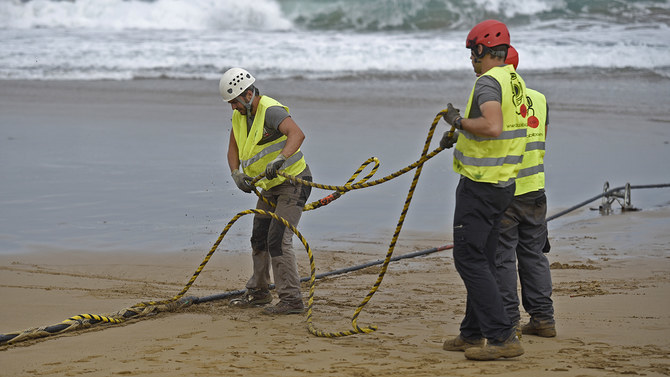
In this file photo, operators handle an undersea fiber optic cable at Arrietara beach near the Spanish Basque village of Sopelana on June 13, 2017. (AFP)
Short Url
Updated 28 September 2021
Follow

Facebook-backed subsea cables project announces extension to Arabian Gulf, Pakistan, India 

  • International submarine telecommunications cable, longest ever deployed, expected to go live in 2023-24
  • Will provide connectivity to three billion people, or about 36 percent of the global population

ISLAMABAD: The Facebook-backed 2Africa consortium will add a new segment to its submarine telecommunication cable system, extending it to the Arabian Gulf, Pakistan and India, Facebook said on Tuesday.

2Africa, a proposed international submarine telecommunications cable, is intended to circumnavigate the coastline of the continent of Africa to interconnect Europe and countries in Africa and the Middle East. It is funded by a consortium of companies comprising China Mobile International, Facebook, MTN GlobalConnect, Orange, Saudi Telecom Company (STC), Telecom Egypt, Vodafone and West Indian Ocean Cable Company (WIOCC).

The system is expected to go live in 2023-24.

“Today, we are thrilled to announce, along with regional and global partners, a new segment of subsea cable called 2Africa Pearls, which connects three continents — Africa, Europe, and Asia,” Facebook said on its website. “This extension will bring the total length of the 2Africa cable system to more than 45,000 kilometers, making it the longest subsea cable system ever deployed.”

The development is expected to increase Internet connectivity in Pakistan and the Arabian Gulf as well as India, which already ranks second on the list of countries with the highest number of Internet users in the world, according to Statista.com, a German firm that specializes in market and consumer data.

“With 2Africa, we had planned to increase connectivity to 1.2 billion people,” Facebook said. “With the addition of Pearls, the system will provide connectivity to an additional 1.8 billion people, totaling 3 billion people, or about 36 percent of the global population.”

A report published in Africanews said the cable would connect three continents, Africa, Europe and Asia terrestrially through Egypt, adding vital landing locations in Oman (Barka), UAE (Abu Dhabi and Kalba), Qatar (Doha), Bahrain (Manamah), Kuwait (Kuwait), Iraq (Al-Faw), Pakistan (Karachi), India (Mumbai), and a fourth landing in Saudi Arabia (Al Khobar).

“The new 2Africa branch joins recently announced extensions to the Canary Islands, the Seychelles, Comoros Islands, Angola, and a new landing to south-east Nigeria,” the report said. 

As with other 2Africa cable landings, the consortium said, service providers in PEARLS landings would obtain capacity at carrier-neutral facilities on a fair and equitable basis, which would support healthy Internet ecosystem development by providing greatly improved Internet accessibility.

“The past 18 months have highlighted the importance of connectivity as billions of people around the world rely on the Internet to work, attend school, and stay connected to people they care about,” Facebook said. “We continue to invest in subsea cables in Africa and beyond as communities and businesses flourish when there is widely-accessible Internet … so that everyone can benefit from the economic, educational, and social advantages of a digitally connected world.”


Pakistanis at remote border describe scramble to leave Iran

Updated 6 sec ago
Follow

Pakistanis at remote border describe scramble to leave Iran

  • Returning Pakistani nationals recount missile fire in Tehran, transport gridlock as people rush to exit Iran
  • PM Sharif condemns targeting of Iranian leader as embassies urge citizens to leave amid escalating strikes

TAFTANT, Pakistan: Pakistani nationals hauled suitcases across the border from neighboring Iran, describing missiles being launched and travel chaos as they scrambled to leave the country after the US and Israel launched strikes over the weekend.

AFP journalists saw a steady trickle of people passing through large metal gates at the remote border crossing between Iran’s Mirjaveh and Taftan in Pakistan’s western Balochistan province.

Powerful explosions have rocked Iran’s capital Tehran since Saturday, with embassies from countries around the world telling their citizens to leave.

“All our Pakistani brothers who were in Tehran and other cities had started to leave and were arriving at the terminal, which caused a lot of crowd pressure,” 38-year-old trader Ameer Muhammad told AFP on Monday.

“Due to the crowds, there were major transport problems.”

The isolated Taftan border lies around 500 kilometers (310 miles) from Balochistan’s capital and largest city, Quetta.

AFP journalists saw the Iranian flag flying at half-mast as soldiers stood guard.

Most people wheeled bulky luggage over the frontier’s foot crossing, while freight lorries formed a long line.

Irshad Ahmed, a 49-year-old pilgrim, told AFP he was staying at a hostel in Tehran when he saw missiles being fired nearby.

“There was an army base near the hostel, and we saw many missiles being fired,” he said.

“After that, we went to the Pakistani embassy so that they could evacuate us from there. They brought us here safely.”

Pakistan’s Prime Minister Shehbaz Sharif has said the killing of Ayatollah Ali Khamenei was a “violation” of international law.

“It is an age old convention that the Heads of State/Government should not be targeted,” Sharif wrote on X.

The “people of Pakistan join the people of Iran in their hour of grief and sorrow and extend the most sincere condolences on the martyrdom” of Khamenei, he added.

A teacher at Tehran’s Pakistani embassy, who gave his name as Saqib, told AFP: “Before we left, the situation was normal. The situation was not that bad.”

The 38-year-old said the strikes on Tehran on Saturday “pushed us to leave the city.”

“The situation became bad on Saturday night, when attacks caused precious lives to be lost,” he said.