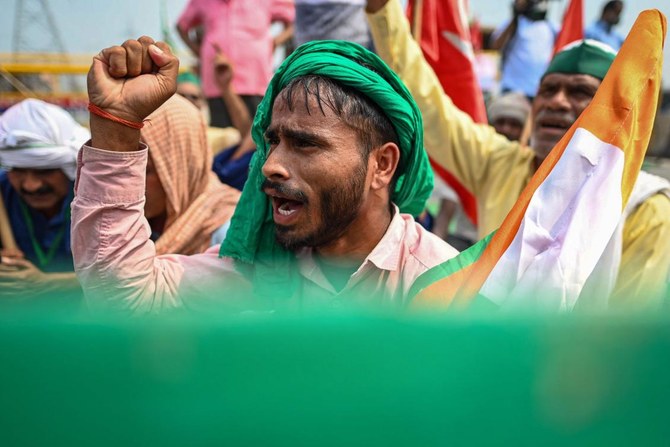

NEW DELHI: Hundreds of thousands of farmers gathered across India on Monday as part of a nationwide strike to press Prime Minister Narendra Modi’s government to repeal three controversial agricultural laws introduced a year ago.
The government says that the new measures introduced last September will help farmers to fetch better prices for their produce as they will be able to sell directly to private buyers, outside government-regulated wholesale markets.
But farmers say that the legislation will leave the sector, which employs more than 50 percent of the country’s population, with little bargaining power and at the mercy of private industrial players.
The tussle has prompted nearly ten months of farmer protests against the government, leading to the third nationwide strike on Monday, paralysing traffic and daily life in different parts of the country of 1.36 billion people.
“Through the all-India strike, I want to tell the government that not only farmers but all sections of society are with us,” Jagmohan Singh, leader of the Indian Farmers Union based in the northern state of Punjab, told Arab News.
“The government is hell-bent on selling this nation to the corporate sector, and we are not going to let this happen,” he said.
Thousands of protesters spilled onto the streets of the capital New Delhi on Monday, occupying roads and causing massive traffic jams with vehicles stuck for hours on the outskirts of the city as police officers kept guard on streets leading to the protest sites.
Neighbouring Rajasthan, too, saw life come to a standstill, with several farmers’ representatives saying that they would not back down until the laws were repealed.
“We want to tell the government — be it farmers, traders or common people — everyone is not happy with the government,” Himmat Singh Gurjar, leader of the Kisan Morcha (Farmers’ Front), told Arab News.
“We want to tell Prime Minister Modi that the whole nation is with us, and the attempt to divide farmers is not going to succeed,” he said.
Farmers fear that the laws will usher in the privatization of traditional agricultural markets, leading to market-driven pricing of products and the elimination of minimum support prices, which the government sets for certain produce every year.
“We want to tell an authoritarian government that this is not only a farmers’ agitation but a movement where common people are the stakeholders,” Suresh Koth, who heads the Bhartiya Kisan Mazdoor Union (Indian Farmers and Workers Union) in the northern state of Haryana, told Arab News.
He added that farm unions would “continue to campaign” against the ruling Bharatiya Janata Party government in the upcoming regional polls.
Key elections will be held in the five crucial states of Uttar Pradesh, Uttarakhand, Punjab, Gujarat and Goa next year. Protesters said that their rallies were a warning to Modi, whose BJP governs all states except Punjab.
“The government cannot rent out the fate of the masses to corporate houses who will enslave common people. That’s why we have called for a nationwide protest,” Koth said.
Meanwhile, the Sanyukt Kisan Morcha, a conglomeration of at least 40 farm unions leading the nationwide protests, said in a statement on Monday that a “complete shutdown” had been reported in several places with “extensive support” from other states in India.
“This response nails the lie of the government’s propaganda and shows how solidly the people of India stand with the farmers in their historic struggle,” it said.
The BJP, however, said that “vested interests” were at play in leading the protests.
“The agitation is being carried on by vested interests, and by weaving false narratives and creating fear they are able to garner some support,” BJP spokesperson Sudesh Verma told Arab News. “The government is not taking away anything from farmers but giving them an alternative route.”
Meanwhile, leader of the main opposition Congress party, Rahul Gandhi, said on Monday that the “farmers’ nonviolent resistance is still resolute, but the exploitative government does not like this, and that is why an India shutdown has been called.”
The government has held ten rounds of talks with farmers and offered to postpone the implementation of the new laws for 15 months to reach an agreement. However, the protesters have rejected the offer and continued to demand that the laws be revoked.
On Sunday, the authorities reiterated their willingness to talk with farmers, asking them “not to protest.”
“I urge farmers to adopt the path of discussion by leaving the path of protests,” Agriculture Minister Narendra Singh Tomar told the media on Sunday.
“Central government is ready to discuss any issues raised by farmers,” he said.
Political experts said that while the farmers’ agitation was initially launched to repeal the agricultural laws, it had, in turn, unified people.
“I think this is the first mass movement of farmers since India’s independence in 1947 . . . which is the longest and sustained,” Urmilesh Singh, a Delhi-based senior journalist and political analyst, told Arab News.
“The rallies are uniting people and bringing them on a single platform, thereby parting religious faultlines that the BJP tried to accentuate through its politics,” he said.
The BJP government has often been accused of causing a rise in polarization across the country by introducing discriminatory laws for non-Hindus, mainly Muslims, since assuming power in 2014.
Singh said that the farmers’ protests could impact the BJP in the upcoming polls in Uttar Pradesh, which is electorally and politically crucial for its survival, sending 80 out of 543 lawmakers to the lower house of parliament.
“I cannot say with certainty, but the agitation might impact the BJP in western Uttar Pradesh, the hub of the farmers’ movement,” Singh said.