

Indian farmers resume protests against Modi’s agriculture reforms

1 / 5
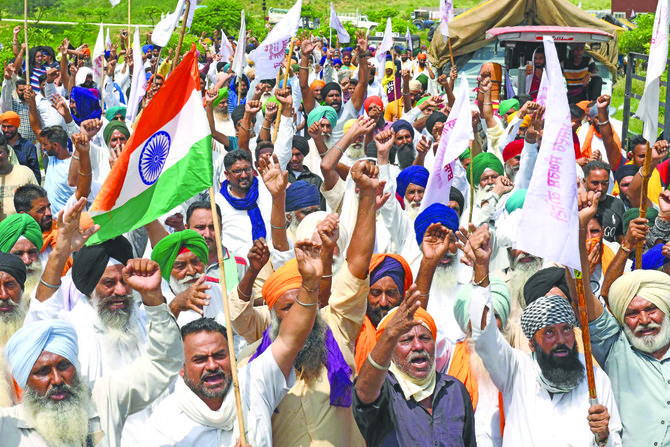
Farmers raise slogans as they make their way to Delhi to join farmers who are continuing their protest against the agricultural laws, in Beas, India. (AFP)
2 / 5
People arrive to attend a Maha Panchayat or grand village council meeting as part of a farmers' protest against farm laws in Muzaffarnagar in the northern state of Uttar Pradesh, India, September 5, 2021. (Reuters)
3 / 5
People attend a Maha Panchayat or grand village council meeting as part of a farmers' protest against farm laws in Muzaffarnagar in the northern state of Uttar Pradesh, India, September 5, 2021. (Reuters)
4 / 5
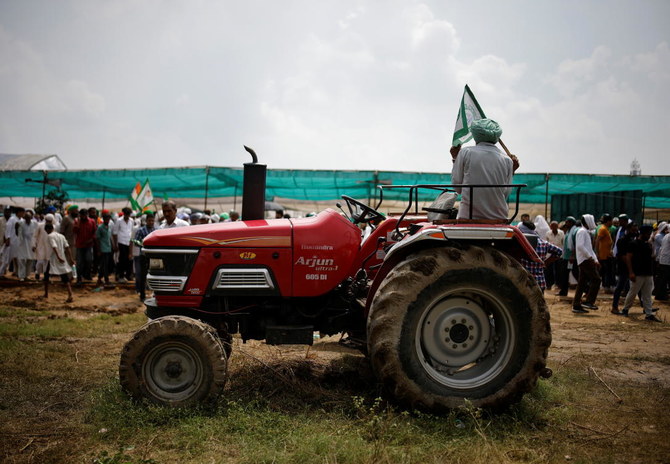
A farmer sits on a tractor as he attends a Maha Panchayat or grand village council meeting as part of a protest against farm laws in Muzaffarnagar in the northern state of Uttar Pradesh, India, September 5, 2021. (Reuters)
5 / 5
People arrive to attend a Maha Panchayat or grand village council meeting as part of a farmers' protest against farm laws in Muzaffarnagar in the northern state of Uttar Pradesh, India, September 5, 2021. (Reuters)
Short Url
Updated 06 September 2021
Follow

Indian farmers resume protests against Modi’s agriculture reforms

  • More than 500,000 farmers attended the rally in the city of Muzaffarnagar, according to local police
  • Over the past 8 months, tens of thousands of farmers have camped on highways to New Delhi to oppose the laws

NEW DELHI: More than 250,000 farmers rallied in Muzaffarnagar in India’s northern Uttar Pradesh state on Sunday in renewed protests against Prime Minister Narendra Modi’s agricultural reforms.
Farmers from Punjab, Haryana and Uttar Pradesh, where most of the country’s agriculture is concentrated and yields are high, have been protesting since September 2020, holding firm on their demand that three farm laws passed last year to open agricultural trade to private companies be scrapped.
While their demonstrations have been less intense in the past few months due to India’s deadly second wave of the coronavirus in March-May, and later the cropping season, Sunday’s rally is seen as a resumption of mass agitation, coming as local elections in Uttar Pradesh — India’s most populous state — are six months away.
“The rally today is an attempt to expand the farmers’ protest and take to different parts of Uttar Pradesh, which is going to the elections soon,” Ashutosh Mishra, leader of the All India Kisan Sangharsh Coordination Committee — an umbrella body of farmer organizations — told Arab News. “The Uttar Pradesh state is going to the polls, and we know that the BJP government works only out of election fear and we want to teach them a lesson,” he said.
“Farmers will spread out to all villages of the state and tell people to vote out the BJP if they don’t act against the three farm laws.” Uttar Pradesh is a crucial state for Indian politics, and if the BJP loses its local polls it may not succeed in the next general election.
Agriculture employs more than 200 million Indians and is the key employer of the country’s workforce.
“The BJP is arrogant and to save its corporate friends it is willing to sacrifice the farming community where 60 percent of Indians find employment,” said farmer leader Sunil Pradhan of the Bhartiya Kisan Union.
“We are left with no option but to launch an open front against the ruling party for its anti-farmer and pro-corporate policies.”
The ruling party sees the protest as “politically motivated.”
“There are people who are doing politics in the name of farmers and it is they who have opened fronts against the BJP,” BJP Uttar Pradesh spokesperson Rakesh Tripathi told Arab News.

“It is a politically motivated agitation and it’s not going to have any impact on people.”

India’s Bharatiya Janata Party government has held 10 rounds of talks with farmers since the beginning of the protests and offered to postpone the implementation of the new laws for 15 months. Protesters have rejected the offer, demanding that the laws be revoked altogether.

Tripathi said that the government was still willing to return to the negotiating table.

“The government is still open to talks,” he said. “The farmer leaders are spreading anarchy through their stubborn approach and if they want to talk with the government they should come out with an open mind and the government will engage with them.”

The resumption of mass farmer rallies may, however, prove expensive for the BJP.

“In democracy, you show your strength when you gather in large numbers. Farmers are showing their strength,” political analyst Surya Pratap Singh, based in Lucknow, the capital of Uttar Pradesh, told Arab News.

“What you are seeing in the gathering today is a reflection of anti-establishment feelings among the people,” he said. “The rally will affect the fortune of the BJP government. It might uproot the government in the next elections.”


India marks ‘significant stride’ in space sector with launch of its heaviest satellite

LVM3-M6 rocket successfully carried its heaviest ever payload to low earth orbit on Dec. 24, 2025. (ISRO)
Updated 7 sec ago
Follow

India marks ‘significant stride’ in space sector with launch of its heaviest satellite

  • Wednesday’s mission also marks India’s 100th orbital launch
  • India plans to launch its first human space mission in 2027

NEW DELHI: India launched its heaviest communication satellite on Wednesday, marking the latest feat in the country’s efforts to establish itself in the global space industry.

The Indian Space Research Organization launched a LVM-3 rocket carrying the BlueBird Block-2 satellite, which weighs over 6 tonnes, from the Satish Dhawan Space Center in Sriharikota island off the Bay of Bengal at 8:55 a.m. local time.

Codenamed LVM3-M6, the mission was the ISRO’s 100th orbital launch and involved deploying the US-built satellite in low Earth orbit.

“A significant stride in India’s space sector,” Indian Prime Minister Narendra Modi said on X soon after the mission was declared successful by the ISRO.

“It strengthens India’s heavy-lift launch capability and reinforces our growing role in the global commercial launch market.”

The BlueBird Block-2 satellite was the “heaviest payload ever launched” from Indian soil, breaking a record set by the ISRO only last month, when it launched the CMS-03 communication satellite, which weighs about 4.4 tonnes.

“The successful LVM3-M6 launch of ISRO’s heaviest commercial payload to date marks a quantum leap in India’s launch capabilities, pushing the boundaries of LVM3’s performance in low Earth orbit,” Lt. Gen. (Retd) A. K. Bhatt, director-general of the Indian Space Association, said in a statement.

The mission exemplified the Indian space agency’s capability to handle “heavier payloads that cater to the global demand for advanced satellite constellations,” he added.

Under Modi, India has been making breakthroughs in the space industry.

For the past few years, the government has been creating the environment and long-term investment for the industry to flourish and involve the private sector. The ISRO has achieved significant milestones to add to India’s status as an emerging space superpower.

The achievements include a successful space docking mission in January. And the ISRO’s Chandrayaan-3 moon rover making history in 2023 by landing on the lunar surface. This made India the first country to land near the lunar south pole and the fourth to land on the moon — after the US, Soviet Union and China.

The ISRO is planning to use a modified version of the LVM-3 rocket for its future space missions, including India’s first human spaceflight program, the Gaganyaan mission, in 2027.

Its long-term space ambitions include building a modular space facility, the Bharatiya Antariksh Station, by 2035, and sending the first Indian to the moon by 2040.