

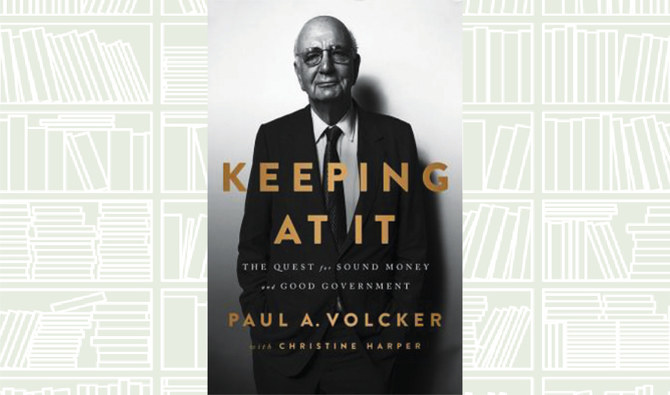
What We Are Reading Today: Keeping At It

Short Url
Updated 25 September 2021
Follow

What We Are Reading Today: Keeping At It

Edited by Paul A. Volcker and Christine Harper

The extraordinary life story of the former chairman of the Federal Reserve, whose absolute integrity provides the inspiration we need.

As chairman of the Federal Reserve (1979-1987), Paul Volcker slayed the inflation dragon that was consuming the American economy and restored the world’s faith in central bankers. That extraordinary feat was just one pivotal episode in a decades-long career serving six presidents, says a review on goodreads.com.

Told with wit, humor, and down-to-earth erudition, the narrative of Volcker’s career illuminates the changes that have taken place in American life, government, and the economy since WWII. He vibrantly illustrates the crises he managed alongside the world’s leading politicians, central bankers, and financiers. Yet he first found his model for competent and ethical governance in his father, the town manager of Teaneck, NJ, who instilled Volcker’s dedication to absolute integrity and his “three verities” of stable prices, sound finance, and good government.


What We Are Reading Today: Power and Possession in the Russian Revolution by Anne O’Donnell

Updated 09 March 2026
Follow

What We Are Reading Today: Power and Possession in the Russian Revolution by Anne O’Donnell

The revolutions of 1917 swept away not only Russia’s governing authority but also the property order on which it stood. The upheaval sparked waves of dispossession that rapidly moved beyond the seizure of factories and farms from industrialists and landowners, envisioned by Bolshevik revolutionaries, to penetrate the bedrock of social life: the spaces where people lived.

In Power and Possession in the Russian Revolution, Anne O’Donnell reimagines the Bolsheviks’ unprecedented effort to eradicate private property and to create a new political economy—socialism—to replace it.

O’Donnell’s account captures the story of property in reverse, showing how the bonds connecting people to their things were broken and how new ways of knowing things, valuing them, and possessing them coalesced amid the political ferment and economic disarray of the Revolution.