



KARACHI: The counterterrorism police in Pakistan’s southwestern Balochistan province revealed on Friday the suicide bomber who targeted Chinese nationals in Gwadar last month had come from Iran, adding that the mastermind of the attack was also the resident of Chahbahar in the neighboring country.
Pakistan’s interior minister Sheikh Rashid Ahmed said in August the attack in Gwadar was carried out by a young suicide bomber who ran toward a vehicle carrying Chinese citizens as it neared a fishermen’s colony before detonating himself.
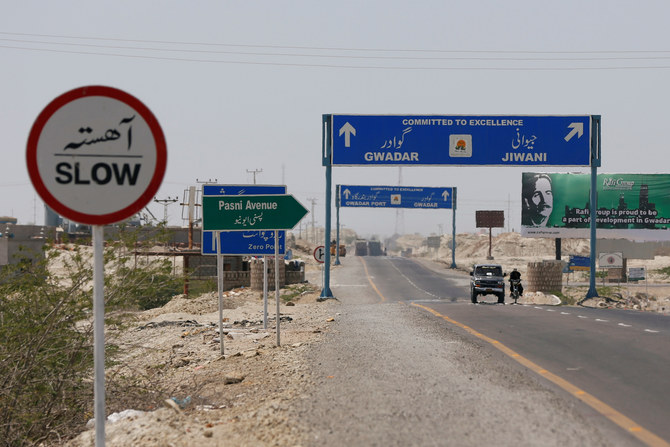
A general view of signs along a highway leading to Gwadar, Pakistan, April 12, 2017 (REUTERS)
The Chinese diplomatic mission in Islamabad also issued a statement after the incident, seeking “practical and effective measures” to ensure the safety of its workers in Pakistan.
The Counterterrorism Department (CTD) of the Balochistan police said in a statement on Friday it had arrested three members of the Balochistan Liberation Army, a proscribed separatist outfit that claimed responsibility of the Gwadar attack, adding that one of them shared details of the incident with its officials during the investigation.
“He … disclosed that Rasool Bux resident of Sheeran Chahbahar area of Iran is the mastermind of the attack,” said the statement.
It added: “Arif S/o [son of] Dur Muhammad alias Dura disclosed that his brother Ahmed transported the suicide bomber from Ramin area of Iran. He [Arif] received the suicide bomber on his arrival on [the] night [between] 10/11 August and provided a place for him to stay near [the] Customs Warehouse.”
A CTD spokesperson said officials of his department “along with a sensitive law enforcement agency” conducted an intelligence-based operation in Turbat city of Balochistan province and arrested three suspected militants who had facilitated the attack.
“On 21 September, 2021, CTD Balochistan had got a credible source information that one terrorist of … Baloch Liberation Army was present at Turbat Bazar,” the statement continued. “He intended to carry out terrorist activity on General Public, LEAs [law enforcement agencies] and Govt Installations. On this information, [a] raid was conducted and one Terrorist namely Shoaib s/o Izzat Ali R/o [resident of] Gwadar was arrested. Another raid was conducted on his pointation and two more arrests were made with recovery of explosive material.”
CTD officials said the arrested individuals also told the interrogators that Rasool Bux, the alleged mastermind of the Gwadar incident, transported four other militants who had targeted Gwadar’s Pearl Continental Hotel in 2019.
The CTD spokesperson said more raids were planned to arrest the remaining members of the network.
The Balochistan Liberation Army had issued a statement in August in which it claimed responsibility for the Gwadar suicide bombing.
According to Pakistani officials, last month’s incident killed two local children and injured a Chinese national.
It took place only a few weeks after another deadly attack that killed nine Chinese workers who were constructing a hydroelectricity dam in Pakistan’s Khyber Pakhtunkhwa province.
The Chinese diplomatic mission in Pakistan condemned the incident in Gwadar and offered its condolences to the families of victims.
It also described the security situation in Pakistan as “severe” in a statement, asking its citizens “to be vigilant [and] strengthen safety precautions.”


