
ISLAMABAD: Saudi ambassador to Pakistan Nawaf bin Said Al-Malki said on Thursday the establishment of the Saudi-Pakistani Supreme Coordination Council showed the depth and importance of the relationship between the kingdom and Islamabad.
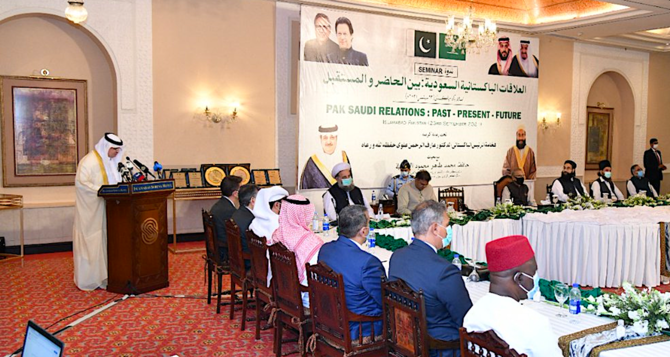
The envoy’s comments to Arab News came on the sidelines of a seminar organized in Islamabad to mark Saudi Arabia’s 91st National Day and attended by top officials including the president, information minister and national security advisor.
In February 2019, Prime Minister Imran Khan held a one-on-one meeting with Saudi Crown Prince Mohammad bin Salman in Islamabad, followed by the inaugural session of the Supreme Coordination Council, which was co-chaired by the two leaders.
The high-powered council was proposed by the crown prince during a visit by Khan to Saudi Arabia in October 2018. The objective, as the Pakistani foreign ministry announced at the time, “was to put in place a high level institutional mechanism to fast track decisions in key areas of bilateral cooperation, and for close monitoring of their implementation.”
“The agreement to establish the Saudi-Pakistani Supreme Coordination Council showed the depth and importance of the relationship between the two countries,” the Saudi envoy told Arab News, adding that a visit by Khan to Saudi Arabia this May had helped strengthen the relationship. We have always stood by Pakistan in thick and thin since its independence.”
Addressing the seminar, President Arif Alvi described Pakistan’s relations with Saudi Arabia as “exemplary,” saying that the kingdom had always helped Pakistan in difficult times and the entire Muslim world looked toward it for leadership.
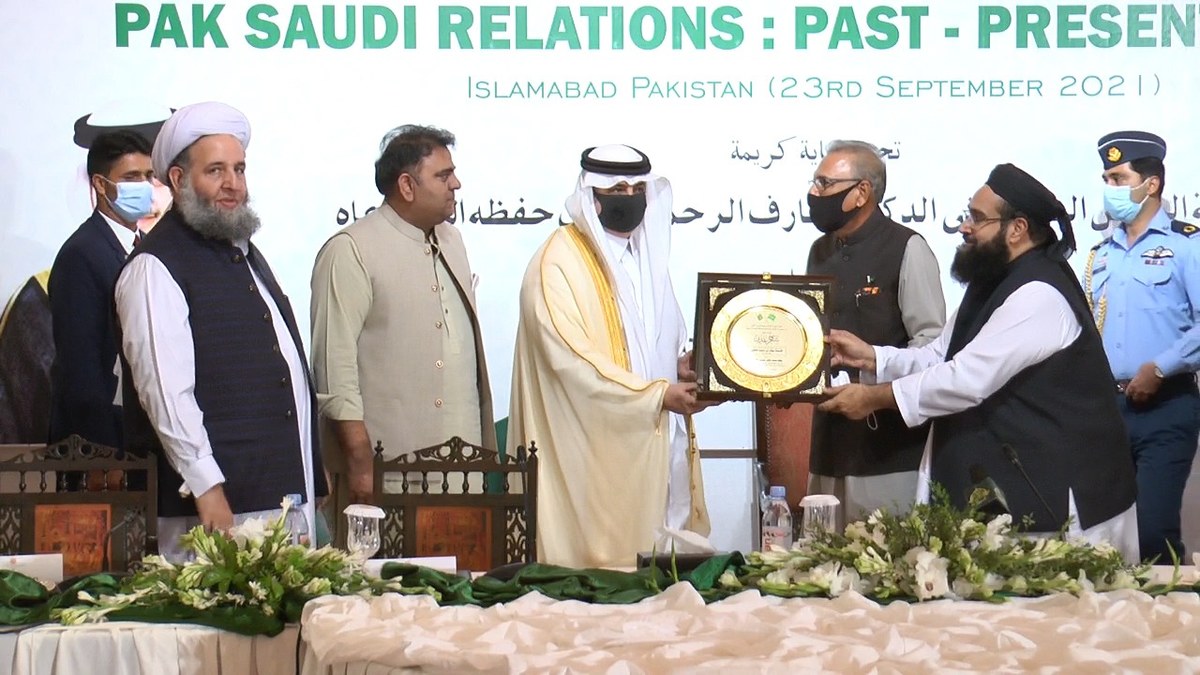
Pakistani President Arif Alvi (third from right) presents a souvenir to Saudi envoy Nawaf bin Said Al-Malki (fourth from left) at the “Pak-Saudi Relations: Past, Present and Future” in Islamabad on September 23, 2021. (Photo courtesy: Tahir Ashrafi)
“Saudi Arabia has supported Pakistan at every critical stage,” Alvi said. “The kingdom even stood by us after the nuclear tests [of May 1998] when everyone was trying to isolate us.”
“Pakistanis love every bit of the Saudi land,” he continued. “This love between the peoples of the two countries is ideological and will remain forever.”
The Pakistani president said there was an “exemplary” cooperation between the two states on all international forums.
“I feel that the whole Muslim ummah looks toward Saudi Arabia for leadership,” he said. “The kingdom has been the leader of the Muslim world and is still continuing to play that role effectively.”
Appreciating Saudi Vision 2030, a framework to reduce the kingdom’s dependence on oil and diversify its economy, Alvi said it would bring about a historical change and constitute a major turning point for the Arab country.
“Saudi vision 2030 will lead to a historic change and I pray for its success. Neom city [that plans to incorporate smart city technologies and function as a tourist destination] will be a unique place for the whole world,” he said, adding that Crown Prince Mohammed bin Salman had skillfully developed the vision for the future of his kingdom.
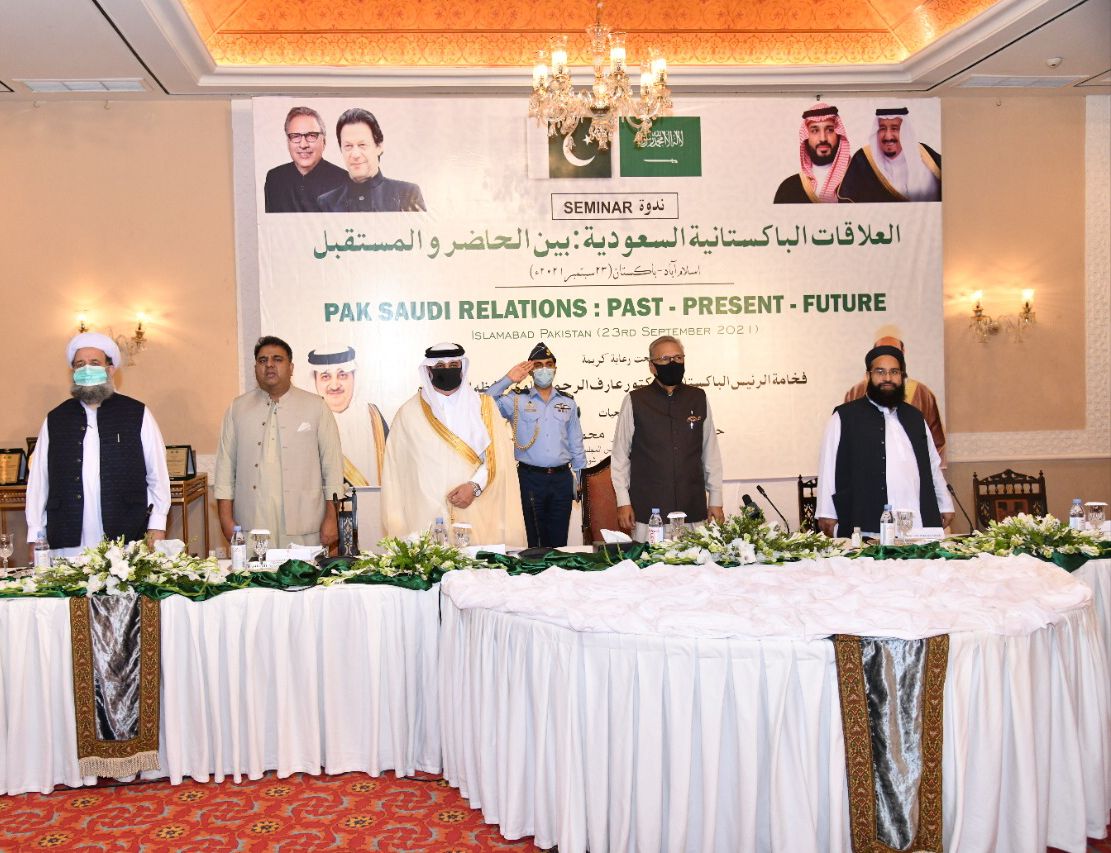
Pakistani leadership and Saudi envoy Nawaf bin Said Al-Malki pose for a photo at the “Pak-Saudi Relations: Past, Present and Future” in Islamabad on September 23, 2021. (Photo courtesy: Tahir Ashrafi)
Pakistan’s information minister Chaudhry Fawad Hussain, who was also present at the gathering, said the bilateral relations between the two countries had entered a new phase under the leadership of the Pakistani prime minister and the Saudi crown prince.
Recounting the history of these ties, he said that Saudi Arabia had supported the All India Muslim League before August 1947 by donating £10,000 on the appeal of Pakistan’s founding father, Muhammad Ali Jinnah, to deal with a crippling famine in Bengal.
“The kingdom also helped Pakistan with its membership of the United Nations after the independence,” he added.
Pakistan’s religious affairs minister Pir Noorul Haq Qadri said that every Pakistani’s heart and soul were connected to the holy land.
“On behalf of the Pakistani nation, I would like to appreciate the services rendered by the Saudi leadership to the pilgrims during Hajj and Umrah,” he said.
Prime Minister Imran Khan’s special assistant on the Middle East Tahir Mahmood Ashrafi, who organized the event, praised the Saudi leadership for showing unconditional love and respect for his country.
“The two countries have remained close partners in all circumstances,” he said.