Carlos the Jackal seeks shorter French jail term at new trial

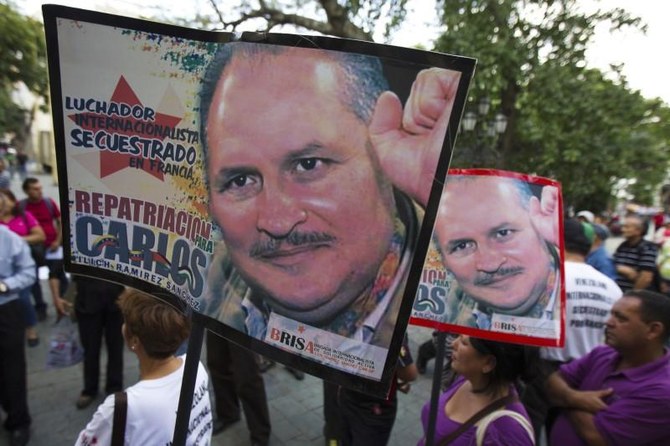
Supporters of Carlos the Jackal, Caracas, Venezuela, June 28, 2013. (Reuters)
Short Url
Updated 22 September 2021
Follow

Carlos the Jackal seeks shorter French jail term at new trial

  • Carlos, who carried out several attacks in support of the Palestinian cause, was convicted of murder in 2017 and sentenced to life in prison
  • He became one of the world’s most wanted fugitives after leading a brazen attack on a meeting of the OPEC oil cartel in Vienna in 1975

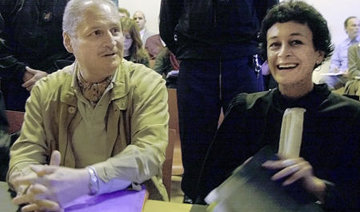
PARIS: Carlos the Jackal, the Venezuelan militant who was behind some of the biggest terror attacks of the 1970s and 1980s, appeared in a Paris court Wednesday in an attempt to have one of his three life sentences reduced.

The self-styled revolutionary, whose real name is Ilich Ramirez Sanchez, has been behind bars in France since 1994, when French police caught up with him in Sudan after two decades on the run.

“I’ve been on forced holiday in France for twenty-seven and a half years,” the moustachioed white-haired defendant, now 71, quipped at the start of the proceedings.

The trial is the third in four years over a grenade attack in Paris in 1974 that killed two people and injured dozens.

Carlos, who carried out several attacks in support of the Palestinian cause, was convicted of murder in 2017 and sentenced to life in prison, a verdict that was upheld on appeal.

But in 2019, France’s highest court sent the case back to court to reconsider his sentence, saying he should not have been convicted of both carrying and using a grenade because it amounted to being convicted twice of the same offense.

Three days of hearings have been scheduled.

Carlos has always denied responsibility for the attack at the Publicis Drugstore at Saint-Germain-des-Pres, in the heart of Paris’s Left Bank.

No DNA evidence or fingerprints were found after the bombing, but a former comrade-in-arms linked Carlos to the attack.

Investigators believe the assault was designed to pressure France into freeing a jailed militant from a far-left Japanese group.

Carlos is also serving life sentences over the 1975 murders of two French policemen and a police informer, as well as for a series of bombings in Paris and Marseille in 1982 and 1983 that killed a total of 11 people and left dozens injured.

Born into a wealthy family in Caracas on October 12, 1949, Carlos joined a communist group as a teenager and studied in Moscow before joining a hard-line Marxist Palestinian group.

“I am a professional revolutionary; revolution is my job,” he told a French court in 2018.

He became one of the world’s most wanted fugitives after leading a brazen attack on a meeting of the OPEC oil cartel in Vienna in 1975.

Carlos and five other gunmen took 11 energy ministers and dozens of others hostage.

Three people were killed before Austrian authorities agreed to supply Carlos with a plane to fly him and his team to Algiers with around 40 hostages.

The hostages were later released in return for a hefty ransom, and their abductors walked free.


Displaced Sudanese escape RSF siege in southern Kordofan

Fighters of the paramilitary Rapid Support Forces (RSF) drive an armoured vehicle in southern Khartoum, on May 25, 2023. (AFP)
Updated 4 sec ago
Follow

Displaced Sudanese escape RSF siege in southern Kordofan

  • Some women haul water from a single well, pouring it into plastic buckets to cook, wash, and clean with, while others wait in a long line outside a makeshift health clinic, little more than a large canvas tent

GEDAREF, Sudan: When paramilitary Rapid Support Force fighters closed in on the Sudanese border town and oil field of Heglig, paraplegic Dowa Hamed could only cling to her husband’s back as they fled, “like a child,” she said
Now, the 25-year-old mother of five — paralyzed from the waist down — lies shell-shocked on a cot in the Abu Al-Naga displacement camp, a dusty transit center just outside the eastern city of Gedaref, nearly 800 km from home.
But her family’s actual journey was much longer, crossing the South Sudan border twice and passing from one group of fighters to another, as they ran for their lives with their children in tow alongside hundreds of others.
“We fled with nothing,” Hamed said. “Only the clothes on our backs.”
Hamed and her family are among tens of thousands of people recently uprooted by fighting in southern Kordofan — the latest front in the war between Sudan’s army and the Rapid Support Forces that erupted in April 2023.
Since capturing the army’s last stronghold in Darfur in October, the RSF and their allies have pushed deeper into neighboring Kordofan, an oil-rich agricultural region divided into three states: West, North, and South.
In recent weeks, the paramilitary group has consolidated control over West Kordofan, seized Heglig — home to Sudan’s largest oil field — and tightened its siege on Kadugli and Dilling in South Kordofan, where hundreds of thousands now face mass starvation.
On the night of Dec. 7, the inhabitants of Heglig — many of them the families of oil technicians, engineers, and soldiers stationed at the field — got word that an attack would happen at dawn.
“We ran on foot, barefoot, without proper clothes,” said Hiyam Al-Hajj, 29, a mother of 10 who says she had to leave her mother and six siblings behind as she ran around 30 km to the border.
“The RSF chased us to the border. The South Sudan army told them we were in their country and they would not hand us over,” she said.
They were sheltered in South Sudan’s Unity State, but barely fed.
“Those who had money could feed their children,” Al-Hajj said. “Those who did not went hungry.”
They spent nearly four weeks on the move, trekking long distances on foot and spending nights out in the open, sleeping on the bare ground.
“We were hungry,” she said. “But we did not feel the hunger; all we cared about was our safety.”
Eventually, authorities in South Sudan put them in large trucks that carried them back across the border to army-controlled territory, where they could head east, away from the front lines.
Hamed, who was paralyzed during childbirth, said that “during the truck rides, my body ached with every movement.”
But not everyone made it to Gedaref.
Between the canvas tents of the Abu Al-Naga camp, 14-year-old Sarah is struggling to care for her little brother alone.
In South Sudan, their parents had put them on one of the trucks, “then they said the truck was full and promised they would get on the next one.”
But weeks on, the siblings have received no word as to where their mother and father might be.
Inside the tents, children and mothers sleep on the ground, huddled together for warmth, while outside, children dart across the cracked soil, dust clinging to their bare feet.
According to camp director Ali Yehia Ahmed, 240 families, or around 1,200 people, are now taking refuge at Abu Al-Naga.
“The camp’s space is very small,” Ahmed said, adding that food was in increasingly short supply.
Food is distributed from a single point, forcing families to wait for limited rations.
Some women haul water from a single well, pouring it into plastic buckets to cook, wash, and clean with, while others wait in a long line outside a makeshift health clinic, little more than a large canvas tent.
Asia Abdelrahman Hussein, the minister of social welfare and development of Gedaref State, said shelter was one of the most urgent needs, especially during the winter months.
“The shelters are not enough. We need support from other organizations to provide safe housing and adequate shelter,” she said.
In one of the tents, Sawsan Othman Moussa, 27, said how she had been forced to flee three times since fighting broke out in Dilling.
Now, though she might be safe, “every tent is cramped, medicine is scarce, and during cold nights, we suffer.”