

Afghan girls school ban is ‘not Islamic,’ Pakistani PM says

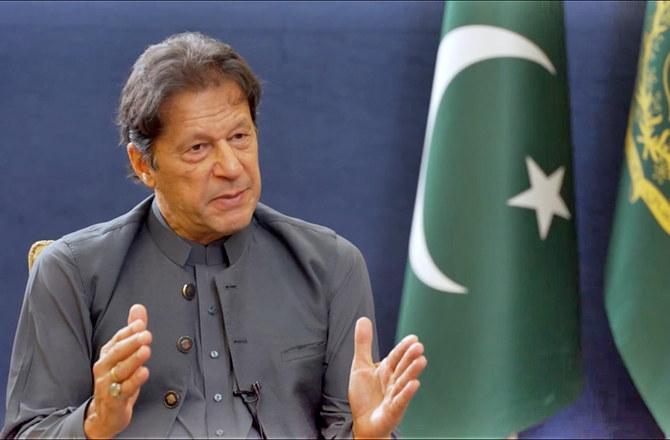
Pakistan Prime Minister, Imran Khan gestures during his interview to BBC in Islamabad, Pakistan, on September 21, 2021. (Screen grab from BBC interview video)
Short Url
Updated 22 September 2021
Follow

Afghan girls school ban is ‘not Islamic,’ Pakistani PM says

  • Says believes Taliban will allow women right to education
  • Calls on international community to give Taliban more time

ISLAMABAD: Pakistani Prime Minister Imran Khan has said preventing women from accessing education in neighboring Afghanistan would be un-Islamic.
In an interview with the BBC broadcast on Tuesday, Khan laid out the conditions that would need to be met for Pakistan to formally recognize the new Taliban government, which included an inclusive government and respect for human rights.
He also said Afghanistan should not be used to house ‘terrorists’ who could threaten Pakistan’s security.
Last week, the Taliban excluded girls from secondary schools with only boys and male teachers allowed back. But Pakistan’s leader said he believed girls would soon be able to attend.
“The statements they have made since they came to power have been very encouraging,” he told the BBC’s John Simpson. “I think they will allow women to go to schools … The idea that women should not be educated is just not Islamic. It has nothing to do with religion.”
Since the Taliban took control of Afghanistan in August, fears have grown over a return to the regime of the 1990s when the hard-line group severely restricted women’s rights.
Its leadership maintains that the rights of women will be respected “within the framework of Islamic law.”
The decision to exclude girls from returning to school last week prompted an international outcry, with a Taliban spokesman later saying they would return to the classroom “as soon as possible.”

But it is not yet clear when girls will be able to return or what form of education will be provided if they do.
When pressed on whether the Taliban would realistically meet his criteria for formal recognition, Khan repeatedly called on the international community to give the group more time.
“It’s just too early to say anything,” he said, adding that he expected Afghan women to eventually “assert their rights.”
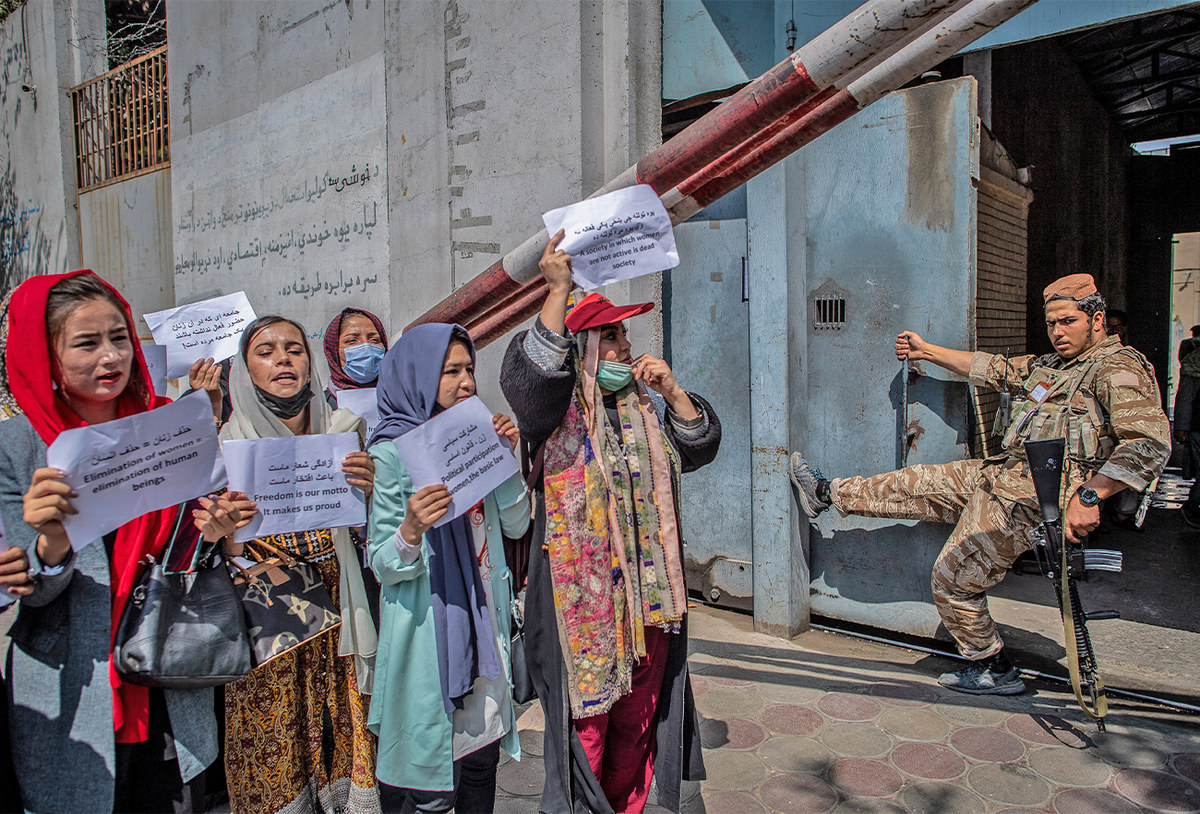


A Taliban fighter watches as Afghan women hold placards during a demonstration demanding better rights for women in front of the former Ministry of Women Affairs in Kabul on September 19, 2021. (AFp)

Khan said Pakistan would make a decision on whether to formally recognize the Taliban government alongside other neighboring states.
“All neighbors will get together and see how they progress,” he said. “Whether to recognize them or not will be a collective decision.”
He also called on the Taliban to form an inclusive government, warning that a failure to do so could see the country descend into civil war.
“If they do not include all the factions, sooner or later they will have a civil war,” he said. “That would mean an unstable, chaotic, Afghanistan and an ideal place for terrorists. That is a worry.”


Pakistan beefs up security in Karachi, Islamabad and Skardu as Khamenei protests kill 24

Updated 48 min 42 sec ago
Follow

Pakistan beefs up security in Karachi, Islamabad and Skardu as Khamenei protests kill 24

  • At least 14 killed in northern Gilgit-Baltistan region, 10 in Karachi during Sunday’s clashes between protesters, law enforcers
  • Police close off roads leading to key government buildings in Islamabad, US consulate in Karachi with army deployed in Skardu

ISLAMABAD/GILGIT: Authorities beefed up security by deploying additional police contingents and sealing off most roads leading to government buildings in Islamabad, Karachi and Skardu on Monday after violent protests in the aftermath of Iranian Supreme Leader Ayatollah Ali Khamenei’s killing led to the deaths of at least 24 people in Pakistan. 

At least 10 people were killed and 73 others sustained injuries on Sunday in clashes with law enforcement outside the US consulate in Karachi. Hundreds of protesters had gathered outside the consulate, with videos showing angry crowds armed with sticks as they smashed doors and windows.

In Islamabad, protesters entered the Red Zone which houses key government and diplomatic offices in the capital, prompting authorities to fire tear gas to disperse them. Similarly, people gathered outside the press club in the northwestern city of Peshawar to protest Khamenei’s killing as well.

Skardu in Pakistan’s northern Gilgit-Baltistan (GB) region saw violent clashes on Sunday as well, as protesters set fire to and vandalized several buildings, including United Nations (UN) regional offices. Clashes with law enforcers caused the deaths of at least 14 people in the region, among them a soldier, a senior official told Arab News.

“Seven protesters were killed in Gilgit and seven in Skardu,” GB Caretaker Information Minister Ghulam Abbas confirmed. “One was soldier martyred in Skardu while the injured there were around 50.”

Police and Paramilitary vehicles stand outside the U.S. Consulate General, a day after a protest following news of U.S. and Israeli strikes on Iran that killed Supreme Leader Ayatollah Ali Khamenei, in Karachi, Pakistan, March 2, 2026. (Reuters)

The minister said the station house officer and deputy superintendent of police in Skardu were also injured, along with two soldiers, while 10 properties were damaged in the clashes. He said police have registered complaints against the culprits for the violence. 

“Schools are closed on Monday and courts’ activities will also be closed,” Abbas said. “A curfew has also been imposed for three days initially in Skardu and Gilgit cities from Mar. 2 to Mar. 4.”

The flare-up also prompted authorities to call in the army in Skardu under Article 245 of the Pakistani constitution, state media reported on Sunday.

Meanwhile, Islamabad Traffic Police said entry into the Red Zone area will remain open for people only through the Margalla Road and another route through Marriott Hotel.

“All other entry points leading toward the Red Zone will remain closed,” it said in its advisory. 

People ride past shipping containers on a road leading to the U.S. Consulate General, a day after a protest following news of U.S. and Israeli strikes on Iran that killed Supreme Leader Ayatollah Ali Khamenei, in Karachi, Pakistan, March 2, 2026. (Reuters)

A spokesperson for the Karachi Traffic Police said in a press release that the MT Khan Road, from PIDC road to the Mai Kolachi Road railway crossing, will remain closed on Monday for general traffic due to security reasons.

The US consulate, which was the scene of clashes between protesters and police, is located on Mai Kolachi Road near MT Khan and PIDC. 

“The general public is requested to cooperate with law enforcement agencies and traffic police to avoid inconvenience and difficulties,” the Karachi Traffic Police spokesperson said. 


MIDDLE EAST TENSIONS

The violence on Sunday came hours after Iranian authorities confirmed Khamenei was killed in coordinated strikes carried out by the US and Israel, dramatically escalating tensions in the Middle East and triggering protests in several countries.

According to US officials, the operation targeted Revolutionary Guard command facilities, air defense systems, missile and drone launch sites, and military airfields. The US military said it suffered no casualties and reported minimal damage to its bases despite what it described as “hundreds of Iranian missile and drone attacks.”

Iran retaliated by launching missiles and drones toward Israel and targeting US military installations in Bahrain, Kuwait, Qatar and the UAE. The Emirati government said its air defense systems intercepted dozens of Iranian missiles and drones, but debris from the interceptions caused material damage in Abu Dhabi and Dubai, and at least one civilian, a Pakistani national, was killed. It issued rare emergency alerts urging residents to seek shelter, underscoring how the conflict has rippled far beyond Iran’s borders.

The Israeli military said dozens of Iranian missiles were fired toward Israeli territory, many of which were intercepted. Israel’s Magen David Adom rescue service said a woman in the Tel Aviv area died after being wounded in a missile strike.