

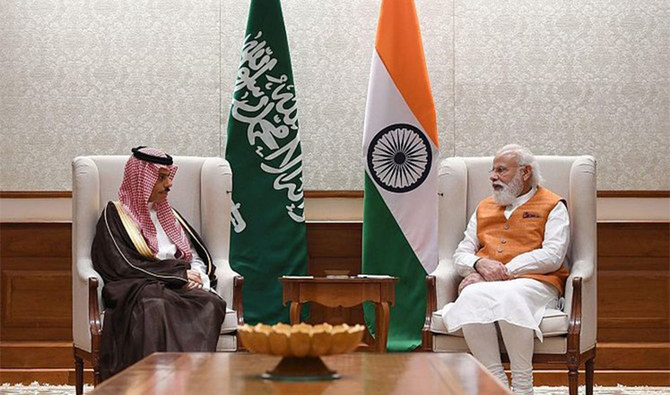

NEW DELHI: Saudi Foreign Minister Prince Faisal bin Farhan held talks with Indian Prime Minister Narendra Modi on Monday, concluding his two-day visit to the South Asian nation that experts said was a step forward in bolstering bilateral ties.
Officials remained tight-lipped about the agenda of the meeting, and the Foreign Ministry did not release details either.
But the Saudi official’s visit marks the first high-level interaction between the two nations since the start of the COVID-19 outbreak early last year.
Dr. Muddassir Quamar, from the Institute of Defense Studies and Analysis, a New Delhi based think tank, said that it “signifies the intent of both nations to overcome the disruptions caused by the pandemic.”
“The fact that the Saudi minister has come for a stand-alone visit to India is significant in terms of bilateral relations. In terms of economic, bilateral and trade ties, investments are the pillar and backbone of Saudi and India’s relationship,” Quamar told Arab News.
He cited figures from the past five to six years showing Saudi investment in India was $50 million in 2014, and almost $3 billion today”.
“Though it has not reached the target of $100 billion investment which both the countries set out to achieve in 2019, this will not take much time,” Quamar, who edits the journal, Contemporary Review of the Middle East, explained.
Others said that it would cement India’s role with “critical and strategic investments” in the Kingdom.
#LISTEN: The visit of the Saudi Foreign Minister Prince Faisal bin Farhan to India strengthens the strategic partnership between the two nations, says New Delhi-based analyst @MuddassirQuamar.https://t.co/gXsIgZ3pqZ pic.twitter.com/YJ5vsZGJAJ
— Arab News (@arabnews) September 21, 2021
“The visit of the Saudi foreign minister is very timely and a continuum of our growing strategic partnership across the whole spectrum,” Anil Trigunayat, former Indian ambassador to Jordan and Libya, told Arab News.
“While the Kingdom has ambitious plans in accordance with its Vision 2030, India is also looking forward to greater critical and strategic investments which will be futuristic and mutually beneficial,” he said.
Trigunayat said that maritime and cybersecurity, technological collaboration, including green sectors, would be the “new areas for closer cooperation.” Quamar agreed, adding that Saudi Arabia’s foreign policy priority “makes India a favorite destination for investment.”
“The global economic nerve center is shifting from the west to Asia, and Saudi Arabia is the country whose foreign policy aspect is an investment. It can invest in a growing market. It is a strategic step that Riyadh is choosing to invest in India,” he said.
“One very important thing that we ignore is the growing security and defense partnership between India and Saudi Arabia. Since 2008, the security and defense relations between both the nations have gone up — both in terms of counter-terrorism and military-to-military relationship,” he said.
On Sunday, Prince Faisal met Indian Foreign Minister S. Jaishankar, who described the talks as a “cordial and productive meeting.”
The two officials also reviewed progress in implementing the Strategic Partnership Council Agreement, signed during Modi’s visit to Saudi Arabia in October 2019, and agreed to “work closely” to deal with pandemic-related challenges, a statement by India’s foreign ministry said.
Later, in interviews with local media, Prince Faisal said that Saudi Arabia’s relationship with India was “critically important to us.”
“It’s a major priority,” he told New Delhi-based English daily, The Times of India, adding that his visit was intended to “make sure the momentum in the relationship keeps going.”
“The depth and breadth of the relationship have expanded exponentially over the past four years, driven to a great extent by . . . prime minister Modi and the (Saudi) king and the crown prince . . . politically, of course, also . . . in the security field, counter-terrorism, counter-extremism areas where we work closely together,” Saudi’s top diplomat said.
In 2019, Saudi Arabia pledged a $100 billion investment in India, with Prince Faisal saying that despite the “challenges” posed by the pandemic, India had become the Kingdom’s third-largest trade partner.
“It’s a significant growth in both trade and also investment. When this announcement was made, we had $500 million direct investments, and we are more than $3 billion now,” he told English daily, The Hindu, on Monday.
According to Indian foreign ministry data, more than two million Indians live and work in the Kingdom. However, the COVID-19 pandemic rendered thousands jobless, with a majority unable to return to work due to travel curbs.
Jaishankar urged an early resumption of direct flights to Saudi Arabia, while both nations “agreed to work closely on all COVID-19-related challenges.”
In April and May, Saudi Arabia supplied more than 140 tons of medical oxygen to India to help it amid a deadly second wave of the coronavirus that claimed the lives of more than 400,000 people.


