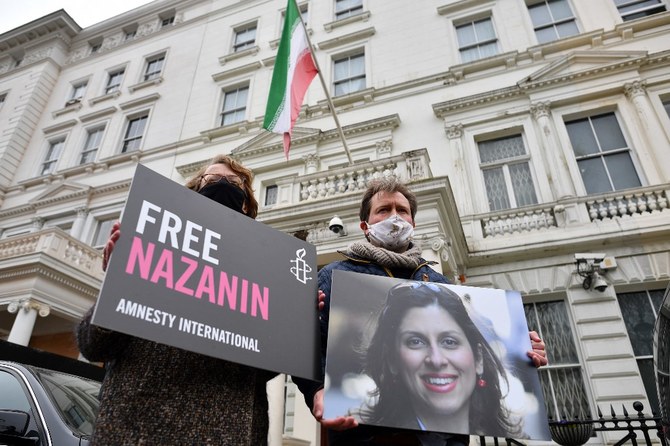
LONDON: The husband of a British-Iranian woman detained in Iran has called on the new British foreign secretary to ensure his wife’s return is a “top priority.”
Richard Ratcliffe told the BBC’s The Andrew Marr Show that he has given the names of 10 people he accuses of being involved with “hostage-taking” in Iran to Liz Truss ahead of a phone call with her on Sunday.
“We’ve put in front of the new foreign secretary a file of names, those who are involved in Iran’s hostage-taking across the chain, so those involved in taking people, processing them, giving them judges, those who are involved in treating them badly in prison,” Ratcliffe said.
“I’ve got a phone call with the foreign secretary today, to be speaking to her two days into the job is a positive sign for sure.
“Partly I just want to hear that this is a top priority and that Nazanin and the others who are being held as bargaining chips will be brought home,” he added.
Nazanin Zaghari-Ratcliffe has been in custody in Iran since 2016 after being accused of plotting to overthrow the government.
Iranian media has linked her detention to the UK’s failure to pay an outstanding £400 million debt to Iran.
“This coming week she (Liz Truss) should be meeting with the new Iranian foreign minister in New York when they’re over for the UN event, so hopefully there will be a positive conversation,” Ratcliffe said.
“Right now I think enough needs to be enough, and it needs to be signaled really clearly to Iran that you can’t use innocent people in this way.
“I’d really like them to be firm, to be brave and make some clear steps,” he added.
Ratcliffe has been campaigning tirelessly to have his wife released from prison and urged former foreign secretary Dominic Raab to take a firmer stand against Iran over the issue.
“One of the key problems I feel these past years is there’s been no cost for the Iranian side to carry on holding Nazanin, to carry on holding others, and so we’ve seen that now there are more British citizens in prison than there were when Nazanin was first taken,” he said.


Zaghari-Ratcliffe’s husband calls for new British foreign secretary to prioritize wife’s return from Iran
https://arab.news/88beg
Zaghari-Ratcliffe’s husband calls for new British foreign secretary to prioritize wife’s return from Iran

- Ratcliffe said he would be speaking to the new British Foreign Secretary Liz Truss on Sunday
- Zaghari-Ratcliffe has been in custody in Iran since 2016 after being accused of plotting to overthrow the government


Airlines hike ticket prices as war against Iran propels fuel costs
- Conflict deals double blow to Indian airlines already hit by Pakistan airspace ban
CANBERRA, NEW DELHI: Australia’s Qantas Airways, Scandinavia’s SAS and Air New Zealand announced airfare hikes on Tuesday, blaming an abrupt spike in the cost of fuel caused by the Middle East conflict.
Jet fuel prices, which were around $85 to $90 per barrel before US-Israeli strikes on Iran, have soared to between $150 and $200 per barrel in recent days, New Zealand’s flag carrier said as it suspended its financial outlook for 2026 due to uncertainty over the conflict. The war, which disrupted shipping via the world’s most vital oil export route, has sent oil prices surging, upending global travel, pushing airline tickets on some routes sky-high, and sparking fears of a deep travel slump that could lead to widespread grounding of planes.
FASTFACT
Flight disruptions due to the Middle East conflict add to problems at IndiGo whose CEO Pieter Elbers stepped down on Tuesday.
“Increases of this magnitude make it necessary to react in order to maintain stable and reliable operations,” an SAS spokesperson said in a statement, adding it had implemented a “temporary price adjustment.”
The largest Scandinavian airline said last year it had temporarily adjusted its fuel hedging policy due to uncertain market conditions and that it had no fuel consumption hedged for the following 12 months. Several Asian and European airlines, including Lufthansa and Ryanair, have oil hedging in place, securing a part of their fuel supplies at fixed prices. Finnair, which had hedged over 80 percent of its first quarter fuel purchases, warned, however, that even the availability of fuel could be at risk if the conflict dragged on.
Qantas said in addition to increasing international fares, it was exploring redeploying capacity to Europe as airlines and passengers seek to evade disruptions in the Middle East
Airspace restrictions in the Middle East have dealt another blow to Indian airlines, which count the region as a corridor for flights to Europe and the US since Pakistan banned Indian carriers from its airspace last year.
As war in the Middle East forces flight rescheduling and re-routing, Indian airlines have limited options because they can’t fly over Pakistan either.
The country’s biggest international carriers Air India and IndiGo did not operate 64 percent of their 1,230 scheduled flights to the Middle East, Europe and North America in the last 10 days, Cirium data shows.
“It is a double whammy for Indian airlines which fly international routes,” said Amit Mittal, an independent aviation expert.
Pakistan has banned Indian carriers from its airspace since last April following military tensions between the two neighbors.