

Pakistani Taliban reject amnesty offer unless Islamic law imposed

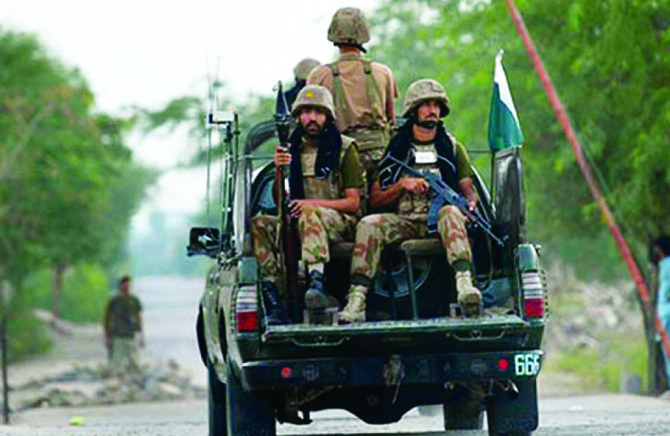
Pakistani soldiers on patrol. The Tehreek-e-Taliban Pakistan has accepted responsibility for several high-profile attacks in the country. (AFP/File)
Short Url
Updated 19 September 2021
Follow

Pakistani Taliban reject amnesty offer unless Islamic law imposed

  • Islamabad says it could pardon the Tehreek-e-Taliban if it renounced violence

PESHWAR: The Tehreek-e-Taliban Pakistan, a banned militant group, has rejected Islamabad’s amnesty offer unless the government agrees to impose Shariah or Islamic law in the Muslim-majority South Asian nation.

The group is an umbrella organization of various militant groups fighting to overthrow the Pakistan government and is responsible for attacking military and civilian targets, especially along the country’s border with Afghanistan.
Islamabad has been particularly worried about the group’s fighters crossing over from Afghanistan and launching lethal attacks on its territory ever since the Afghan Taliban swept across Afghanistan in a lightning offensive and captured power last month.
Last week, Pakistani President Dr. Arif Alvi and Foreign Minister Shah Mahmood Qureshi said that the government could pardon the group’s members if they laid down arms, abandoned the group’s ideology and adhered to the country’s constitution.
However, in a statement on Friday, the TTP said: “Pardon is usually offered to those who commit crimes, but we are quite proud of our struggle.”
“We can offer conditional amnesty to our enemy if they promise to implement Shariah in the country,” it added.
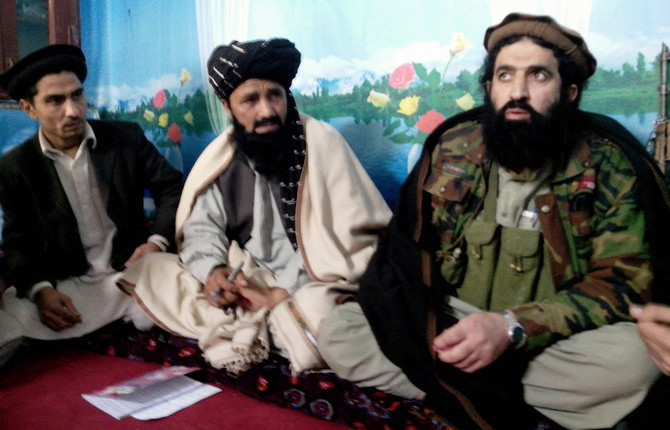


Tehreek-e-Taliban Pakistan spokesman Shahidullah Shahid, right, speaks during a press conference at an undisclosed location in Pakistan on Feb. 21, 2014. (AFP)

Adnan Bhittani, a senior security analyst based in the northwestern Khyber Pakhtunkhwa province, told Arab News that the recent release of the group’s fighters from Afghan prisons after the Taliban’s  capture of Kabul had emboldened the armed faction to increase its attacks in Pakistan.
“TTP has up to 6,000 fighters who can create mayhem in different parts of Pakistan,” he said.
So far, there has been no response from the Pakistan government to the group’s statement.

FASTFACT

The Tehreek-e-Taliban Pakistan is an umbrella organization of various militant groups fighting to overthrow the Pakistan government and is responsible for attacking military and civilian targets, especially along the country’s border with Afghanistan.

However, senior opposition leader, Bilawal Bhutto Zardari, criticized the government’s “policy of appeasement” in a Twitter post, saying it would come to haunt the country in the future.
Since returning to power, the Afghan Taliban has repeatedly assured Pakistan it will not allow its territory to be used by militants to attack any nation.
Thousands of Pakistanis have been killed in violence launched by the militant group in the past two decades.
The group has accepted responsibility for several high-profile attacks in Pakistan, including an attack on an army-run school in Peshawar in which 134 children were killed in 2014 and an assassination attempt on activist and Nobel prize winner Malala Yousafzai when she was a schoolgirl.


IAEA board meets over Ukraine nuclear safety concerns

Updated 30 January 2026
Follow

IAEA board meets over Ukraine nuclear safety concerns

  • The war in Ukraine “continues to pose the world’s biggest threat to nuclear safety,” Grossi said
  • The mission will assess 10 substations “crucial to nuclear safety,” according to Grossi

VIENNA: The UN nuclear watchdog’s board of governors on Friday discussed nuclear safety in Ukraine, with several countries expressing “growing concern” following Russian attacks on the power grid.
Energy supplies to Ukraine’s nuclear plants have been affected as Russia has pounded its neighbor’s power sector since the start of its 2022 invasion, prompting fears of a nuclear disaster.
The war in Ukraine “continues to pose the world’s biggest threat to nuclear safety,” Rafael Grossi, director general of the International Atomic Energy Agency (IAEA), said when opening the board meeting.
The extraordinary meeting that lasted four hours was called after 13 countries led by the Netherlands expressed in a letter seen by AFP a “growing concern about the severity and urgency of nuclear safety risks” following a series of attacks.
Ukrainian ambassador Yurii Vitrenko told reporters before the meeting that it was “high time” for the IAEA board to discuss the situation.
A weeks-long IAEA expert mission to Ukrainian substations and power plants is under way and expected to wrap up next month, Vitrenko said.
The mission will assess 10 substations “crucial to nuclear safety,” according to Grossi.
Russian Ambassador Mikhail Ulyanov dismissed the board’s gathering as “absolutely politically motivated,” adding there was “no real need to hold such a meeting today.”
Last week, Ukraine’s Chernobyl nuclear power plant temporarily lost all off-site power.
Europe’s biggest nuclear power plant, Zaporizhzhia, occupied by Russian forces since March 2022, has also been repeatedly affected by fighting.
Earlier this month, Russia and Ukraine agreed to a localized ceasefire to allow repairs on the last remaining backup power line supplying Zaporizhzhia.
The line was damaged and disconnected as a result of military activity in early January.
The Zaporizhzhia plant’s six reactors have been shut down since the occupation. But the site still needs electricity to maintain its cooling and security systems.
Moscow and Kyiv have repeatedly accused each other of risking a nuclear catastrophe by attacking the site.