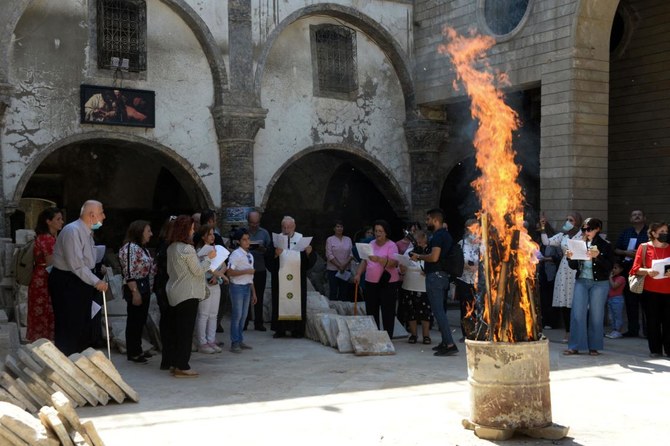
MOSUL: A bell was inaugurated at a church in Mosul on Saturday to the cheers of Iraqi Christians, seven years after the Daesh group overran the northern city.
Dozens of faithful stood by as Father Pios Affas rang the newly installed bell for the first time at the Syriac Christian church of Mar Tuma, an AFP correspondent reported.
It drew applause and ululations from the crowd, who took photos on mobile phones, before prayers were held.
“After seven years of silence, the bell of Mar Tuma rang for the first time on the right bank of Mosul,” Affas told them.
Daesh swept into Mosul and proclaimed it their “capital” in 2014, in an onslaught that forced hundreds of thousands of Christians in the northern Nineveh province to flee, some to Iraq’s nearby Kurdistan region.
The Iraqi army drove out the jihadists three years later after months of gruelling street fighting.
The return of the Mosul church bell “heralds days of hope, and opens the way, God willing, for the return of Christians to their city,” said Affas.
“This is a great day of joy, and I hope the joy will grow even more when not only all the churches and mosques in Mosul are rebuilt, but also the whole city, with its houses and historical sites,” he told AFP.
The bell weighing 285 kilogrammes (nearly 630 pounds) was cast in Lebanon with donations from Fraternity in Iraq, a French NGO that helps religious minorities, and transported from Beirut to Mosul by plane and truck.
The church of Mar Tuma, which dates back to the 19th century, was used by the jihadists as a prison or a court.
Restoration work is ongoing and its marble floor has been dismantled to be completely redone.
Nidaa Abdel Ahad, one of the faithful attending the inauguration, said she had returned to her home town from Irbil so that she could see the church being “brought back to life.”
“My joy is indescribable,” said the teacher in her forties. “It’s as if the heart of Christianity is beating again.”
Faraj-Benoit Camurat, founder and head of Fraternity in Iraq, said that “all the representations of the cross, all the Christian representations, were destroyed,” including marble altars.
“We hope this bell will be the symbol of a kind of rebirth in Mosul,” he told AFP by telephone.
Iraq’s Christian community, which numbered more than 1.5 million in 2003 before the US-led invasion, has shrunk to about 400,000, with many of them fleeing the recurrent violence that has ravaged the country.
Camurat said around 50 Christian families had resettled in Mosul, while others travel there to work for the day.
“The Christians could have left forever and abandoned Mosul,” but instead they being very active in the city, he said.

Church in former Daesh Iraqi stronghold gets new bell
Short Url
https://arab.news/wdjxf
Church in former Daesh Iraqi stronghold gets new bell
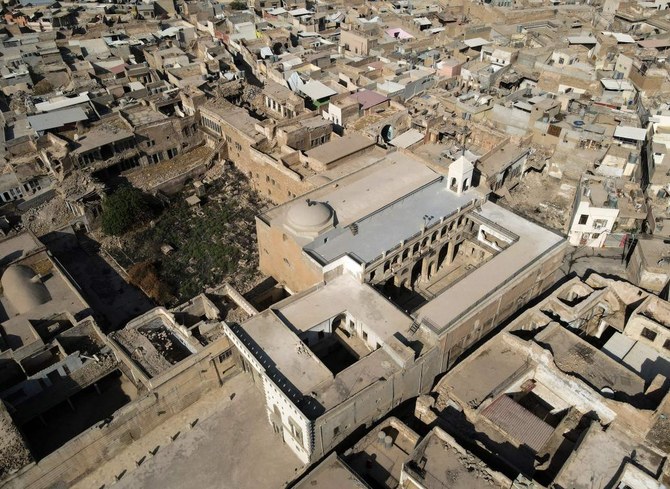
- The bell weighing 285kg was cast in Lebanon with donations from a French NGO
Israel accused of move expanding Jerusalem borders for first time since 1967
- Planned development is formally a westward expansion of the Geva Binyamin, or Adam, settlement situated north-east of Jerusalem in the West Bank
- Some 200,000 Israelis live in Israeli-annexed east Jerusalem, while more than 500,000 others live in West Bank settlements and outposts
JERUSALEM: Israeli NGOs have raised the alarm over a settlement plan signed by the government which they say would mark the first expansion of Jerusalem’s borders into the occupied West Bank since 1967.
Israel has occupied east Jerusalem since 1967 and later annexed it in a move not recognized by the international community.
Palestinians view east Jerusalem as the capital of their future state.
The proposal, published in early February but reported by Israeli media only on Monday, comes as international outrage mounts over creeping measures aimed at strengthening Israeli control over the West Bank.
Critics say these actions by the Israeli authorities are aimed at the de facto annexation of the Palestinian territory.
The planned development, announced by Israel’s Ministry of Construction and Housing, is formally a westward expansion of the Geva Binyamin, or Adam, settlement situated north-east of Jerusalem in the West Bank.
In a statement, the ministry said the development agreement included the construction of around 2,780 housing units for the settlement, with an investment of roughly 120 million Israeli shekels (around $38.7 million).
But the area to be developed lies on the Jerusalem side of the separation barrier built by Israel in the early 2000s, while Geva Binyamin sits on the West Bank side of the barrier, and the two are separated by a road.
In a statement, Israeli settlement watchdog Peace Now said there would be no “territorial or functional connection” between the area to be developed and the settlement.
“The new neighborhood will be integral to the city of Jerusalem,” Lior Amihai, Peace Now’s executive director, told AFP.
“What is unique about that one is that it will be connected directly to Jerusalem, but it will be beyond the annexed municipal border. So it will be in complete West Bank territory, but just adjacent to Jerusalem,” he said.
‘Living there as Jerusalemites’
The move comes days after Israel’s government approved a process to register land in the West Bank as “state property,” drawing widespread international condemnation and fears among critics that it would accelerate annexation of the Palestinian territory.
Days earlier, Israel’s security cabinet approved a series of measures to tighten control over areas of the West Bank administered by the Palestinian Authority under the Oslo accords.
Those measures, which also sparked international backlash, include allowing Jewish Israelis to buy West Bank land directly and allowing Israeli authorities to administer certain religious sites in areas under the Palestinian Authority’s control.
Amihai said that the current government — one of the most right-wing in Israel’s history — was “systematically working to annex the occupied territories and to prevent Palestinian statehood.”
The case of Jerusalem, he said, was particularly symbolic.
“Every change to Jerusalem is sensitive to both the Israeli public, but also to the Palestinians,” he told AFP.
Aviv Tatarsky, a researcher at Ir Amim, an Israeli NGO focusing on Jerusalem within the context of the Israeli-Palestinian conflict, said the latest planned development amounted to a de facto expansion of the city of Jerusalem.
“If it is built, and people live there, the people who will live there, they will be living there as Jerusalemites,” he told AFP.
“In all practical terms, it’s basically not the settlement that will be expanded, but Jerusalem.”
‘Facts on the ground’
The development agreement was signed by Israel’s Construction and Housing Ministry, the Finance Ministry and the Binyamin Regional Council, which represents settlements north of Ramallah in the central West Bank.
It has yet to be reviewed by the Civil Administration’s Higher Planning Committee, in a process which could take several months or years.
Tatarsky said that international pressure had so far made it difficult for recent Israeli governments to make formal declarations on annexation.
“It’s much easier to create facts on the ground, which, altogether... actually add up to annexation,” the researcher said.
The West Bank, occupied since 1967, would form the largest part of any future Palestinian state but is seen by many on the religious right as Israeli land.
Some 200,000 Israelis live in Israeli-annexed east Jerusalem, while more than 500,000 others live in West Bank settlements and outposts, which are illegal under international law.
Around three million Palestinians live in the territory.
The current Israeli government has fast-tracked settlement expansion, approving a record 52 settlements in 2025.
Israel has occupied east Jerusalem since 1967 and later annexed it in a move not recognized by the international community.
Palestinians view east Jerusalem as the capital of their future state.
The proposal, published in early February but reported by Israeli media only on Monday, comes as international outrage mounts over creeping measures aimed at strengthening Israeli control over the West Bank.
Critics say these actions by the Israeli authorities are aimed at the de facto annexation of the Palestinian territory.
The planned development, announced by Israel’s Ministry of Construction and Housing, is formally a westward expansion of the Geva Binyamin, or Adam, settlement situated north-east of Jerusalem in the West Bank.
In a statement, the ministry said the development agreement included the construction of around 2,780 housing units for the settlement, with an investment of roughly 120 million Israeli shekels (around $38.7 million).
But the area to be developed lies on the Jerusalem side of the separation barrier built by Israel in the early 2000s, while Geva Binyamin sits on the West Bank side of the barrier, and the two are separated by a road.
In a statement, Israeli settlement watchdog Peace Now said there would be no “territorial or functional connection” between the area to be developed and the settlement.
“The new neighborhood will be integral to the city of Jerusalem,” Lior Amihai, Peace Now’s executive director, told AFP.
“What is unique about that one is that it will be connected directly to Jerusalem, but it will be beyond the annexed municipal border. So it will be in complete West Bank territory, but just adjacent to Jerusalem,” he said.
‘Living there as Jerusalemites’
The move comes days after Israel’s government approved a process to register land in the West Bank as “state property,” drawing widespread international condemnation and fears among critics that it would accelerate annexation of the Palestinian territory.
Days earlier, Israel’s security cabinet approved a series of measures to tighten control over areas of the West Bank administered by the Palestinian Authority under the Oslo accords.
Those measures, which also sparked international backlash, include allowing Jewish Israelis to buy West Bank land directly and allowing Israeli authorities to administer certain religious sites in areas under the Palestinian Authority’s control.
Amihai said that the current government — one of the most right-wing in Israel’s history — was “systematically working to annex the occupied territories and to prevent Palestinian statehood.”
The case of Jerusalem, he said, was particularly symbolic.
“Every change to Jerusalem is sensitive to both the Israeli public, but also to the Palestinians,” he told AFP.
Aviv Tatarsky, a researcher at Ir Amim, an Israeli NGO focusing on Jerusalem within the context of the Israeli-Palestinian conflict, said the latest planned development amounted to a de facto expansion of the city of Jerusalem.
“If it is built, and people live there, the people who will live there, they will be living there as Jerusalemites,” he told AFP.
“In all practical terms, it’s basically not the settlement that will be expanded, but Jerusalem.”
‘Facts on the ground’
The development agreement was signed by Israel’s Construction and Housing Ministry, the Finance Ministry and the Binyamin Regional Council, which represents settlements north of Ramallah in the central West Bank.
It has yet to be reviewed by the Civil Administration’s Higher Planning Committee, in a process which could take several months or years.
Tatarsky said that international pressure had so far made it difficult for recent Israeli governments to make formal declarations on annexation.
“It’s much easier to create facts on the ground, which, altogether... actually add up to annexation,” the researcher said.
The West Bank, occupied since 1967, would form the largest part of any future Palestinian state but is seen by many on the religious right as Israeli land.
Some 200,000 Israelis live in Israeli-annexed east Jerusalem, while more than 500,000 others live in West Bank settlements and outposts, which are illegal under international law.
Around three million Palestinians live in the territory.
The current Israeli government has fast-tracked settlement expansion, approving a record 52 settlements in 2025.
© 2026 SAUDI RESEARCH & PUBLISHING COMPANY, All Rights Reserved And subject to Terms of Use Agreement.