

Pakistan-Afghanistan Joint Chamber of Commerce says trade down 50% over currency confusion

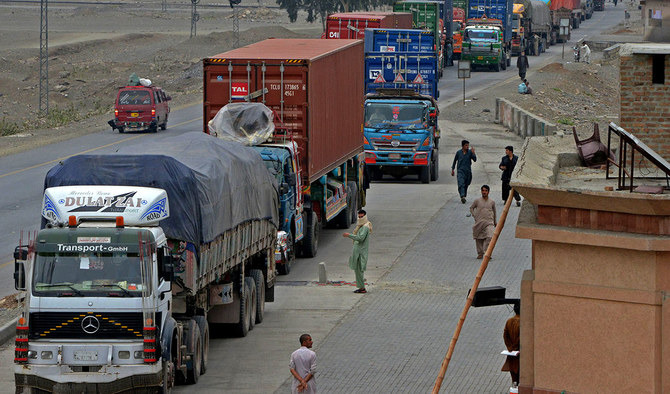
In this file photo, trucks and other vehicles travel in the mountainous area near Torkham, close to the Pakistan-Afghanistan border on March 21, 2017. (AFP)
Short Url
Updated 19 September 2021
Follow

Pakistan-Afghanistan Joint Chamber of Commerce says trade down 50% over currency confusion

  • Pakistan’s finance minister’s assertion that Pak rupee would be used for trade between the two countries is still not notified by the central bank
  • Pakistani business community says the country has a ‘golden chance’ to increase its export footprint in Afghanistan

KARACHI: Pakistani traders said on Friday the country’s bilateral trade with Afghanistan had declined by 50 percent since they were not sure which currency had to be used to facilitate business activities between the two countries.
Afghanistan has been facing an acute shortage of US dollars since the withdrawal of international forces last month.
The country lost its connection with foreign banks and donor agencies after the Taliban takeover, creating fears of an economic implosion that could lead to another humanitarian crisis and refugee influx in the region.
Pakistan’s finance minister Shaukat Tarin told a Senate standing committee earlier this month the bilateral trade between the two countries would be carried out in Pakistan’s national currency, though the country’s central bank has not notified the decision as yet.
“The State Bank of Pakistan has not issued the notification to facilitate trade in Pak rupee despite the announcement by the finance minister, causing the bilateral trade to suffer,” Muhammad Zubair Motiwala, chairman Pakistan-Afghanistan Joint Chamber of Commerce and Industry, told the seventh annual general meeting of the body in Karachi. “The trade has declined by about 50 percent and we fear it may completely stop if appropriate measures are not taken now.”
The Pakistani rupee on Wednesday hit an all-time low of Rs169.12 against the US dollar primarily due to the flight of the American currency to Afghanistan. Local currency traders told Arab News earlier this month about $2 million were going to Afghanistan from Pakistan on a daily basis.
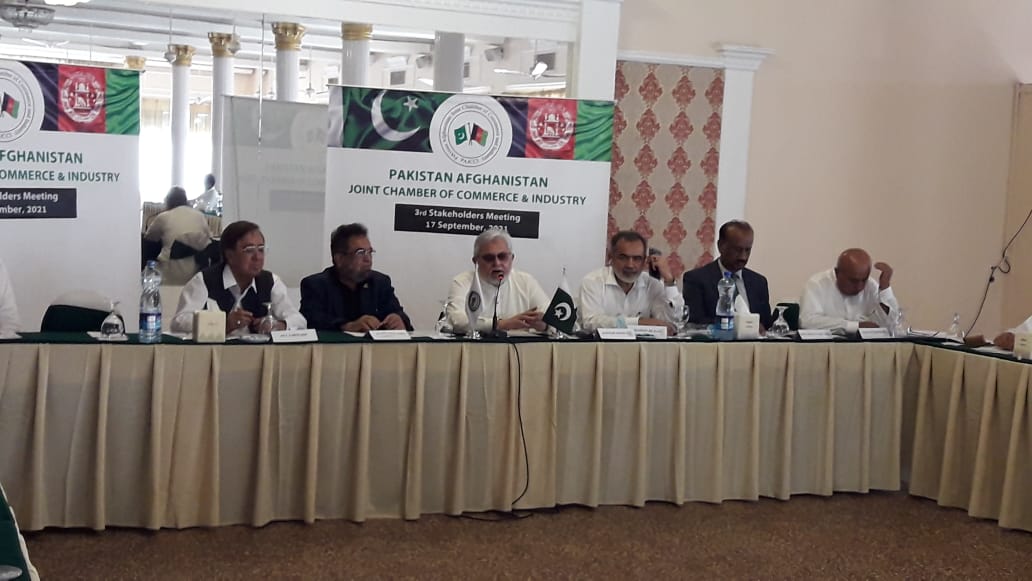


Muhammad Zubair Motiwala, a leading businessman, speaks at the 7th Annual General Meeting of Pakistan-Afghanistan Joint Chambers of Commerce and Industry in Karachi, Pakistan, on September 17, 2021. (AN Photo)

Motiwala told the forum that Afghan businessmen were willing to use the Pakistani currency as a temporary arrangement since they are aware of the depleting dollar reserves of their country.
“It is time we moved forward to increase our export footprint in Afghanistan,” he said. “Pakistan has a golden chance to increase its exports and avail the opportunity to make Afghanistan its second largest export destination.”
The highest export volume from Pakistan to Afghanistan was recorded at $2.7 billion in 2010-11. The trade in the subsequent years remained below $1 billion since Indian exporters aggressively marketed their products after leveraging their government’s favorable relations with the previous administrations in Kabul, said local traders attending the business gathering.
“With a relatively more friendly government in Afghanistan, we can be hopeful to increase our bilateral trade,” Motiwala said. “We can easily enhance our trade to $10 billion in the long run and $5 billion within the next couple of years.”
Speaking at the occasion, Shahid Hussain from the Sarhad Chamber of Commerce and Industry said even the transit trade with Afghanistan had declined.
“The Afghan traders are not in position to import as they are required to make payments in dollars and they don’t have the American currency anymore,” he said. “Exports from Pakistan, on the other hand, are taking place at a limited scale which must be rectified by the government.”


Pakistan consumer confidence rises by 4 percentage points in two years, survey shows

Updated 28 February 2026
Follow

Pakistan consumer confidence rises by 4 percentage points in two years, survey shows

  • Four in 10 Pakistanis believed the country is on the right track, with optimism higher among men
  • Economic concerns remained most worrying, but their quantum fell drastically across all issues

ISLAMABAD: Consumer confidence in Pakistan has risen by 4 percentage points from 31.5 to 35.5 over the last two years, which highlights improving public optimism under the government’s tenure, Ipsos market research firm said in a recent survey.

The survey was conducted through computer-assisted telephonic interviews (CATI) and included more than a thousand participants from all provinces and Azad Kashmir and Gilgit Baltistan regions on Feb. 2-14.

It comes at a time when Pakistan has undergone a difficult period of stabilization, though international rating agencies have acknowledged improvements after Islamabad began implementing structural reforms as part of its $7 billion International Monetary Fund (IMF) program.

The Ipsos survey revealed a “measurable” improvement in Pakistan’s economic sentiment, marked by a decline in inflation alongside notable reductions in poverty and unemployment, since the current government took charge two years ago.

“These findings point to a clear two-year transformation in the Consumer Confidence Index, demonstrating the perceived impact of consistent governance and policy measures,” read the key takeout in the survey.

“Sustained performance, coupled with transparent communication of achievements, will be essential to maintain momentum, reinforce optimism, and support further improvements in economic confidence.”

Four in 10 Pakistanis believed the country is on the right track, with optimism higher among men, while confidence in the country’s direction being right increased more than three times, from 12 percent to 40 percent, since the government came to power, according to the survey.

Economic concerns remained most worrying, but their quantum fell drastically across all issues since the first quarter of 2024. Inflation has dropped by 23 percent, unemployment by 10 percent, poverty by 20 percent, electricity prices by 34 percent and the burden of additional taxes was reduced by 18 percent in Q1 2026 as compared to Q1 2024.

“One in 3 Pakistanis expect the economy to strengthen,” the survey read. “Confidence to invest has grown steadily over two years, rising from 11 percent to 16 percent, with even stronger optimism among urban residents.”