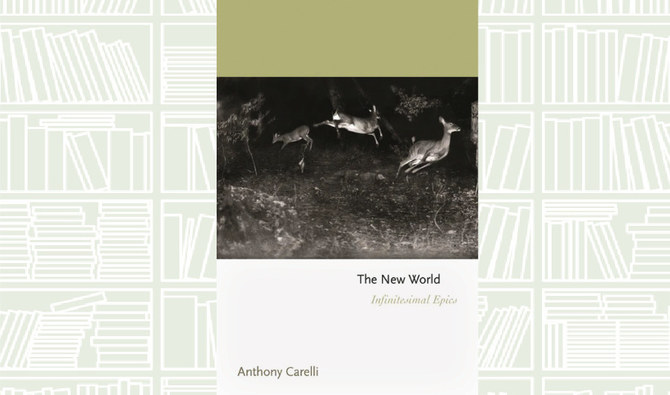
What We Are Reading Today: The New World: Infinitesimal Epics

Short Url
Updated 18 September 2021
Follow

What We Are Reading Today: The New World: Infinitesimal Epics

Author: Anthony Carelli

The New World, Anthony Carelli’s new collection of poems, is an American travelogue that unfolds in a series of darkly comic episodes, with allusions to Dante as a thread throughout. In these epics in miniature, we meet a pilgrim-poet as he awaits the arrival of his child, a would-be Columbus, on the shores of a land “disenstoried” by explorers present and past. It’s a land and a people largely lost in mindscapes and mythscapes, haunted by sketchy aspirational visions, misbegotten misremembering, and emptiness. Nonetheless, the poet steps out to the shore to sing for the child—and reader—to do what Columbus never did: “land gently. /And listen and/ listen and listen/and stay.”
From an Arizona nursing home and a grandmother’s memory of a stolen golden Schwinn in the occupied Philippines, to a tale of road-tripping west through Pennsylvania as sunrise transpires in the wrong sky, The New World opens strange spaces for us to re-see, lament, and re-sing the stories we tell.


What We Are Reading Today: Renaissance

Photo/Supplied
Updated 28 December 2025
Follow

What We Are Reading Today: Renaissance

  • Designed by Adjaye Associates in association with Cooper Robertson, the new facility positions the museum at the heart of both campus and civic life as a center for the public humanities

Author: James Christen Steward

“Renaissance: A New Museum for Princeton” reflects on the history of the Princeton University Art Museum as one of the oldest collecting institutions in North America and the role of its architecture in campus making. 

The 2025 opening of its new building affirms the museum’s long-standing commitment to considering works of art in the original as essential tools for understanding the wider world. 

Designed by Adjaye Associates in association with Cooper Robertson, the new facility positions the museum at the heart of both campus and civic life as a center for the public humanities.