France recalls envoys in US and Australia over submarine deal

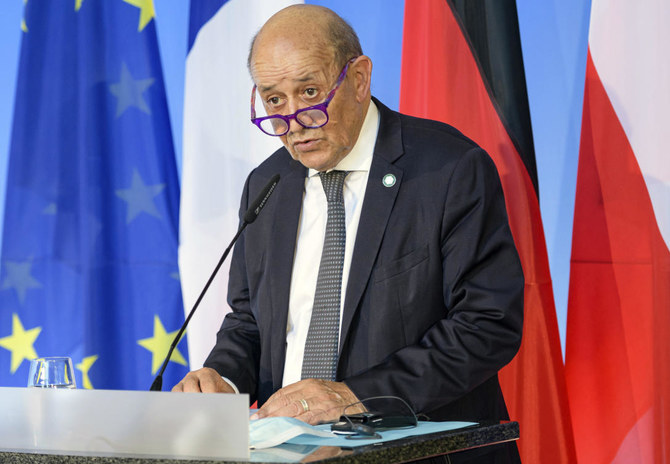
France’s Foreign Minister Jean-Yves Le Drian said the French decision, on request from President Emmanuel Macron, is justified by the exceptional seriousness of the announcements made by Australia and the US. ( AP)
Short Url
Updated 17 September 2021
Follow

France recalls envoys in US and Australia over submarine deal

  • Foreign minister Jean-Yves Le Drian said the rare decision taken by President Emmanuel Macron was made due to the seriousness of the event
  • Earlier on Friday, Australian Prime Minister Scott Morrison rejected French criticism

PARIS/CANBERRA/WASHINGTON: France said on Friday it had decided to recall its ambassadors in the US and Australia for consultations after Australia struck a deal with the United States and Britain which ended a $40 billion deal to purchase French-designed submarines.
Foreign minister Jean-Yves Le Drian said in a statement that the rare decision taken by President Emmanuel Macron was made due to the seriousness of the event.
The US State Department and White House did not immediately respond to requests for comment.
Earlier on Friday, Australian Prime Minister Scott Morrison rejected French criticism that it had not been warned, saying he had raised the possibility in talks with the French president in June that Australia might scrap the 2016 submarine deal with a French company.
On Thursday, Australia said it would scrap the $40 billion deal with France’s Naval Group to build a fleet of conventional submarines and would instead build at least eight nuclear-powered submarines with US and British technology after striking a trilateral security partnership.
Le Drian described the decision as a stab in the back.
Morrison acknowledged the damage to Australia-France ties but insisted he had told French President Emmanuel Macron in June that Australia had revised its thinking on the deal.
“I made it very clear, we had a lengthy dinner there in Paris, about our very significant concerns about the capabilities of conventional submarines to deal with the new strategic environment we’re faced with,” Morrison told 5aa Radio.
“I made it very clear that this was a matter that Australia would need to make a decision on in our national interest,” he said.
Strained Australia-French ties come as the United States and its allies seek additional support in the Asia and the Pacific amid concern about the rising influence of a more assertive China.
France is about to take over the presidency of the European Union, which on Thursday released its strategy for the Indo-Pacific, pledging to seek a trade deal with Taiwan and to deploy more ships to keep sea routes open.


Kosovo voters cast ballots in a second attempt this year to elect a government and avoid more crisis

Updated 58 min 32 sec ago
Follow

Kosovo voters cast ballots in a second attempt this year to elect a government and avoid more crisis

  • The prime minister’s party is again the favorite in the race, but it is unclear whether it will manage to muster a majority this time in the 120-member parliament

PRISTINA: Voters in Kosovo cast ballots on Sunday in an early parliamentary election in hopes of breaking a political deadlock that has gripped the small Balkan nation for much of this year.
The snap vote was scheduled after Prime Minister Albin Kurti’s governing Vetevendosje, or Self-Determination, party failed to form a government despite winning the most votes in a Feb. 9 election.
The deadlock marked the first time Kosovo could not form a government since it declared independence from Serbia in 2008 following a 1998-99 war that ended in a NATO intervention.
The prime minister’s party is again the favorite in the race, but it is unclear whether it will manage to muster a majority this time in the 120-member parliament, after other mainstream parties refused an alliance.
According to Kosovo’s election laws, 20 parliamentary seats are automatically assigned to ethnic Serb representatives and other minority parties.
Another inconclusive vote would further deepen the crisis. Kosovo has already not approved a budget for next year, sparking fears of possible negative effects on the already poor economy in the country of 2 million people.
Lawmakers are set to elect a new president in March as current President Vjosa Osmani’s mandate expires in early April. If this fails too, another snap election must be held.
The main opposition parties are the Democratic League of Kosovo and the Democratic Party of Kosovo. They have accused Kurti of authoritarianism and of alienating Kosovo’s US and European Union allies since he came to power in 2021.
A former political prisoner during Serbia’s rule in Kosovo, the 50-year-old Kurti has taken a tough stand in talks mediated by the European Union on normalizing relations with Belgrade. In response, the EU and the United States imposed punitive measures.
Kurti has promised to buy military equipment to boost security.
No reliable pre-election polls have been published. Kurti’s party at the previous election won around 42 percent of the votes while the two main rival parties had together around 40 percent.
Analysts say that even the slightest changes in numbers on Sunday could prove decisive for the future distribution of power but that nothing is certain.
Tensions with restive ethnic Serbs in the north exploded in clashes in 2023 when scores of NATO-led peacekeepers were injured. In a positive step, ethnic Serb mayors this month took power peacefully there after a municipal vote.
Kurti has also agreed to accept third-country migrants deported from the United States as part of tough anti-immigration measures by the administration of President Donald Trump. One migrant has arrived so far, authorities have told The Associated Press.
Kosovo is one of the six Western Balkan countries striving to eventually join the EU, but both Kosovo and Serbia have been told they must first normalize relations.