Iran joins expanding Asian security body led by Moscow, Beijing

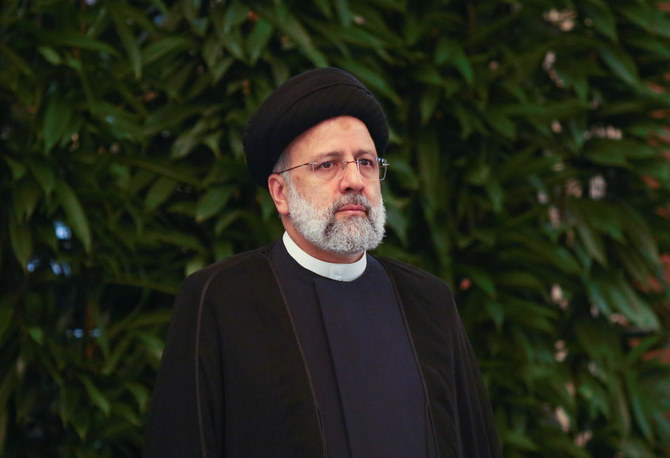
Iranian President Ebrahim Raisi attends the Shanghai Cooperation Organization (SCO) summit in Dushanbe, Tajikistan September 17, 2021. (Reuters)
Short Url
Updated 17 September 2021
Follow

Iran joins expanding Asian security body led by Moscow, Beijing

  • Raisi hailed the opportunity that membership would provide for Iran to join important trade links across Eurasia

Iran joined a rapidly expanding central Asian security body led by Russia and China on Friday, calling on the countries in the Shanghai Cooperation Organization to help it form a mechanism to avert sanctions imposed by the West.
The body, formed in the 2001 as a talking shop for Russia, China and ex-Soviet states in Central Asia, expanded four years ago to include India and Pakistan, with a view to playing a bigger role as counterweight to Western influence in the region.
In a sign of its growing influence, the body’s summit in Tajikistan was the first appearance abroad of Iran’s new hard-line president, Ebrahimi Raisi, since taking office in August.
Raisi hailed the opportunity that membership would provide for Iran, as a country along China’s “Belt and Road” route, to join important trade links across Eurasia. Iranian television described Iran’s membership as giving it access to huge markets across the continent.
In his speech to members, Raisi compared sanctions on Iran to terrorism, and said the organization should design a mechanism that helps Tehran avert them.
Russia and China, along with Western countries, are parties of a 2015 agreement between Iran and world powers under which Tehran agreed to curbs on its nuclear program in return for the lifting of sanctions.
Washington abandoned that deal in 2018 and unilaterally reimposed financial sanctions. Negotiations this year to revive it have been stalled since Raisi’s election.
“Nothing can stop Iran’s peaceful nuclear activities that are within the framework of international regulations,” Raisi said. “Diplomacy is only effective when all parties adhere to it. Threats and pressure tie diplomacy’s hands and render it ineffective.”


Tunisian police arrest member of parliament who mocked president

Updated 05 February 2026
Follow

Tunisian police arrest member of parliament who mocked president

  • Ahmed Saidani mocked the president in a Facebook post, describing him as the “supreme commander of sewage and rainwater drainage”

TUNIS: Tunisian police arrested lawmaker Ahmed Saidani on Wednesday, two of his colleagues ​said, in what appeared to be part of an escalating crackdown on critics of President Kais Saied.
Saidani has recently become known for his fierce criticism of Saied. On Tuesday, he mocked the president in a Facebook post, describing him as the “supreme commander of sewage and rainwater drainage,” blasting what he said ‌was the absence ‌of any achievements by Saied.
Saidani ‌was ⁠elected ​as ‌a lawmaker at the end of 2022 in a parliamentary election with very low voter turnout, following Saied’s dissolution of the previous parliament and dismissal of the government in 2021.
Saied has since ruled by decree, moves the opposition has described as a coup.
Most opposition leaders, ⁠some journalists and critics of Saied, have been imprisoned since he ‌seized control of most powers in 2021.
Activists ‍and human rights groups ‍say Saied has cemented his one-man rule and ‍turned Tunisia into an “open-air prison” in an effort to suppress his opponents. Saied denies being a dictator, saying he is enforcing the law and seeking to “cleanse” the country.
Once a supporter ​of Saied’s policies against political opponents, Saidani has become a vocal critic in recent months, accusing ⁠the president of seeking to monopolize all decision-making while avoiding responsibility, leaving others to bear the blame for problems.
Last week, Saidani also mocked the president for “taking up the hobby of taking photos with the poor and destitute,” sarcastically adding that Saied not only has solutions for Tunisia but claims to have global approaches capable of saving humanity.
Under Tunisian law, lawmakers enjoy parliamentary immunity and cannot be arrested for carrying out their ‌duties, although detention is allowed if they are caught committing a crime.