

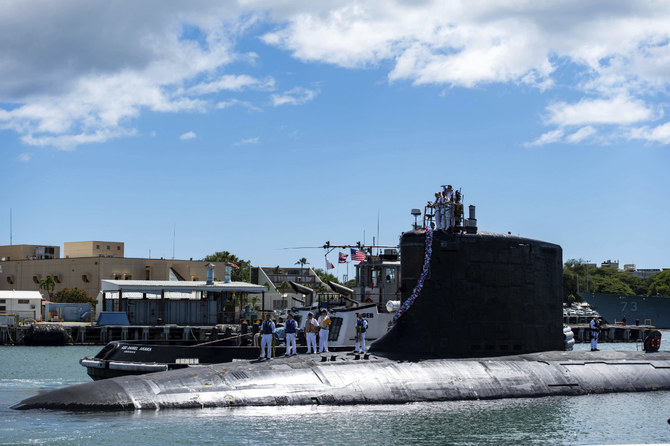

SYDNEY, Australia: A quick barrage of missile tests and bumper defense deals in the Pacific have highlighted a regional arms race that is intensifying as the China-US rivalry grows.
“There’s a little frenzy in the Indo-Pacific of arming up,” said Yonsei University professor John Delury. “There’s a sense of everyone’s doing it.”
Within 24 hours this week, North Korea fired off two railway-borne weapons, South Korea successfully tested its first submarine-launched ballistic missile, and Australia announced the unprecedented purchase of state-of-the-art US nuclear-powered submarines and cruise missiles.
A remarkable flurry, but indicative of a region spending apace on the latest wonders of modern weaponry, experts say.
Last year alone, the Asia and Oceania region lavished more than half a trillion US dollars on its militaries, according to data from the Stockholm International Peace Research Institute.
“You’ve really seen an upward trend for the last 20 years,” the institute’s Lucie Beraud-Sudreau told AFP. “Asia is really the region where the uptick trend is the most noticeable.”
She points to a perfect storm of rapid economic growth — which puts more money in the government kitties — and changing “threat perceptions” in the region.
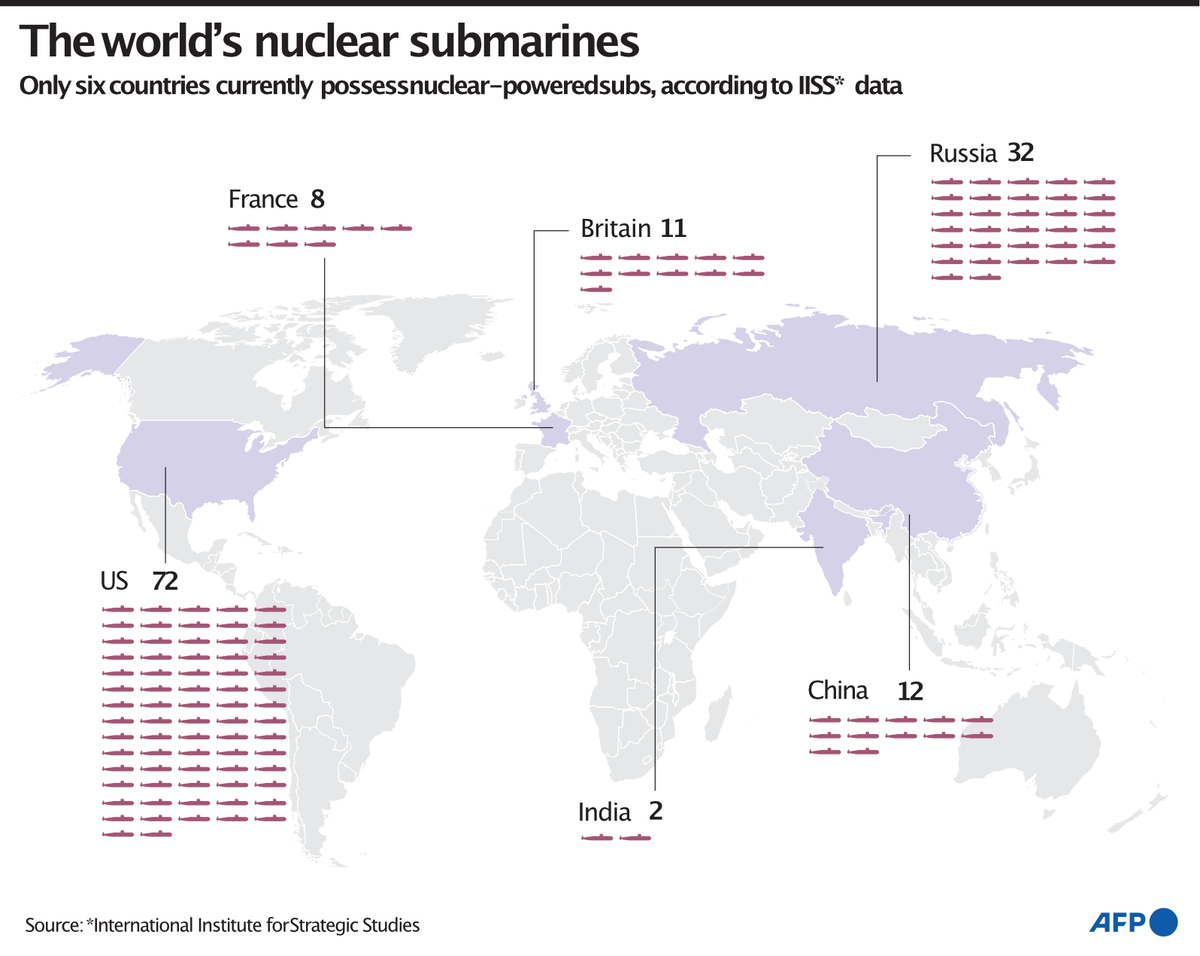
China accounts for about half of Asia’s total and has increased defense spending every year for the last 26 years, turning the People’s Liberation Army into a modern fighting force.
Beijing now spends an estimated $252 billion a year — up 76 percent since 2011 — allowing it to project power across the region and directly challenge US primacy.
But defense spending in Australia, India, Japan, South Korea and elsewhere is also gathering pace.
Michael Shoebridge, a former Australian defense intelligence official, now with the Australia Strategic Policy Institute, believes that spending is a direct reaction to China.
“The actual military competition is between China and other partners that are wanting to deter China from using force,” he said.
“That reaction has just grown, particularly since Xi (Jinping) has become leader. He’s clearly interested in using all the power that China gains fairly coercively and aggressively.”
Today around 20 percent of the region’s defense spending is on procurement, notably on maritime assets and long-range deterrence designed to convince Beijing — or any another adversary — that the cost of attack is too high.
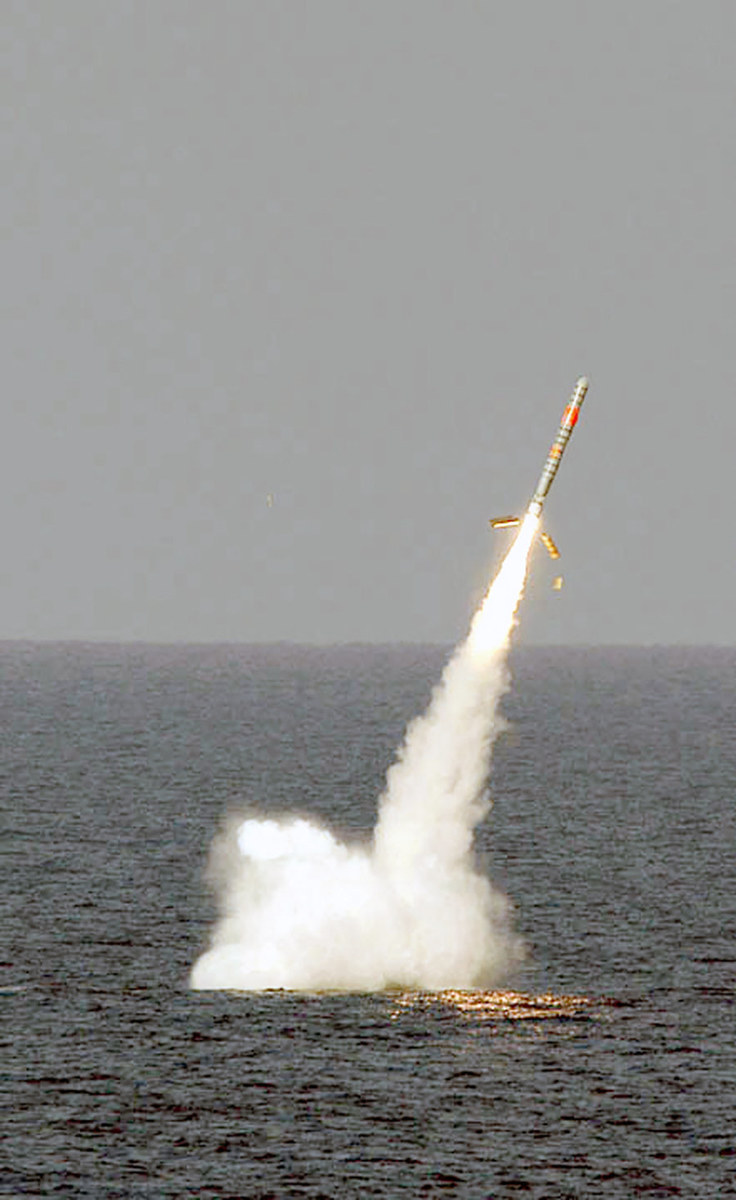
File photo showing the USS Florida Ohio-class ballistic missile submarine launching a Tomahawk cruise missile during Giant Shadow in the waters off the coast of the Bahamas. (US Navy photo via AFP))
Shoebridge points to Australia’s landmark decision Thursday to acquire at least eight US nuclear-powered submarines and an unspecified number of Tomahawk cruise missiles.
“They’re all focused on raising the cost to China of engaging in military conflict. They’re a pretty effective counter to the kinds of capabilities the PLA has been building.”
But even South Korean spending “is as much driven by China as North Korea,” he said. “There’s no explanation for (Seoul’s decision to build) an aircraft carrier that involves North Korea.”
Similarly, “India’s military modernization is clearly driven by China’s growing military power,” Shoebridge added.
For its part China — fond of describing its relationship with the United States as “great power rivalry” — accuses the United States of fueling the arms race.
In the words of state-backed tabloid the Global Times, Washington is “hysterically polarizing its alliance system.”
If fear of China is the driving force behind regional defense spending, then the United States has appeared happy to speed the process along, actively helping regional allies to beef up.
As China and Japan were “blazing forward” with defense programs, Delury says Washington has been “aiding and abetting” allies “in the name of deterring China.”
“We’re not seeing arms control here, we’re seeing the opposite,” he said.


