Pakistani money management app aims to target Saudi Arabia, UAE to expand international footprint

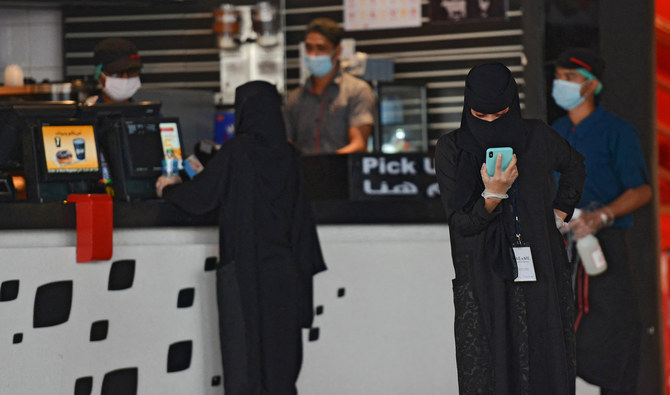
A woman checks her mobile as another orders food from a restaurant in a mall in Riyadh, Saudi Arabia on June 4, 2020. (AFP/File)
Short Url
Updated 17 September 2021
Follow

Pakistani money management app aims to target Saudi Arabia, UAE to expand international footprint

  • Hysab Kytab has established a network of over 15 banks and financial services providers in the Middle East and North Africa region
  • Pakistan has witnessed a massive surge of 53 percent in digital payments since the beginning of the coronavirus pandemic, survey says

KARACHI: A Karachi-based company, which launched a personal finance management mobile app in 2019, has decided to penetrate Saudi Arabia and the United Arab Emirates, along with other markets in the Middle East and North Africa (MENA) region, to expand its international footprint, said the company officials on Thursday.
Hysab Kytab is a fully customizable mobile app that offers a platform to manage the user’s financial activities and budgeting.
The app has over 640,000 users who have clocked in more than 12 million transactions.
About 78 percent of them are from Pakistan.
“For the current year, our first target is the MENA region for going global,” Muhammad Yasir Ilyas, global head of Hysab Kytab, told Arab News. “So far, we have developed a good network of 15-plus channel partners including banks in the region. We are also engaging with banks in Saudi Arabia, the UAE, Qatar, Nigeria and other African countries.”

Ilyas continued that his company was also talking to leading global banking solutions providers, such as Temenos and IBM, since it wanted to partner with them before spreading its tentacles in other markets.
“Our target is to make this Pakistani born product a global reality,” he said, adding that the app also provided research data on consumer spending behavior.
Digital financial solutions have been gaining traction in Pakistan -- traditionally a cash-based economy -- since the outbreak of the coronavirus pandemic.
According to a survey conducted by Visa, the use of digital payments, including contactless cards and mobile wallets, increased by 53 percent since the beginning of the contagion.
“Pakistani consumers are increasingly stepping away from cash and putting their trust in digital payments in both in-store and online environments during the pandemic,” Visa said in a statement issued Wednesday.
The financial services company said consumer feedback reinforced the belief that there is no reversal of this trend, with 20 percent of people saying they were less likely to use cash on delivery and 35 percent mentioning the likelihood of using contactless payment methods in the future.
While e-commerce and contactless payments have increased in popularity, the trend of paying by cash on delivery has declined by 28 percent, according to the Visa survey.
Global trend also shows that 12 out 50 startups from Forbes Fintech 50 belong to the personal finance management category.
According to the magazine, together these 12 startups have secured a total funding of $3.6 billion.


Pakistan to launch last 2025 anti-polio nationwide drive targeting 45 million children next week

Updated 08 December 2025
Follow

Pakistan to launch last 2025 anti-polio nationwide drive targeting 45 million children next week

  • Over 400,000 frontline health workers will participate in Dec. 15-21 nationwide polio vaccination campaign, say authorities
  • Pakistan is one of only two countries in the world, the other being Afghanistan, where wild poliovirus remains endemic

KARACHI: Pakistan will kick off the last nationwide anti-polio vaccination campaign of 2025 targeting 45 million children next week, the National Emergencies Operation Center (NEOC) said on Monday, urging parents to coordinate with health workers during the drive. 

The campaign takes place days after Pakistan launched a nationwide vaccination drive from Nov. 17-29 against measles, rubella and polio. Pakistan said it had targeted 22.9 million children across 89 high-risk districts in the country with oral polio vaccination drops during the drive. 

Over 400,000 health workers will perform their duties during the upcoming Dec. 15-21 nationwide polio vaccination campaign, the NEOC said in a statement. 

“Parents are urged to cooperate with polio workers and ensure their children are vaccinated,” the NEOC said. “Complete the routine immunization schedule for all children up to 15 months of age on time.”

Health authorities aim to vaccinate 23 million children in Punjab, 10.6 million in Sindh, over 7.2 million in Khyber Pakhtunkhwa, over 2.6 million in Balochistan, more than 460,000 in Islamabad, over 228,000 in Gilgit-Baltistan and more than 760,000 children in Pakistan-administered Kashmir during the seven-day campaign, it added. 

Pakistan is one of only two countries in the world where wild poliovirus remains endemic.

Polio is a highly infectious and incurable disease that can cause lifelong paralysis. The only effective protection is through repeated doses of the Oral Polio Vaccine for every child under five during each campaign, alongside timely completion of all routine immunizations.

Islamabad’s efforts to eliminate poliovirus have been hampered by parental refusals, widespread misinformation and repeated attacks on anti-polio workers by militant groups. In remote and volatile areas, vaccination teams often operate under police protection, though security personnel themselves have also been targeted and killed in attacks.