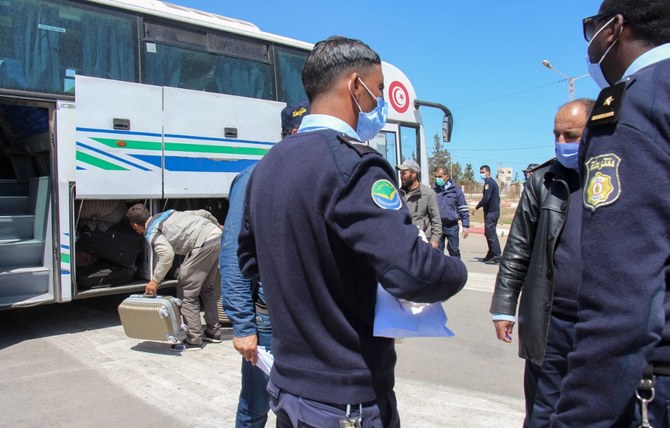
TUNIS: Tunisia and Libya are to reopen their shared border on Friday, the presidency in Tunis said, two months after they were closed as the country's coronavirus caseload soared.
"The president of (Tunisia) issued orders to reopen border crossings with the state of Libya from Friday" at 7:00 am local time (0600 GMT), the office of President Kais Saied said in a statement.
Libya closed its land borders and suspended flights between the two countries on July 8 due to an explosion in Covid-19 cases in Tunisia, which responded by closing its own crossings.
But with the caseload rapidly dropping, officials on both sides agreed to reopen the frontier, with measures in place to limit the possibility of contaminations.
Tunis and Tripoli agreed on a health protocol "subject to revision in light of developments in the health situation in the two countries," the Tunisian statement read.
The reopening would be reviewed in case of any "violation", it added.
Tunisia's Covid-19 caseload, which in August was the world's worst according to official data, has since significantly improved.
On Tuesday the country of 11.7 million recorded 1,142 new cases and nine coronavirus-caused deaths.
Reopening the border was a key point of discussions between Saied and Libyan transitional Prime Minister Abdulhamid Dbeibah, who visited Tunis last Thursday.
The Ras Al-Jdeir and Dahabiya crossings are key economic lifelines for Tunisian traders in the country's economically marginalised south, while many Libyans cross to access medical treatment and visit Tunisia for tourism.

Tunisian president says border with Libya to reopen
Short Url
https://arab.news/ym6wm
Tunisian president says border with Libya to reopen
- Tunis and Tripoli agreed on a health protocol “subject to revision in light of developments in the health situation”
- The Ras Al-Jdeir and Dahabiya crossings are key economic lifelines for Tunisian traders in the country's south
Iran FM criticizes Israel for ‘doctrine of domination’
- Doctrine allows Israel to expand its military arsenal while pressuring other countries in the region to disarm
- His remarks came a day after renewed nuclear talks with Washington in Oman
DOHA: Iran’s Foreign Minister Abbas Araghchi on Saturday criticized what he said was a “doctrine of domination” that allows Israel to expand its military arsenal while pressuring other countries in the region to disarm.
His remarks came a day after renewed nuclear talks with Washington, with previous talks collapsing when Israel launched an unprecedented bombing campaign against Iran last June that triggered a 12-day war.
Araghchi was speaking at the Al Jazeera Forum conference in Qatar but made no reference to Friday’s talks with the United States.
“Israel’s expansionist project requires that neighboring countries be weakened: militarily, technologically, economically and socially,” Araghchi said.
“Under this project Israel is free to expand its military arsenal without limits ... Yet other countries are demanded to disarm. Others are pressured to reduce defensive capacity. Others are punished for scientific progress,” he added.
“This is a doctrine of domination.”
During the 12-day war Israel targeted senior Iranian military officials, nuclear scientists and sites as well as residential areas, with the US later launching its own attacks on key nuclear facilities.
Iran responded at the time with drone and missile attacks on Israel, as well as by targeting the largest US military base in the Middle East, located in Qatar.
On Friday, Araghchi led the Iranian delegation in indirect nuclear talks with US Middle East envoy Steve Witkoff in Muscat.
The top Iranian diplomat later described the atmosphere as having been “very positive,” while US President Donald Trump said the talks were “very good,” with both sides agreeing to proceed with further negotiations.
The talks followed threats from Washington and its recent deployment of an aircraft carrier group to the region following Iran’s deadly crackdown on anti-government protests last month.
The United States has sought to address Iran’s ballistic missile program and its support for militant groups in the region — issues which Israel has pushed to include in the talks, according to media reports.
Tehran has repeatedly rejected expanding the scope of negotiations beyond the nuclear issue.
His remarks came a day after renewed nuclear talks with Washington, with previous talks collapsing when Israel launched an unprecedented bombing campaign against Iran last June that triggered a 12-day war.
Araghchi was speaking at the Al Jazeera Forum conference in Qatar but made no reference to Friday’s talks with the United States.
“Israel’s expansionist project requires that neighboring countries be weakened: militarily, technologically, economically and socially,” Araghchi said.
“Under this project Israel is free to expand its military arsenal without limits ... Yet other countries are demanded to disarm. Others are pressured to reduce defensive capacity. Others are punished for scientific progress,” he added.
“This is a doctrine of domination.”
During the 12-day war Israel targeted senior Iranian military officials, nuclear scientists and sites as well as residential areas, with the US later launching its own attacks on key nuclear facilities.
Iran responded at the time with drone and missile attacks on Israel, as well as by targeting the largest US military base in the Middle East, located in Qatar.
On Friday, Araghchi led the Iranian delegation in indirect nuclear talks with US Middle East envoy Steve Witkoff in Muscat.
The top Iranian diplomat later described the atmosphere as having been “very positive,” while US President Donald Trump said the talks were “very good,” with both sides agreeing to proceed with further negotiations.
The talks followed threats from Washington and its recent deployment of an aircraft carrier group to the region following Iran’s deadly crackdown on anti-government protests last month.
The United States has sought to address Iran’s ballistic missile program and its support for militant groups in the region — issues which Israel has pushed to include in the talks, according to media reports.
Tehran has repeatedly rejected expanding the scope of negotiations beyond the nuclear issue.
© 2026 SAUDI RESEARCH & PUBLISHING COMPANY, All Rights Reserved And subject to Terms of Use Agreement.


