Pakistan among 1,000 troops participating in multinational peacekeeping drill hosted by China

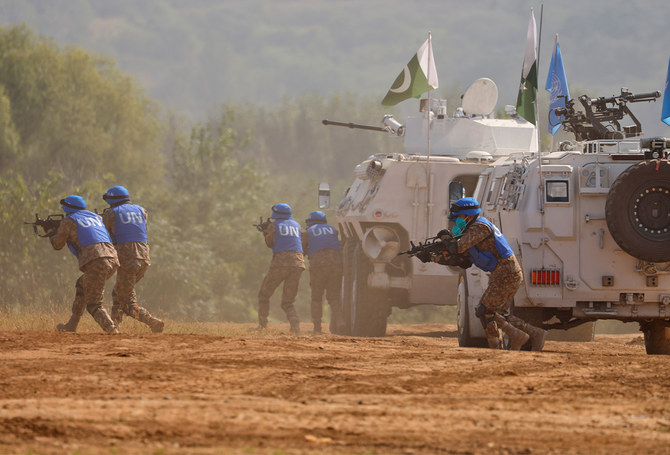
Pakistan soldiers take part in a multinational U.N. peacekeeping military exercise with troops of the Chinese People's Liberation Army (PLA), Mongolia and Thailand, on the outskirts of Zhumadian, Henan province, China, on September 15, 2021. (REUTERS)
Short Url
Updated 15 September 2021
Follow

Pakistan among 1,000 troops participating in multinational peacekeeping drill hosted by China

  • China's army shows off combat prowess with drones, mine-clearing robots while seeking to project more benign image
  • Troops from China, Pakistan, Mongolia and Thailand participated in 10-day exercise at People's Liberation Army base

QUESHAN: China's armed forces concluded their first multinational peacekeeping exercise on Wednesday, showing off their combat prowess with drones and mine-clearing robots while seeking to project a more benign image.
As the Asian giant modernises and beefs up its military by pumping hundreds of billions of dollars annually into its defence budget, it has also strived to assure other countries that its military is a force for good, not a threat.
About 1,000 troops from China, Pakistan, Mongolia and Thailand participated in the 10-day exercise at a People's Liberation Army training base in Queshan county in the central province of Henan, though most of the soldiers appeared to be Chinese.
The exercise, codenamed "Shared Destiny 2021", underscored China's position as a "staunch defender of world peace and international order", Senior Colonel Lu Jianxin, a Chinese military expert on peacekeeping, told reporters at the base.
The soldiers, in front of a small group of journalists, enacted clashes between terrorists and peacekeepers in the strife-torn fictitious country of Carana.
The exercise was based on a 2016 incident in Mali when Chinese peacekeepers were attacked and one of them was killed.
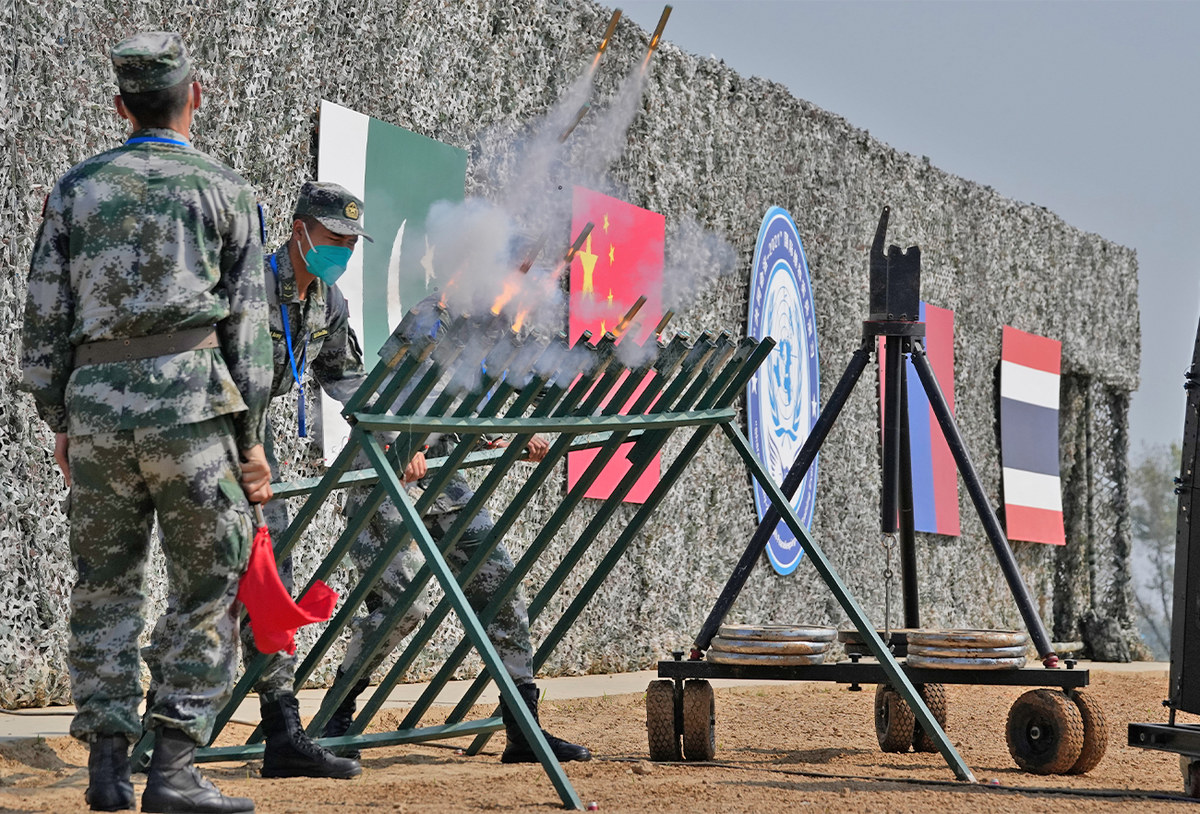


Soldiers of Chinese People's Liberation Army (PLA) take part in a joint multinational U.N. peacekeeping military exercise with troops from Pakistan, Mongolia and Thailand, on the outskirts of Zhumadian, Henan province, China, on September 15, 2021. (REUTERS)

The troops also reenacted a scene based on another 2016 incident in South Sudan, when peacekeepers had to protect civilians caught up in fighting between factions.
In another scenario, drones buzzed the battlefield to spot bombs, which when found were disposed of by robots. Drones also doubled up as loudspeakers and released multi-coloured leaflets to urge people to stop fighting.
The exercise was also a showcase for Chinese military hardware. The foreign troops trained with Chinese weapons and other equipment.
"The use of Chinese equipment by foreign troops can be touted as a sign of enhanced military interoperability ... and also for the purpose of marketing them to foreign militaries," said Collin Koh, a defence research fellow with Singapore's Rajaratnam School of International Studies.
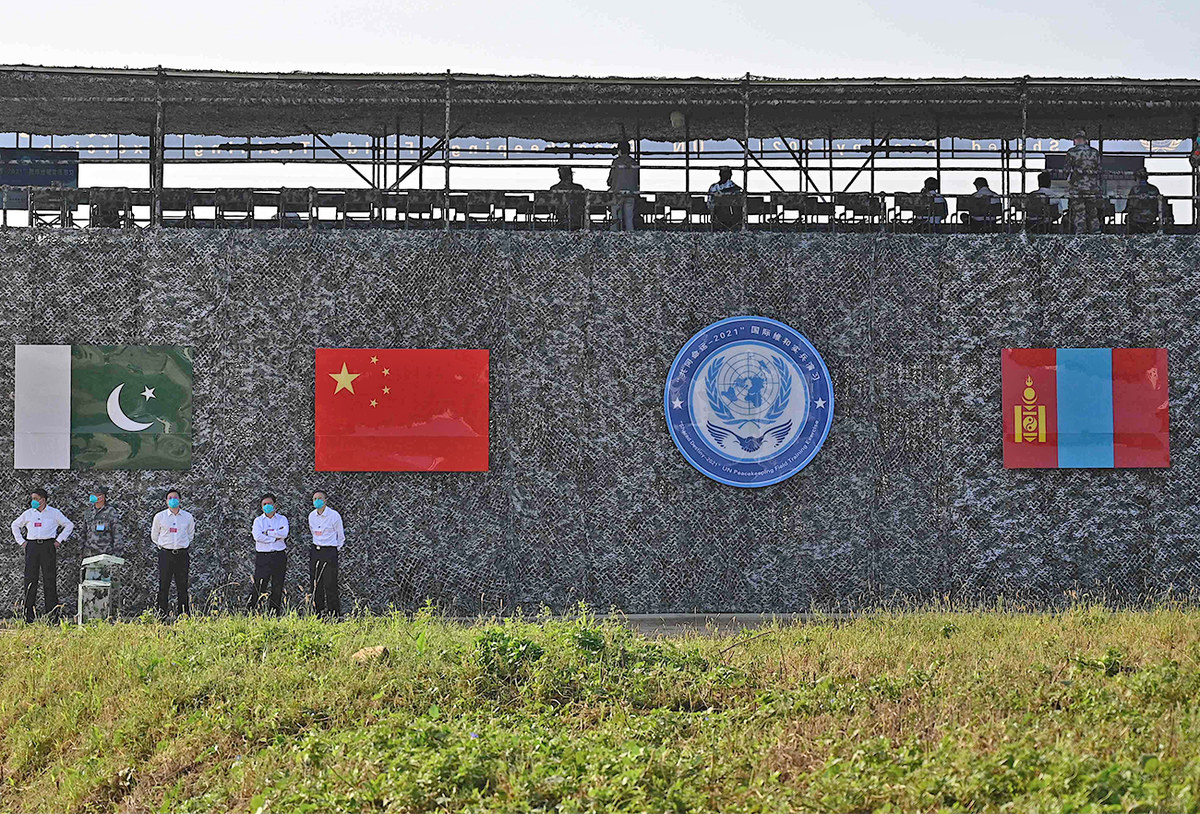


The national flags of Pakistan, China and Mongolia are seen during the multinational UN peacekeeping live exercise “Shared Destiny-2021” held by Chinese military at a tactical training base of the Chinese People’s Liberation Army in Zhumadian, central China’s Henan province on September 15, 2021. (REUTERS)

China has repeatedly sought to dispel worries in neighbouring countries and further afield about its military intentions, even as it drills regularly near Chinese-claimed Taiwan and in the disputed South China Sea.
China takes prides in being the largest contributor of peacekeeping troops among major powers as represented by the five permanent members of the UN Security Council.
As the second largest financial contributor, China footed 15% of the total expenses for U.N. peacekeeping operations in 2020.
Since 1990, it has sent 50,000 troops to participate in 25 peacekeeping missions globally, built or fixed 17,000 km (10,600 miles) of roads and more than 300 bridges, and removed 18,000 mined, said expert L


Pakistan nears $1.5 billion deal to supply weapons, jets to Sudan

Updated 09 January 2026
Follow

Pakistan nears $1.5 billion deal to supply weapons, jets to Sudan

  • Deal may include drones, air defense systems and Karakoram-8 aircraft, with possible JF-17 fighters
  • The sale is expected to bolster Sudan’s army in the ongoing civil war with the Rapid Support Forces

ISLAMABAD: Pakistan is in the final phases of striking a $1.5-billion deal to supply weapons and jets to Sudan, a former top air force official and three sources said, promising a major boost for Sudan’s army, battling the paramilitary Rapid Support Forces.

Their conflict has stoked the world’s worst humanitarian crisis for more than 2-1/2 years, drawing in myriad foreign interests, and threatening to fragment the strategic Red Sea country, a major gold producer.

The deal with Pakistan encompasses 10 Karakoram-8 light attack aircraft, more than 200 drones for scouting and kamikaze attacks, and advanced air defense systems, said two of the three sources with knowledge of the matter, who all sought anonymity.

It was a “done deal,” said Aamir Masood, a retired Pakistani air marshal who continues to be briefed on air force matters.

Besides the Karakoram-8 jets, it includes Super Mushshak training aircraft, and perhaps ‌some coveted JF-17 ‌fighters developed jointly with China and produced in Pakistan, he added, without giving figures ‌or ⁠a delivery ‌schedule.

Pakistan’s military and its defense ministry did not immediately respond to requests for comment.

A spokesman for Sudan’s army did not immediately respond to a message requesting comment.

Assistance from Pakistan, especially drones and jets, could help Sudan’s army regain the air supremacy it had toward the start of its war with the RSF, which has increasingly used drones to gain territory, eroding the army’s position.

PAKISTAN’S DEFENSE AMBITIONS

The deal is another feather in the cap for Pakistan’s growing defense sector, which has drawn growing interest and investment, particularly since its jets were deployed in a conflict with India last year.

Last month, Islamabad struck a weapons deal worth more than $4 billion with the Libyan National Army, officials said, for one of the South Asian nation’s largest arms sales, which includes JF-17 fighter jets and training aircraft.

Pakistan has also held talks with Bangladesh on a defense deal that could includes the Super Mushshak training jets and JF-17s, as ties improve ties with Dhaka.

The government sees Pakistan’s burgeoning industry as a catalyst to secure long-term economic stability.

Pakistan is now in a $7-billion IMF program, following a short-term ‌deal to avert a sovereign default in 2023. It won IMF support after Saudi Arabia and other Gulf allies provided financial and deposit rollovers.